



How to Fix Cannabis Nitrogen Deficiency: Yellow Leaves & Fixes
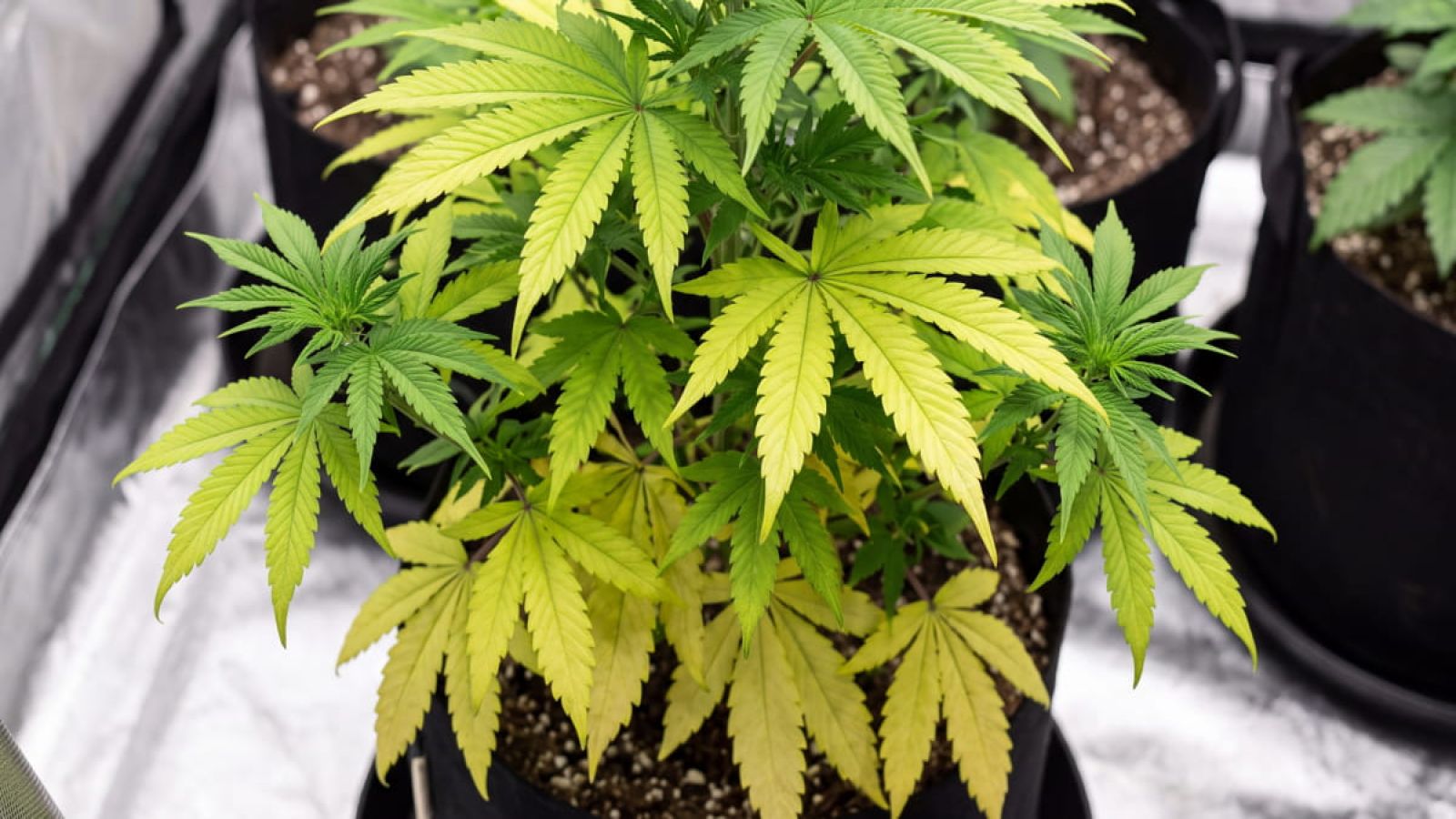
Yellowing that starts on the lowest, oldest fan leaves and climbs upward is the classic sign of cannabis nitrogen deficiency. Nitrogen is a mobile nutrient, so a hungry plant strips it from mature leaves to feed new growth, and those older leaves fade to pale green and then yellow.
Here's the quick tell: the fade is uniform across each leaf and works its way up the plant, rather than hitting one spot or edge. Fixing it is usually straightforward once you confirm it: check the root-zone pH first, then feed a nitrogen-rich nutrient at a strength that suits the plant's stage.
The one catch is timing, because some bottom-up yellowing during late flowering is completely normal and needs no correction at all.
What Is Nitrogen Deficiency in Cannabis?
Nitrogen deficiency in cannabis is a shortage of usable nitrogen at the roots, and it's one of the most common feeding problems growers run into. Nitrogen drives chlorophyll production, and chlorophyll is what makes leaves green and powers photosynthesis.
When supply drops, the plant rations what it has, so the oldest growth loses its color first while the newest growth stays green.
Nitrogen is what growers call a mobile nutrient, meaning the plant can move it around internally. That mobility is exactly why the symptom shows up from the bottom up rather than randomly across the canopy.
Understanding that one behavior makes the whole diagnosis easier, because the pattern tells you almost as much as the color does.
What Does Cannabis Nitrogen Deficiency Look Like?
Cannabis nitrogen deficiency looks like a pale, washed-out green that deepens into full yellow, spreading evenly across each affected leaf.
The color covers the whole leaf rather than sitting in patches or between the veins, and over time those leaves soften, curl slightly and drop. Growth slows alongside the color loss, so the whole plant can start to look thin and pale rather than lush.
This section breaks the visual diagnosis into three parts:
-
Why bottom leaves turn yellow first - the mobility behavior that sets the pattern.
-
Nitrogen deficiency vs other yellowing causes - how to rule out look-alikes.
-
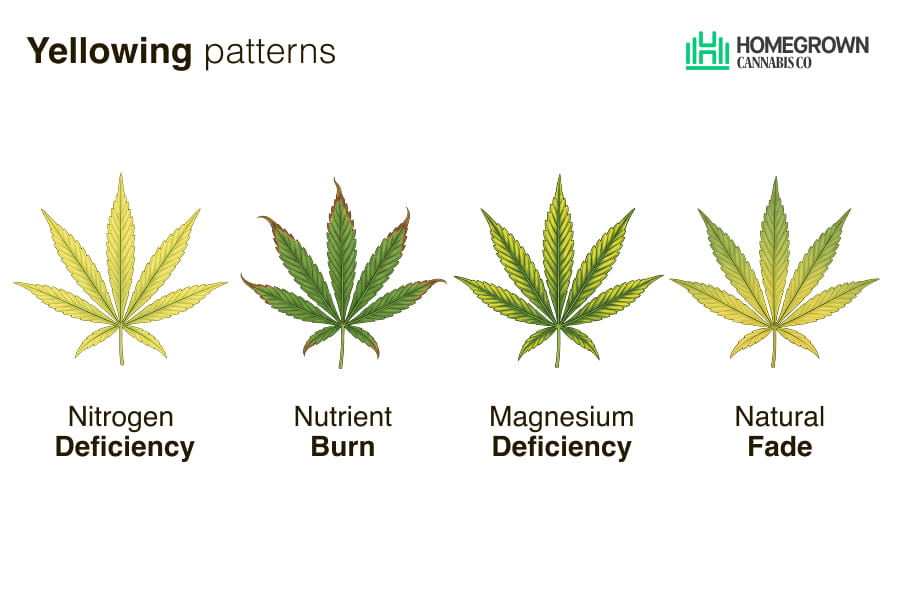
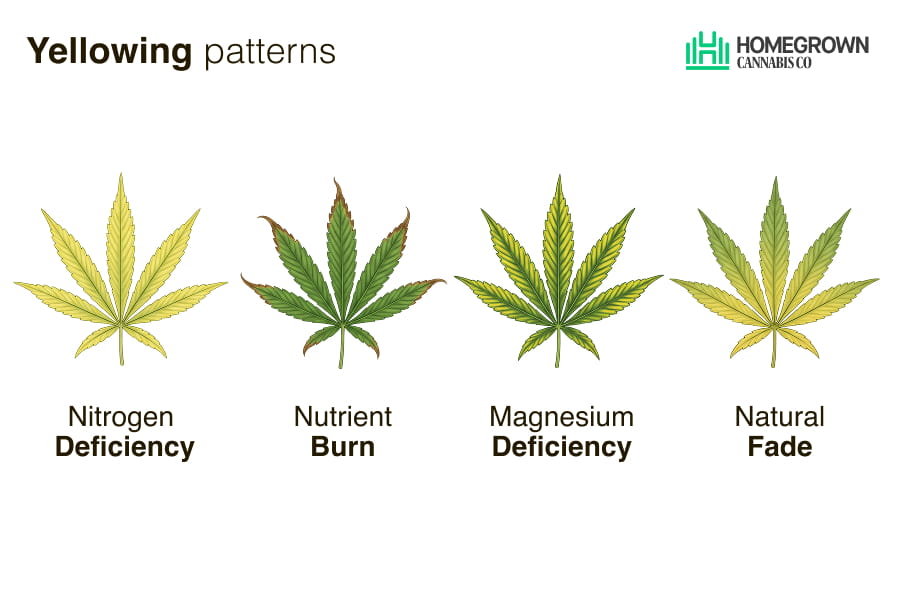
Cannabis leaf yellowing chart - a quick pattern-to-cause map you can scan.
Why Bottom Leaves Turn Yellow First
Bottom fan leaves yellow first because they sit lowest in the plant's priority order - cannabis rations scarce nitrogen to its youngest, most productive growth and lets the oldest leaves go.
That is why a nitrogen problem reads as a wave of yellowing that works its way up from the base leaf by leaf, while the youngest top growth stays green the longest.
Nitrogen Deficiency vs Other Yellowing Causes
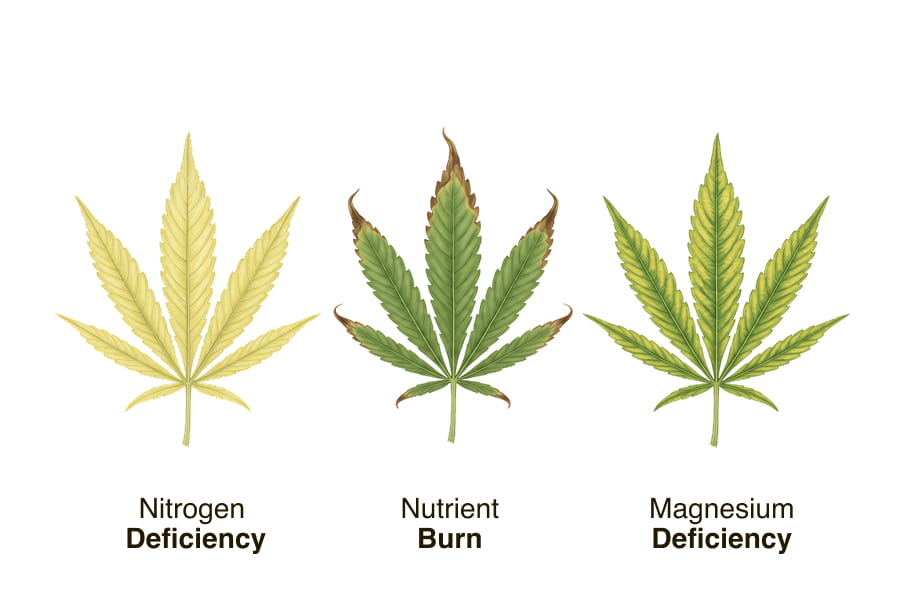
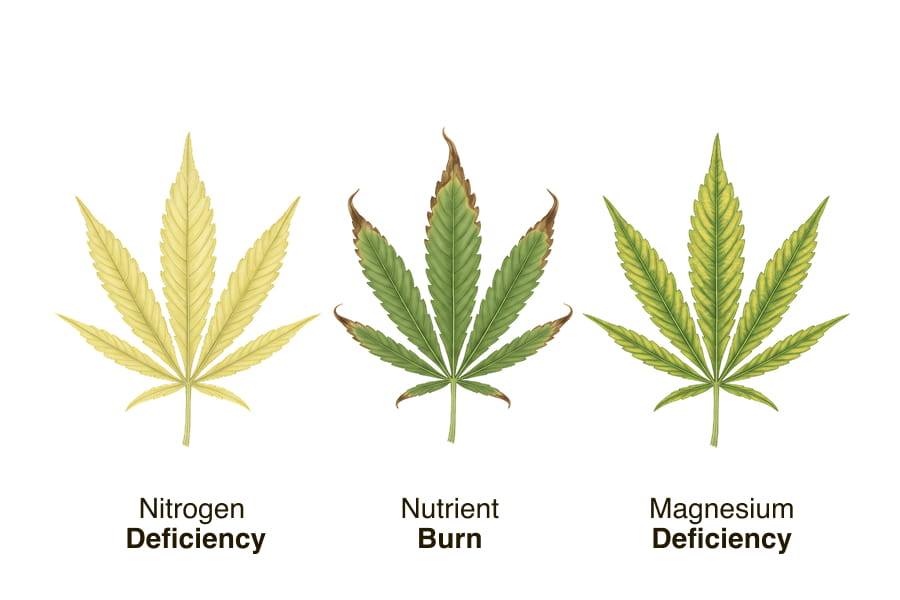
Nitrogen deficiency differs from other yellowing causes mainly in its bottom-up, whole-leaf pattern. Nutrient burn starts at the leaf tips and burns them brown, while a magnesium shortfall yellows the tissue between the veins and leaves the veins themselves green.
Matching the pattern to the cause prevents the most common mistake: adding more nitrogen to a plant that is actually overfed or short on a different nutrient.
|
Trait |
Nitrogen deficiency |
Nutrient burn |
Magnesium deficiency |
Reliability |
|
Where it starts |
Oldest, lowest leaves |
Leaf tips |
Lower-mid leaves |
High |
|
Pattern |
Whole-leaf, uniform yellowing |
Brown, burnt tips that curl |
Yellow between veins, green veins |
High |
|
Direction |
Climbs upward |
Moves inward from tips |
Spreads outward between veins |
Medium |
|
Speed |
Gradual |
Can be rapid after overfeeding |
Gradual |
Medium |
The table sorts the three most common yellowing culprits by where and how they appear. Start with the "where it starts" row, because leaf position alone rules out most of the confusion.
Cannabis Leaf Yellowing Chart
This cannabis leaf yellowing chart matches the pattern you're seeing to its most likely cause and the right next step. Use it as a fast triage step before you change anything, since the wrong correction can make a healthy plant worse.
|
Observation |
What it means |
Confidence |
What to do |
|
Uniform yellowing, bottom leaves, veg stage |
Nitrogen deficiency |
High |
Correct pH, then feed nitrogen |
|
Yellowing plus burnt brown tips |
Overfeeding, not deficiency |
High |
Flush, check pH and reduce feed — do not add nitrogen |
|
Yellow between green veins |
Likely magnesium |
Medium |
Check Cal-Mg, recheck pH |
|
Bottom-up yellowing in late flower |
Natural fade toward harvest |
High |
Usually leave it |
|
Pale whole plant from seedling |
Possible pale genetics or pH lockout |
Low |
Recheck pH before feeding more |
The matrix pairs each observation with a confidence level so you know when to act and when to wait. High-confidence rows are safe to act on directly, while low-confidence rows call for a pH check before any feeding change.
What Causes Nitrogen Deficiency in Cannabis Plants?
Nitrogen deficiency in cannabis plants results from either too little nitrogen in the medium or a lockout that blocks the plant from absorbing what is already there.
The first cause is simple depletion, common in older soil or under a light feeding schedule. The second is trickier, because the nitrogen is present but the root zone cannot take it up.
Root-zone pH is the usual gatekeeper for the second cause. Cannabis absorbs nitrogen best within a specific pH band, and drifting outside that band locks the nutrient out even when the tank or soil holds plenty.
The ideal range shifts with the medium, sitting a little higher in soil than in coco or hydroponic setups, so the same feed can succeed in one medium and fail in another.
How to Fix Cannabis Nitrogen Deficiency
You fix cannabis nitrogen deficiency by restoring available nitrogen through a correct pH range and a nitrogen-rich feed, where cultivation is lawful under federal, state and local rules. The order matters, because feeding more nitrogen into a pH lockout wastes the nutrient and can push the plant toward overfeeding.
This section works through three steps:
-
Check and correct pH first - the gate that decides whether feeding will even work.
-
Feed nitrogen for your medium - soil, coco and hydro each behave differently.
-
How long recovery takes - what to expect once you have corrected it.
Check and Correct pH First
Root-zone pH controls whether the plant can absorb the nitrogen already present. In soil, cannabis takes up nitrogen best between 5.5 and 6.5, with the sweet spot around 6.0–6.3. In coco or hydro, the target is 5.6–6.4, ideally about 5.8–6.2.
Test the runoff or reservoir, and read that number as a warning light for drift (not a target to chase). How you bring pH back depends on the medium.
Living, organic soil holds pH steady on its own through the root-zone microbes, so pH’ing the water alone won’t help. To correct genuine pH drift, use slow-working organic amendments (lime to raise it, elemental sulfur to lower it).
In coco, hydro, or synthetic-fed soil, mix your feed into water and adjust the resulting solution with pH Up or pH Down before it goes in. A pH fix alone can sometimes turn a locked-out plant around without extra feeding.
Feed Nitrogen — Soil, Coco and Hydro
A nitrogen-rich feed restores the mobile nitrogen the plant pulls into new growth. In soil, a gentle top-dress or a balanced grow nutrient with a higher first number works well and releases slowly.
In coco and hydroponic systems, nitrogen is delivered directly in solution, so corrections show up faster but also demand closer attention to strength. Match the dose to the plant's stage, feeding more generously in vegetative growth and easing back as flowering begins.
How Long Recovery Takes
Cannabis usually shows its first new-growth response within three to five days once nitrogen and pH are corrected, with fuller recovery inside a week.
The leaves that already yellowed will not turn green again, since the plant has already recycled their nitrogen, and they can simply be left or removed. Judge success by the color of fresh growth at the top, not by the old leaves at the bottom.
Should You Worry About Yellow Leaves During Flowering?
No, not always. Some yellowing during late flowering is normal, because the plant naturally pulls nitrogen from its fan leaves as the buds mature. The trick is separating this healthy fade from a genuine shortfall, and the timing tells you which one you are looking at.
When Flowering Yellowing Is Normal
Late-flower yellowing signals natural nitrogen remobilization as harvest approaches. In the final weeks, the plant deliberately empties its fan leaves to finish the flowers, so a gradual bottom-up fade near the end is expected and usually needs no correction.
Many growers even reduce nitrogen late in flower on purpose.
When Flowering Yellowing Is a Problem
Early-flower yellowing signals a real nitrogen shortfall that can cut into bud development. If leaves start fading fast in the first few weeks of flower, well before the finish, the plant is short on nitrogen at a stage when it still needs some.
Correct the pH and add a light flowering-appropriate feed, since bud sites depend on healthy surrounding leaves to bulk up.
Nitrogen Deficiency vs Nitrogen Toxicity
Nitrogen deficiency and nitrogen toxicity sit at opposite ends of the same nutrient scale. A deficient plant fades pale from the bottom up, while an overfed plant tips into nitrogen toxicity — dark green foliage with leaf tips that bend down into a claw.
Reading the color and posture together keeps you from correcting in the wrong direction, since feeding a toxic plant more nitrogen only makes it worse.
Not every look-alike is a nitrogen problem at all. Darkening leaves paired with purple stems point instead to a phosphorus deficiency, a different issue with its own fix. When the color and pattern do not match the nitrogen picture, step back and check the alternatives before feeding.
How Should You Prevent Nitrogen Deficiency?
Cannabis nitrogen deficiency is largely preventable; most of it comes down to feeding for the plant's stage and keeping root-zone pH stable.
Vegetative plants use the most nitrogen, so they need the richest feeding, while flowering plants taper their demand as they shift energy to buds. A simple habit of testing pH at every feed catches most lockouts before they ever show on a leaf.
Restraint matters as much as feeding. Overcorrecting after a deficiency can swing a plant into nutrient burn, so raise feed strength gradually rather than all at once. Watch where new symptoms appear, too: when pale color shows up on new top growth rather than old bottom leaves, a sulfur deficiency is the more likely explanation.
Keep pH near the center of your medium's range as a standing defense. That habit also heads off rarer lockout problems, like a molybdenum deficiency that shows up as yellowing with reddish leaf edges and usually clears once pH comes back into line.
How Seed Choice Supports Healthier, More Resilient Plants
Starting from stable, well-bred marijuana seeds gives a young plant a stronger root and leaf system, so it slips into deficiency more slowly and bounces back faster once you correct one. Genetics do not replace good feeding, but they widen the margin for error while you learn a plant's appetite.
Two options in particular ease the learning curve. Feminized cannabis seeds produce all-female gardens, so there are no males to identify and cull mid-grow and you can focus entirely on plant health. Autoflowering seeds take a different route, flowering on age instead of a light-cycle change, which spares first-time growers the job of managing a photoperiod.
Frequently Asked Questions
Should I Remove Yellow Leaves From Cannabis Plants?
You can remove fully yellow leaves once the plant has recycled their nitrogen, because they no longer contribute much to photosynthesis. Leave partially green leaves in place, since the plant is still drawing energy and nutrients from them. Removing dead or fully faded growth also improves airflow through the lower canopy.
Why Are My Autoflower's Leaves Turning Yellow?
Autoflower leaves turn yellow for the same reasons as any cannabis plant, most often a nitrogen shortfall or a pH lockout. Autoflowers move through their life cycle quickly, so problems show and progress faster, which makes early pH checks especially useful. Late-cycle bottom yellowing is still usually the normal pre-harvest fade.
Are Light-Green or Lime-Green Leaves Always a Deficiency?
No, some strains naturally grow lighter, lime-green foliage without any nutrient problem. A true deficiency shows as a fade from a previously healthy green, usually starting on older leaves and spreading. If the whole plant has been pale and uniform from early on, and pH is in range, genetics are the more likely explanation.
How Fast Should Cannabis Recover After Fixing Nitrogen Deficiency?
New growth greens up within three to five days of correcting pH and feeding nitrogen. The already-yellowed leaves won't recover, so judge by the fresh growth up top. If new leaves keep fading after a week, recheck pH before adding more nutrients.
Can Nitrogen Deficiency Happen in Hydroponics?
Yes, hydroponic plants can go nitrogen deficient when the reservoir runs low or when pH drifts out of the uptake range. Because hydro delivers nutrients directly in solution, both the problem and the correction appear faster than in soil. Keep the reservoir topped up and pH stable to avoid sudden swings.
Does Nitrogen Deficiency Lower My Yield?
Nitrogen deficiency can lower yield when it strikes during vegetative growth or early flowering, since healthy fan leaves feed developing buds. Catching it early and correcting it usually protects the harvest, because the plant recovers on new growth quickly. A gentle fade in the final weeks of flower, by contrast, has little effect on the finished result.