



Cannabis Molybdenum Deficiency: Red Leaf Edges, Yellowing & the pH Fix
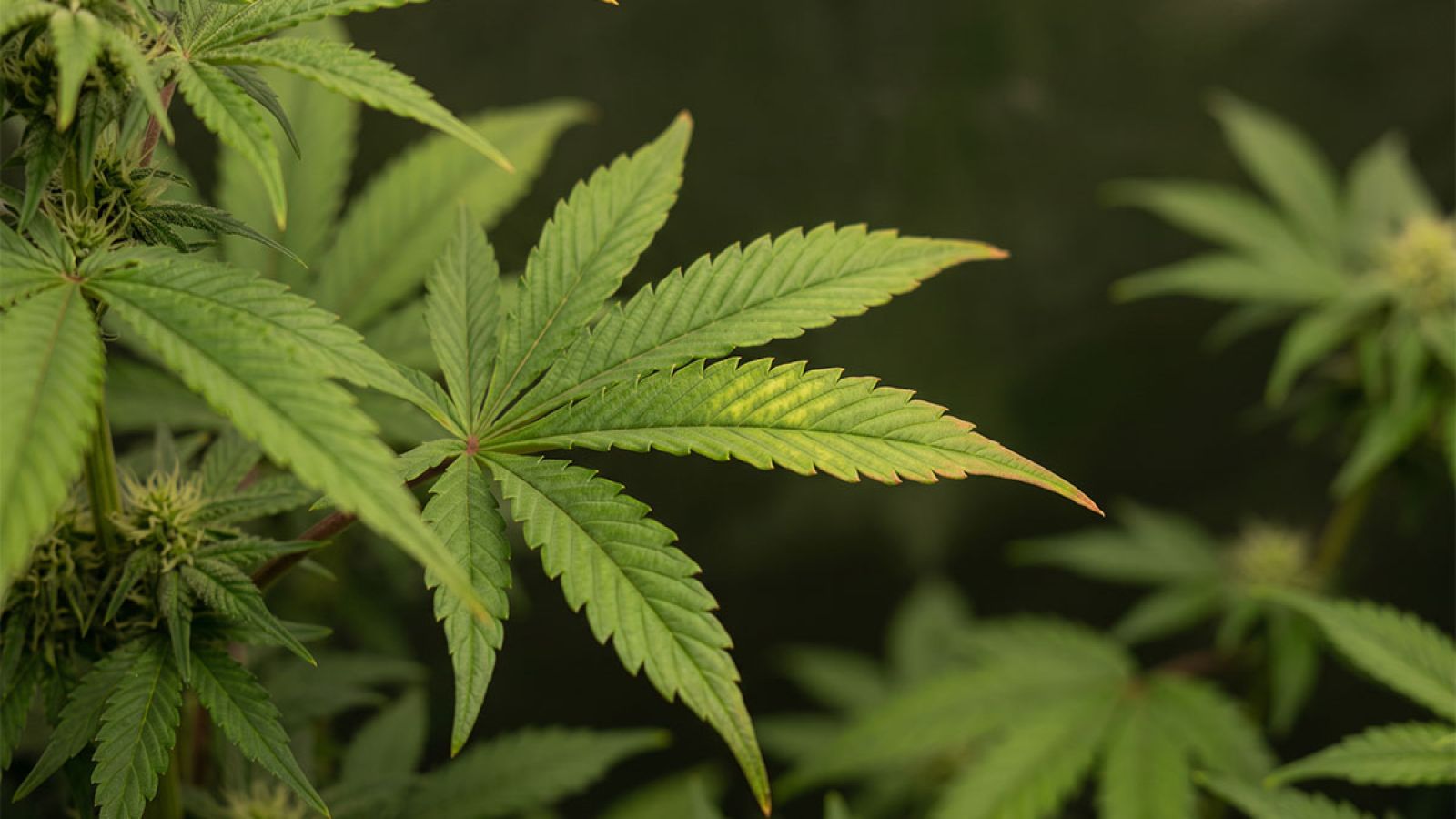
Molybdenum deficiency in cannabis shows up first on the middle leaves, which yellow between the veins and often develop a red, orange, or pink edge. From there, the problem climbs toward the newest growth.
It looks alarming, but rarely means your plant is short on molybdenum. In most grows the nutrient is already in the root zone, and a pH that has drifted out of range is blocking uptake. This guide shows you how to confirm it, separate it from a nitrogen shortage, fix the real cause, and keep it from returning.
Bottom line: that red leaf margin is the tell that sets molybdenum apart from a plain iron or nitrogen shortage, and the fix is bringing your root-zone pH back into range - done the right way for your growing medium. Because a true shortage is so uncommon, a pH correction clears up most cases within about a week of new growth.
What Is Molybdenum Deficiency in Cannabis?
Molybdenum deficiency in cannabis occurs when plants cannot access enough of the micronutrient molybdenum to turn nitrates into a usable form, the step that lets them process nitrogen properly. Molybdenum is a trace mineral, so plants need only tiny amounts, which is why a true dietary shortage is uncommon.
That gives you two very different situations wearing the same symptoms: a genuine shortage, where the nutrient really is missing, and a lockout, where it sits in the medium but the roots can't take it up. The two call for opposite responses, which is why identifying the right one comes before any attempt to correct it.
What Does Molybdenum Do for Cannabis Plants?
Molybdenum activates the nitrate reductase enzyme that lets cannabis plants convert nitrates into ammonia, the form the plant then uses to build the proteins it needs to grow.
When molybdenum runs low, that nitrogen-processing pathway stalls, so the plant behaves as though it is short on nitrogen even when nitrogen is available.
This is the reason molybdenum deficiency and nitrogen deficiency get confused early on, both begin with yellowing leaves. The molybdenum-specific signs, like the red leaf margins, appear as the shortfall deepens.
What Are the Symptoms of Molybdenum Deficiency in Cannabis?
Molybdenum deficiency shows first on the middle leaves as interveinal yellowing that moves inward over time, then climbs toward the newer growth at the top.
Because molybdenum is a mobile nutrient, the plant shifts it toward fresh growth, so the mid-plant foliage flags the problem first. As it advances, distinctive coloring and leaf damage set in to confirm the diagnosis.
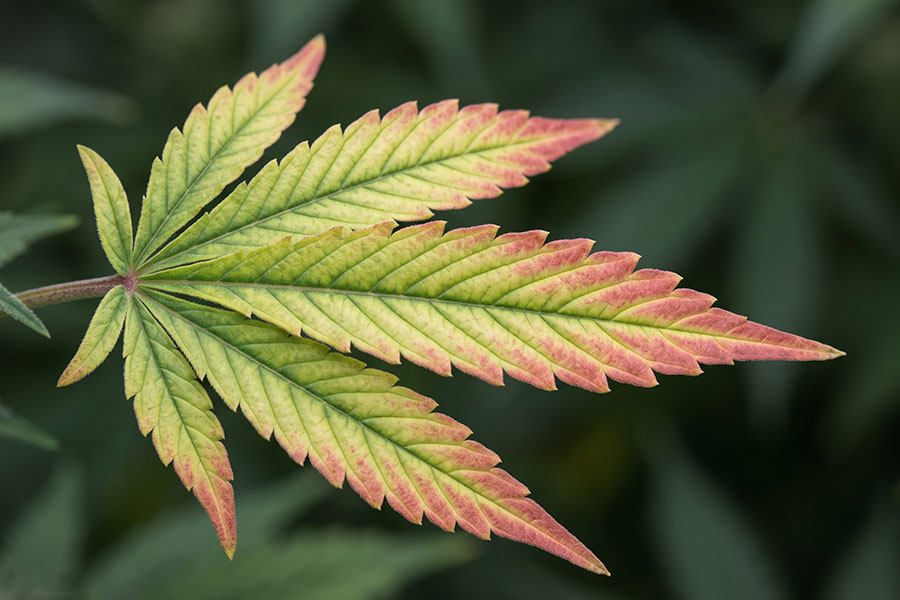
Interveinal yellowing with red-pink leaf margins - the tell-tale sign of molybdenum deficiency, not nitrogen.
The three signs below appear roughly in order:
- Yellowing the middle leaves - the first and least specific signal, also seen with nitrogen deficiency.
- Red, orange, or pink leaf edges - the tell-tale sign that points specifically to molybdenum.
- Spotting, mottling, and leaf curl - later-stage damage as tissue starts to fail.
Yellowing on the Middle Cannabis Leaves
Yellowing from molybdenum deficiency starts on the mid-plant fan leaves and pushes upward, showing between the veins and along the edges rather than as a flat, even fade.
On its own this symptom is not diagnostic, since a nitrogen shortage produces similar early yellowing. You confirm molybdenum only when the color signs below join in.
Red, Orange, or Pink Leaf Edges - the Tell-Tale Sign
Red, orange, or pink coloring along the leaf margins distinguishes molybdenum deficiency from a plain nitrogen shortage. The color usually starts at the leaf margins and works inward, though it can show up in the interveinal areas too.
This margin coloring is the single most reliable visual signal, so it carries the most weight when you diagnose. If you see it alongside mid-plant yellowing, molybdenum lockout is the likely answer.
Spotting, Mottling, and Leaf Curl in Cannabis
Dark spotting and margin curl appear on molybdenum-deficient leaves as the condition advances. The mottled patches reduce the leaf's ability to photosynthesize, and severe cases progress to necrosis, where sections of tissue die off.
These later signs indicate the deficiency has gone unaddressed for a while. Catching the problem at the yellowing-and-red-edge stage keeps damage from reaching this point.
Is It Molybdenum Deficiency or Nitrogen Deficiency?
Nitrogen deficiency yellows the bottom leaves first, while molybdenum starts in the middle of the plant and climbs, and only molybdenum adds red-to-pink leaf margins.
Leaf position is the first tell, the red edge confirms it. You will often see molybdenum deficiency described as starting on the older, lower leaves, but that lower-leaf pattern actually belongs to nitrogen. Molybdenum begins in the middle of the plant and climbs, so the two are easy to mix up.
A grower sees yellowing leaves, assumes nitrogen, and misses the mid-plant start and red edges that point to molybdenum. The table below sorts the shared signals from the ones that actually separate the two conditions, with a reliability rating for each trait.
The comparison covers what you can see and what each trait tells you:
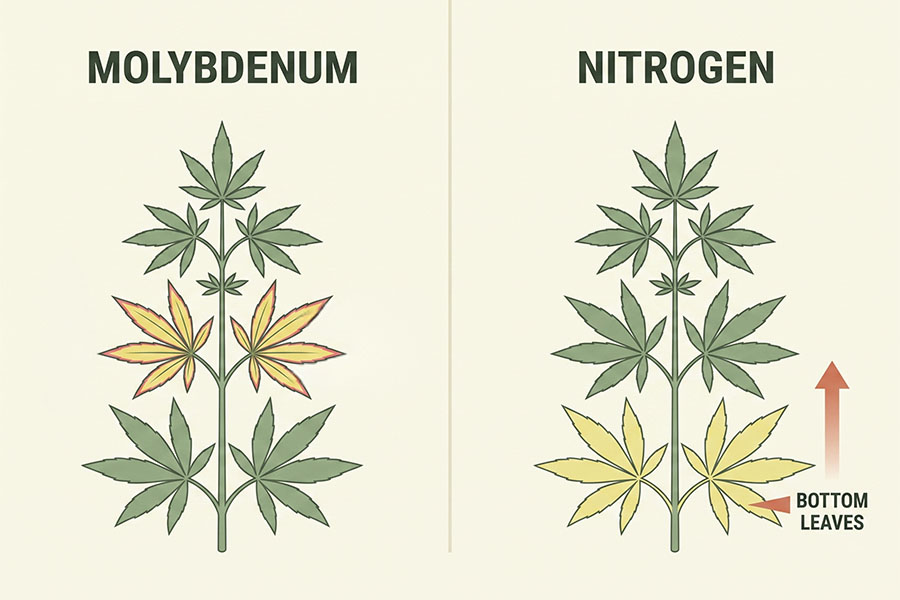
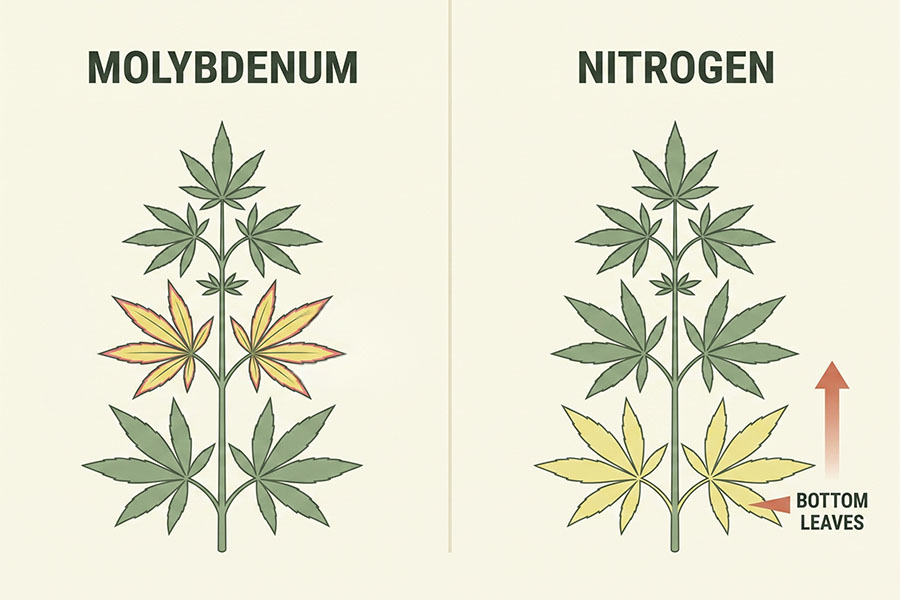
Molybdenum starts mid-plant with red edges; nitrogen starts at the bottom and fades to uniform yellow.
|
Trait |
Molybdenum Deficiency |
Nitrogen Deficiency |
Reliability |
|
First-affected leaves |
Middle leaves first, moving upward |
Bottom leaves first |
High (position is a key differentiator) |
|
Leaf-edge color |
Red, orange, or pink margins moving inward |
No red edge; leaf fades to pale yellow |
High (key differentiator) |
|
Yellowing pattern |
Interveinal and mottled |
Uniform, whole leaf pales |
Medium |
|
Typical trigger |
Low pH lockout or heavy sulfate feeding |
Actual nitrogen shortage in the feed |
Medium |
|
Fix that works |
Correct root-zone pH for your medium first |
Add nitrogen, then verify pH |
Medium |
The red leaf edges are the deciding factor between the two. If you want to rule the two apart with more confidence, the observation matrix below maps what you see to what you should do next:
|
Observation |
What It Means |
Confidence |
What to Do |
|
Red or pink edges plus interveinal yellowing on mid-plant leaves |
Molybdenum lockout very likely |
High |
Check runoff pH, then correct by medium |
|
Yellowing old leaves, no red edge |
More likely nitrogen |
Medium |
Check feed nitrogen and pH |
|
Symptoms persist after a pH correction |
Possible sulfate overload or a root problem |
Medium |
Run a soil test; check root health and aeration |
|
Only top growth affected |
Likely iron or calcium, not molybdenum |
High |
Check pH, then suspect iron or calcium |
Iron deficiency can look similar too. Both produce interveinal yellowing, but iron shows up on the newest top growth instead of the middle of the plant, comes with no red edge, and traces back to pH drifting too high rather than too low.
Since the two lock out at opposite ends of the pH range, they rarely show up from the same cause. If only the top of the plant is affected, suspect iron before molybdenum.
What Causes Molybdenum Deficiency in Cannabis?
Molybdenum deficiency results most often from a root-zone pH that drops too low and locks the nutrient out of reach. Because true shortages are rare, the cause is usually about availability rather than quantity. Four factors drive most cases.
- Low pH lockout - the primary cause, and the first thing to check.
- Heavy sulfate feeding - competes with molybdenum for uptake.
- Excess iron - competes with molybdenum for uptake.
- Cold temperatures - more likely to trigger deficiency in color-changing cultivars grown in cool conditions.
Low pH Locks Out Molybdenum
Molybdenum availability falls off sharply as root-zone pH drifts below the plant's ideal window, which makes an acidic root zone the usual culprit. The nutrient is still sitting in the medium; the roots just can't pull it in.
So the fix is almost never more molybdenum, but bringing pH back into range. This is why a pH check is always the first diagnostic step.
Heavy Sulfate Feeding Can Crowd Out Molybdenum
Molybdenum shares an uptake pathway with sulfate, so feeds that lean hard on sulfate-based inputs (Epsom salts, gypsum, sulfate-heavy bloom formulas) can produce molybdenum deficiency symptoms even when pH checks out fine.
If symptoms persist after a pH correction, ease off sulfate-heavy feeding before assuming a genuine shortage is behind it.
Poor Root Health and Compacted Soil
Compacted or waterlogged soil restricts the root growth cannabis plants need to absorb molybdenum. Roots that can't spread or breathe take up trace minerals poorly, so even a well-balanced medium can produce deficiency signs.
Aerating the medium and improving drainage restores the root function that uptake depends on. Healthy roots are the foundation that makes every other correction hold.
Cold Temperatures and Color-Changing Cultivars
Cannabis cultivars bred for color expression are more prone to molybdenum deficiency when grown in cool conditions. The cold stress compounds with the tiny amounts of molybdenum these plants already need, so it's worth watching color-changing strains more closely if your grow space runs cool.
Does Excess Iron Cause Molybdenum Deficiency?
No, excess iron doesn’t cause a molybdenum deficiency on its own. Iron and aluminum oxides in acidic media bind molybdenum tightly to soil particles, pulling it further out of root reach, but this binding is a function of pH, not a separate mineral conflict.
The more acidic your root zone, the more of these oxides are present and reactive, so iron's role here is really just another expression of the same pH story covered above.
That's why testing iron levels on their own rarely tells you much. Bringing pH back into range addresses the iron-oxide binding at the same time as the lockout itself. Iron becomes worth investigating on its own only if symptoms persist well after a genuine pH correction, at which point a soil test is the right next step.
How Do You Fix Molybdenum Deficiency in Cannabis?
You fix molybdenum deficiency by restoring the right root-zone pH for your growing medium so the plant can absorb the molybdenum already present. The instruction "fix your pH" is correct, but how you fix it changes completely depending on whether you grow in living soil, coco, or hydro. That distinction is where most generic advice goes wrong.
The steps below correct the pH the right way, handle salt buildup as its own separate issue, and use a foliar spray to buy time while the root-zone fix takes effect.
- Correct pH by medium - the core fix, and it looks different for soil, coco, and hydro.
- Flush salt buildup - a separate step, only when your readings call for it.
- Foliar spray - fast, temporary relief through the leaves.
Correct Root-Zone pH for Your Growing Medium
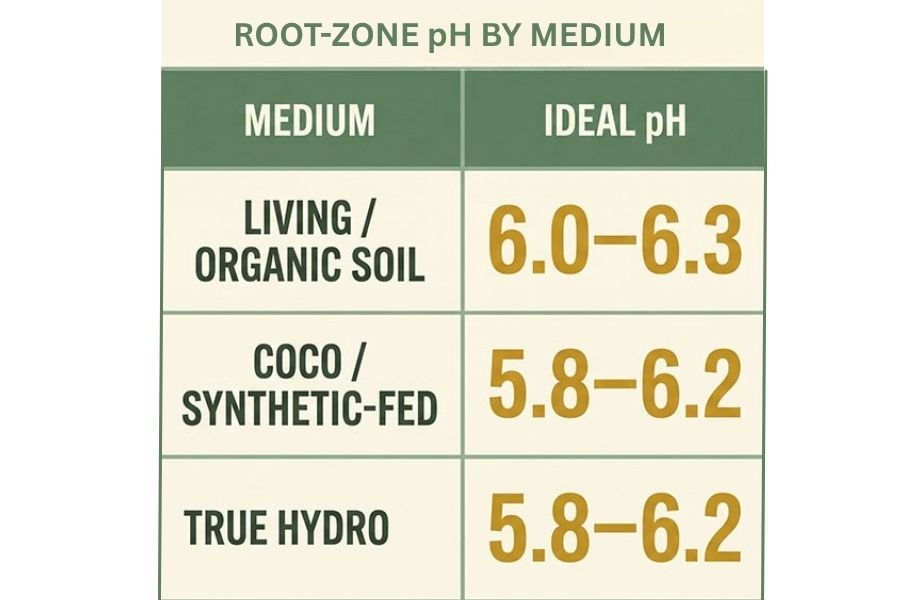
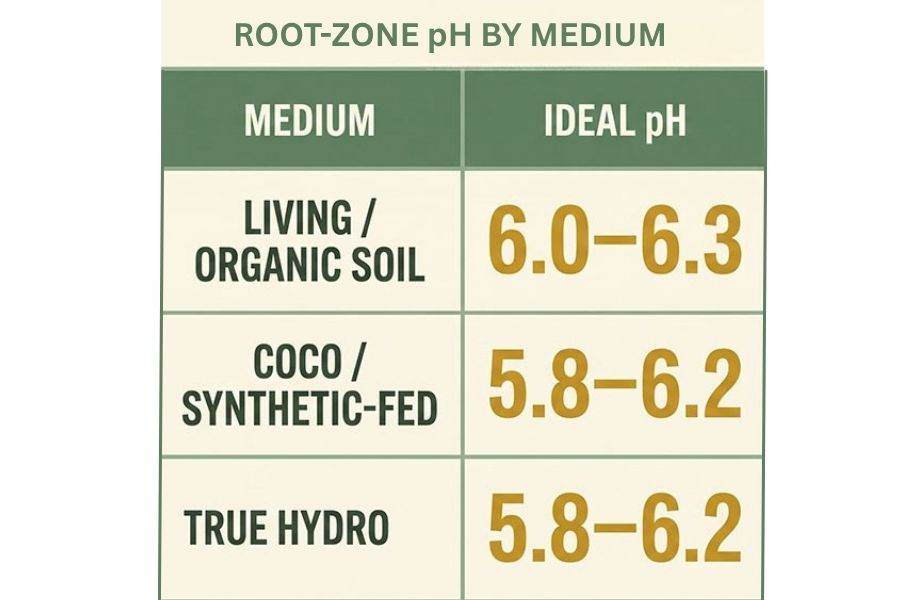
Ideal root-zone pH by growing medium - the range that keeps molybdenum available to your plant.
The right pH fix depends on whether you grow in living soil, coco, or true hydro, because each medium reaches the roots differently. The table below pairs each medium with its target range and the method that actually moves pH in that system.
|
Growing Medium |
Ideal pH |
Acceptable Range |
How You Adjust It |
|
Living / organic soil |
6.0–6.3 |
5.5–6.5 |
Amendments only — lime to raise, elemental sulfur to lower (both slow-acting). Don't pH the water. |
|
Coco / synthetic-fed soil |
5.8–6.2 |
5.6–6.4 |
pH the nutrient solution (mix nutrients first, then adjust), checked weekly |
|
True hydro (DWC / NFT / rockwool) |
5.8–6.2 |
5.6–6.4 |
pH the final nutrient solution, adjusted daily |
In a living or organic soil, the root-zone microbes regulate pH toward what the plant needs, so you generally don't pH your water or reach for pH Up or Down. When organic soil is genuinely out of range, you correct it with amendments - calcium carbonate or lime to raise pH, elemental sulfur to lower it - and these act slowly rather than overnight.
Input water pH has only a small, temporary effect on soil; what actually shifts soil pH over time is water alkalinity, the carbonate content, not the pH number you feed. If you run synthetic salt-based nutrients in soil, that microbial buffering is inhibited, so you pH the input the way a coco or hydro grower would.
For coco and true hydro, you pH the nutrient solution itself: mix your nutrients into the water first, then adjust, because the nutrients shift the reading and the solution is what reaches the roots. Coco growers check and correct at each feed, usually weekly, while true hydro solutions drift faster and need a daily adjustment to the target range.
Treat runoff pH as a warning light that flags when things have drifted, not a dial you chase up and down until the runoff reads perfect.
Flush Salt Buildup — a Separate Step From pH
Flushing clears salt buildup, which is a different problem from a pH that has drifted, and the two fixes should never be merged into one step. Confirm salt buildup with an EC or TDS reading that sits well above your input, rather than assuming it from the symptoms alone.
To flush, run plain, pH'd water with no nutrients mixed in until about 30% drains from the bottom. When both salt buildup and pH drift apply, the order is flush first, then correct pH, then feed only if a genuine shortage remains. Flushing on its own never corrects pH or cures the deficiency.
Apply a Molybdenum Foliar Spray
A molybdenum foliar spray delivers the nutrient through leaf stomata while the root-zone correction takes effect. Foliar feeding bypasses the roots entirely, which makes it a useful stopgap when you need color to stabilize quickly.
Mix and apply a molybdenum-inclusive micronutrient spray according to the product instructions, misting the foliage rather than soaking it.
Treat this as short-term support, not a substitute for correcting the underlying pH.
Molybdenum Deficiency and Co-Occurring Deficiencies
A molybdenum and sulfur deficiency can happen together because both leach out of the same sandy, low-organic-matter soils. A phosphorus deficiency can also show up alongside a molybdenum shortage — the former helps the latter get absorbed. So when phosphorus is scarce, more molybdenum stays locked away and out of reach of the roots.
If you're correcting a molybdenum deficiency, it's worth pulling up your feed log to check phosphorus levels at the same time, and if you're growing in a light, sandy, or heavily leached medium, keep an eye on sulfur too rather than waiting for a second deficiency to show up on its own.
How Do You Prevent Molybdenum Deficiency in Cannabis?
You prevent molybdenum deficiency by monitoring runoff pH regularly and keeping the root zone in the correct range for your medium. Checking your runoff about once a week lets you catch pH drift early, before it locks out molybdenum or any other trace mineral.
A balanced feed that includes micronutrients - rather than heavy single-nutrient dosing - keeps the whole trace-mineral group, including manganese deficiency and copper deficiency risks, in check at once.
Aerating the medium at the start of the season protects the root health that all nutrient uptake relies on.
Will Cannabis Recover From Molybdenum Deficiency?
Yes, cannabis recovers from molybdenum deficiency once the root-zone pH is corrected, though leaves already damaged by the deficiency stay discolored.
The plant stops the problem from spreading to fresh foliage, and new growth returns to a healthy green within about a week. Rather than watching the old damaged leaves for improvement, judge recovery by the color of the new leaves emerging at the top. Steady, green new growth is the clearest sign the correction worked.
Molybdenum Deficiency and the Wider Trace-Nutrient Picture
Molybdenum deficiency rarely travels alone, because the trace nutrients cannabis relies on share the same pH-lockout mechanics. A root zone that drifts out of range can starve several minerals at once, so the yellowing you trace to molybdenum today may sit next to a different trace-nutrient issue tomorrow.
Telling them apart is the real skill: a molybdenum problem carries its red leaf margins, a nitrogen deficiency fades to a flat, uniform yellow with no red at all, and an iron deficiency strikes the newest top leaves instead of the old ones. Learning to read the whole trace-nutrient group turns a single fix into a repeatable diagnostic habit.
And where cultivation is lawful, starting from healthy, viable seed genetics gives every plant a steadier baseline to work from.
Frequently Asked Questions
Is Molybdenum Deficiency in Cannabis Common?
No, molybdenum deficiency is rare in cannabis because plants need only trace amounts of the mineral. When symptoms do appear, they usually reflect a pH lockout rather than a true shortage, meaning the molybdenum is present but not absorbable. Correcting root-zone pH resolves the large majority of cases.
What pH Prevents Molybdenum Lockout in Cannabis?
The ideal pH depends on your medium: living soil sits best at 6.0–6.3 (5.5–6.5 acceptable), while coco and hydro sit best at 5.8–6.2 (5.6–6.4 acceptable). Living soil buffers itself through microbes, so it's adjusted with slow amendments rather than by pH-ing the water.
The exception is soil fed with synthetic nutrients, which lose that buffering - so like coco and hydro growers, you pH the mixed nutrient solution instead.
Can Molybdenum-Deficient Cannabis Leaves Turn Green Again?
Leaves already damaged by molybdenum deficiency generally do not turn green again, since the tissue damage is permanent. Recovery shows instead in the new growth, which returns to a healthy color within about a week of a pH correction. Judge success by the fresh leaves at the top of the plant, not the older damaged ones.
Does Molybdenum Deficiency Affect Autoflowers and Photoperiods Differently?
Molybdenum deficiency works the same way in autoflower and photoperiod cannabis, since both rely on the same nutrient-uptake and pH dynamics. The difference is timing pressure: autoflowers move through their life cycle faster, so catching and correcting the deficiency quickly matters more. The diagnosis and the pH-based fix are otherwise identical.
Does Molybdenum Deficiency Start on the Lower Leaves?
It is commonly described that way, but in cannabis molybdenum deficiency actually starts on the middle leaves and works its way up toward the new growth. Lower-leaf yellowing points to nitrogen instead. The red or pink leaf margin is the signal that separates the two, so if you see mid-plant yellowing with colored edges, check your pH before adding nitrogen.