



Manganese Deficiency in Cannabis: Signs, Causes & Fixes
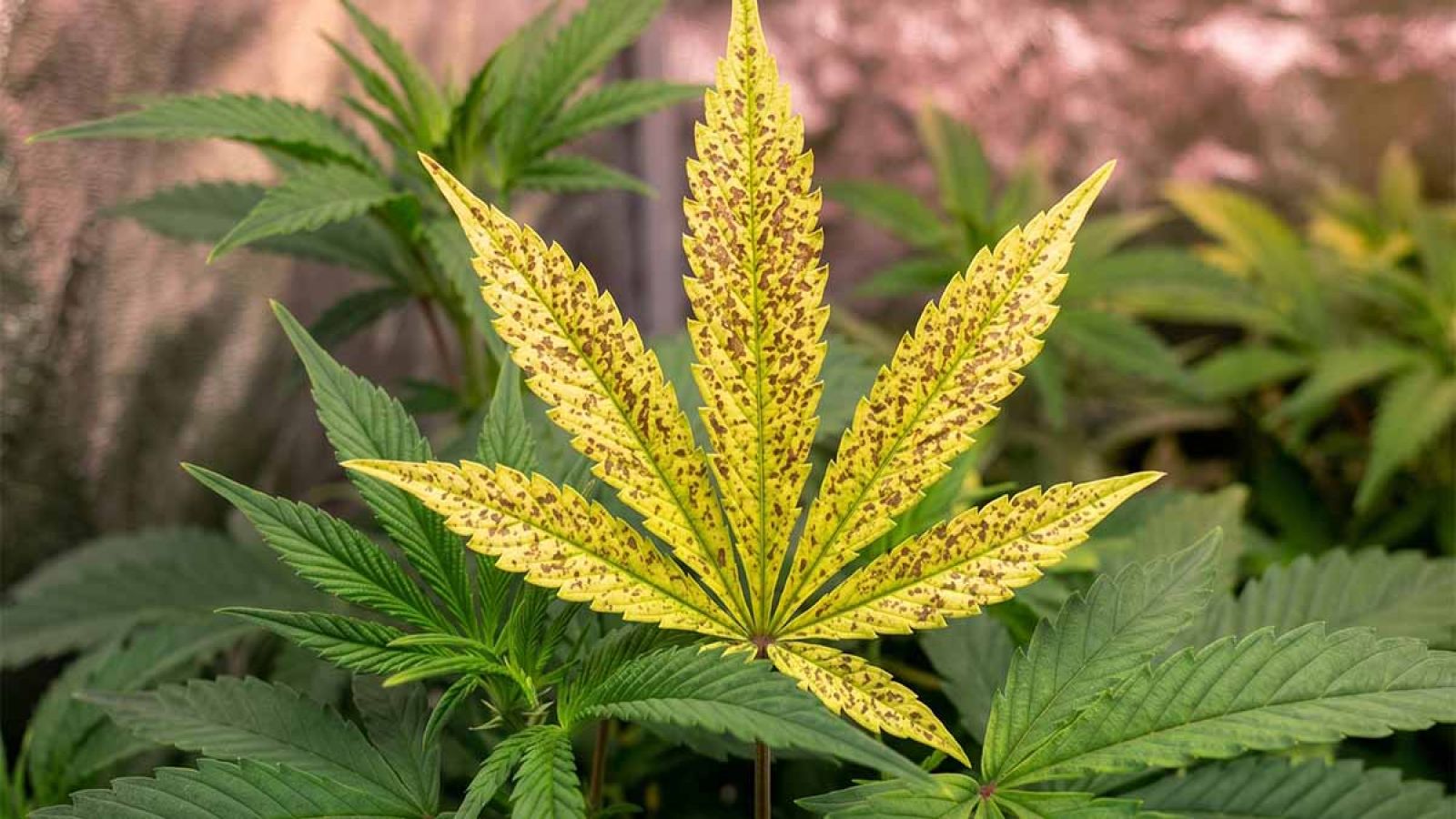
Manganese deficiency in cannabis shows up as yellowing between the veins on the newest top leaves, with the veins staying green, followed by brown spots. It is almost always caused by a root-zone pH that sits too high, not by a real shortage of manganese in your medium.
Caught early, it clears within one to two weeks, but left alone it kills leaf tissue and stunts new growth.
The short version: the manganese is usually already there and simply locked out, so check pH first. Living soil buffers itself and shifts slowly through amendments, while coco and hydro need the mixed nutrient solution pH'd to range. Flushing only clears salt buildup; it does not fix pH or cure the deficiency.
What Is a Manganese Deficiency in Cannabis?
A manganese deficiency in cannabis develops when plants cannot absorb enough manganese (Mn) to drive photosynthesis and activate key enzymes. Manganese is a micronutrient, meaning the plant needs it only in trace amounts, but those trace amounts do real work.
It helps split water during photosynthesis and acts as a cofactor for enzymes that run respiration and nitrogen metabolism.
When manganese runs short, chlorophyll production stalls and the leaf tissue loses its green color. Because manganese does not move easily through the plant, the newest growth at the top suffers first while older leaves stay comparatively normal.
That top-down pattern is one of the first clues that separates a manganese problem from other deficiencies.
What Are the Symptoms of Manganese Deficiency in Cannabis?
Manganese deficiency symptoms appear first on the youngest upper leaves, where the tissue yellows in patches while the veins hold their green. This "green veins on yellow tissue" contrast is the single most reliable early signal, and it develops in stages as the problem progresses. Watching which stage your plant is in tells you how urgently you need to act.
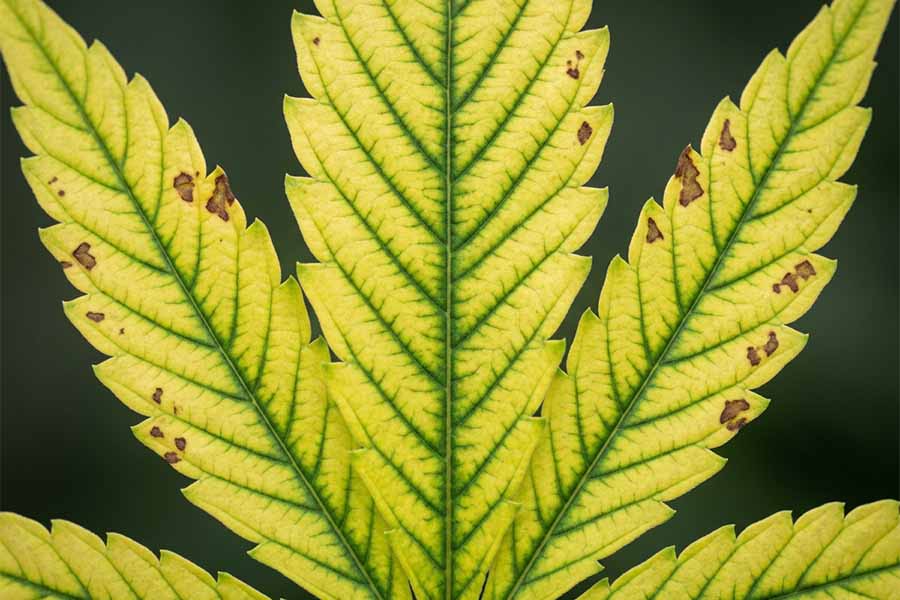
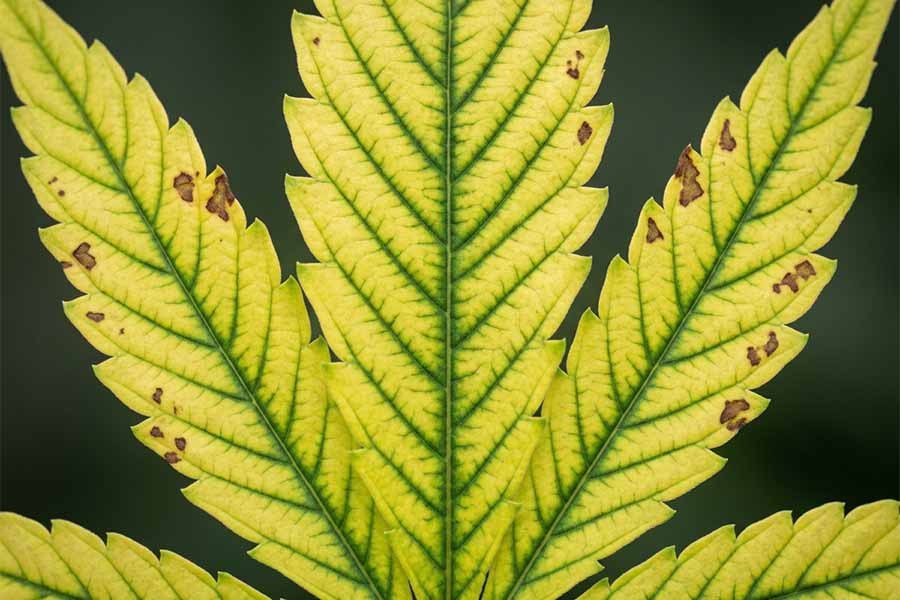
The tell-tale signature: interveinal yellowing with green veins and small brown necrotic spots.
The three stages below move from a subtle color shift to tissue death:
- Early: mottled yellowing between the veins on the youngest top leaves
- Progressing: brown necrotic spots forming inside the yellowed areas
- Late: crispy brown patches, curling leaves and stunted new growth
Early Signs of Manganese Deficiency in Cannabis
Early manganese deficiency shows as mottled interveinal chlorosis on the youngest top leaves while the veins stay green. Interveinal chlorosis simply means yellowing in the tissue between the leaf veins, and at this stage the pattern looks blotchy rather than uniform.
Growers often misread it as an early nitrogen or iron issue, so the location matters: manganese hits the top of the plant, and the yellowing is patchy, not a smooth fade.
Because the change is subtle, many growers miss it until it spreads. Catching the deficiency here gives you the fastest and cleanest recovery.
Progressing Symptoms of Manganese Deficiency
Progressing manganese deficiency produces brown necrotic spots between the veins as the yellowing intensifies. Necrosis is the death of leaf tissue, and these small dead spots signal that the shortage has moved past a simple color change. The veins still hold their green, which keeps the "green net" look intact even as the damage deepens.
At this point the affected leaves lose photosynthetic capacity, so the plant's overall vigor starts to dip. New shoots may also begin to shrink as internodes tighten.
Late-Stage Manganese Deficiency Symptoms
Late-stage manganese deficiency kills leaf tissue, leaving crispy brown patches, curling leaves and badly stunted growth.
The dead areas spread, leaves become fragile and start to crumble, and new growth slows to a crawl. If this happens during flowering, the plant may form fewer bud sites and produce a lighter harvest.
Leaves damaged this far will not turn green again even after you correct the problem. Recovery is measured by healthy new growth, not by the old leaves healing.
How Do You Know It's Manganese and Not Iron or Magnesium?
Manganese deficiency can resemble iron or magnesium deficiency, so checking where symptoms appear and how they develop can help narrow down the cause.
The key signs to look for are: new-growth yellowing with green veins and fast-forming brown spots points to manganese. If those signals line up, move on to the cause and fix below. A full side-by-side comparison with iron and magnesium appears near the end of this guide for closer diagnosis
What Causes Manganese Deficiency in Cannabis?
Manganese deficiency in cannabis usually results from a high pH that locks manganese out of the roots, not from an actual lack of manganese in the medium. Most grow mediums already contain enough manganese; the problem is availability.
Cannabis absorbs manganese in its Mn²⁺ form, and the further pH drifts toward the top of your medium's range, the more of that form converts into compounds the roots cannot take up. This is why adding more manganese without addressing pH rarely helps and can make salt buildup worse.
A handful of secondary factors can block uptake even when pH looks reasonable, which the two subsections below cover.
How High pH Causes Manganese Lockout
High pH converts manganese into forms cannabis roots cannot absorb, with availability tightening as the root zone climbs toward the upper end of its range. Nutrient lockout describes this exact situation: the nutrient is physically present but chemically unavailable.
The higher and more alkaline the root zone drifts, the tighter manganese gets locked away, regardless of how much you feed.
This is the core insight behind fixing the problem. You are almost never adding manganese back, you are unlocking what is already there by bringing pH into the right range for your medium.
Other Causes of Manganese Deficiency in Cannabis
Excess iron, waterlogged medium and damaged roots each reduce the manganese a cannabis plant can take up. Too much iron competes directly with manganese at the root, so an overdose of one can starve the plant of the other. Waterlogged, poorly drained medium creates oxygen-starved conditions that stress roots and impair uptake.
Root damage from pests, disease or constant overwatering also cuts nutrient absorption across the board. Healthy, well-drained roots are the baseline that lets any pH correction actually work.
How Do You Fix Manganese Deficiency in Cannabis?
You fix manganese deficiency in cannabis by matching root-zone pH to your growing medium first, then addressing salt buildup and re-feeding only if a true shortage remains.
Because pH availability is the usual culprit, the correction is mostly about getting the root zone into the right window, and that window and method differ by medium. Rushing to add nutrients before pH is right tends to deepen the problem.
Work through these three moves in order:
- Correct pH by medium - the step that resolves most cases
- Flush only if salt buildup is confirmed - clears blockage, not pH
- Foliar spray - fast relief while the roots recover
Correct Root-Zone pH by Growing Medium
Correcting root-zone pH depends on your growing medium, because soil, coco and hydro each behave differently. Getting this right resolves the majority of manganese deficiencies on its own.
In living or organic soil, the root-zone microbes regulate pH toward what the plant needs, so you generally do not pH your water or use pH Up/Down products. Genuinely out-of-range soil is corrected with slow-acting amendments: calcium carbonate or lime to raise pH, elemental sulfur to lower it.
One important nuance: the pH number of the water you feed shifts substrate pH only slightly and temporarily, while water alkalinity (its carbonate and bicarbonate load) is what actually moves soil pH over time.
In coco or synthetic-fed soil, mix your nutrients into the water first, then pH the finished solution to range and check it around weekly. Synthetic salt-based feeds suppress the microbial buffering that living soil relies on, so a synthetic-fed soil grow needs the same pH discipline as coco.
In true hydro systems like DWC, NFT, rockwool or LECA, pH the final nutrient solution to target and adjust it daily. The nutrients themselves shift the solution's pH, and that final number is what reaches the roots.
Flush Only to Clear Confirmed Salt Buildup
Flushing clears salt buildup that you have confirmed with an EC or TDS reading well above your input, not pH problems and not the deficiency itself.
Salt buildup is measured, not assumed: if your runoff EC reads far higher than the solution going in, excess salts are accumulating in the root zone. A flush uses plain, pH'd water with no nutrients mixed in, run until roughly 30% drains from the bottom.
Keep flushing and pH correction separate, because they do different jobs. When both salt buildup and pH drift apply, the order is flush first, then correct your feed pH, then feed again only if a genuine shortage remains after that.
Apply a Manganese Foliar Spray for Fast Recovery
A manganese foliar spray delivers the nutrient straight to the leaves, bypassing slow root uptake. Leaves absorb nutrients through small pores called stomata, so a foliar application can relieve symptoms while you sort out the root-zone pH that caused them. Use a manganese-inclusive product mixed and applied to label instructions.
Treat the spray as a bridge, not a cure. It buys time and speeds visible recovery, but the deficiency returns unless the underlying pH or uptake issue is fixed.
What pH Range Prevents Manganese Deficiency in Cannabis?
Cannabis takes up manganese best within a medium-specific pH range - roughly 5.5–6.5 in soil and 5.6–6.4 in coco or hydro. Staying inside these safe zones keeps manganese and most other nutrients available.
Dialing closer to the ideal target within each zone gives the most consistent uptake.
|
Growing medium |
General range (safe zone) |
Ideal target |
|
Soil |
5.5–6.5 |
6.0–6.3 |
|
Coco |
5.6–6.4 |
5.8–6.2 |
|
Hydro |
5.6–6.4 |
5.8–6.2 |
The general range is where plants stay out of trouble, while the ideal target is where uptake runs smoothest. Because manganese tightens up as pH climbs, the safest habit is holding the root zone at the ideal target for your medium instead of letting it drift toward either edge of the safe zone.
How Do You Prevent Manganese Deficiency in Cannabis?
You prevent manganese deficiency in cannabis by keeping the root zone in the right pH range for your medium and watching for early drift. Prevention costs far less effort than recovery, since a locked-out plant has already taken some damage by the time symptoms show.
Consistent pH discipline handles the large majority of cases. The two habits below catch problems before they reach the leaves.
Read Runoff pH and EC as a Warning Light
Runoff pH and EC readings signal that something in the root zone has drifted, which tells you to look at your feed. Treat runoff as a warning light, not a dial. It flags that a value has moved, rather than a number you chase and retest until it lands in range.
Read runoff during watering, roughly once a week, so you catch that movement early. When a reading swings away from your input, check the solution you are feeding and your medium before the imbalance turns into lockout.
Start With Healthy Genetics and Clean Medium
Vigorous genetics from quality cannabis seeds, paired with a well-draining medium, give plants a stronger baseline against nutrient stress. Healthy roots in a properly aerated medium absorb nutrients more reliably, so they shrug off minor pH swings that might tip a weaker plant into deficiency.
A clean, well-structured medium also drains properly, which protects roots from the waterlogging that impairs manganese uptake. Buy seeds and grow only where cannabis cultivation is legal under federal, state and local law.
Manganese Deficiency vs Iron and Magnesium Deficiency in Cannabis
Manganese deficiency resembles iron and magnesium deficiency, but the pattern and leaf location separate them. All three can show interveinal yellowing, which is why growers mix them up, yet each has a distinct fingerprint.
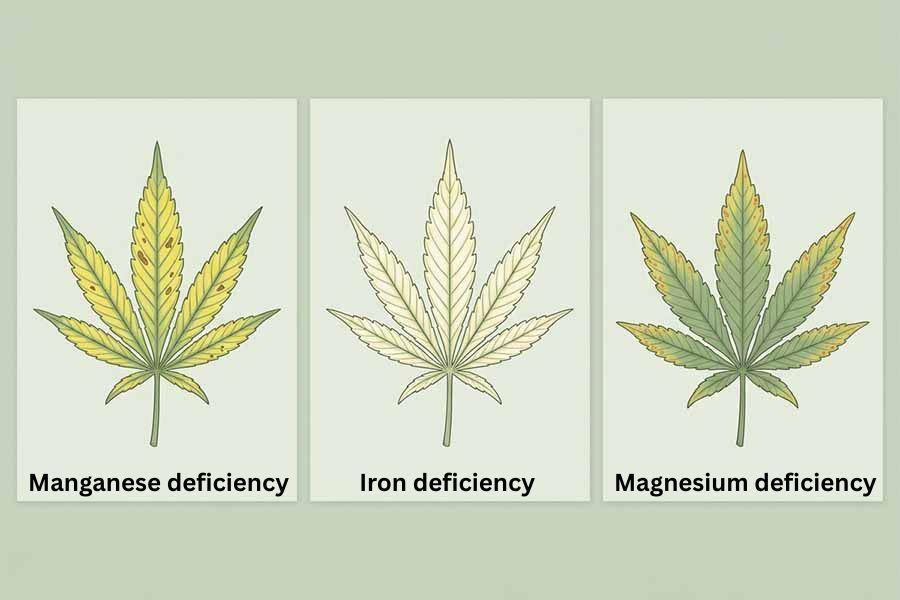
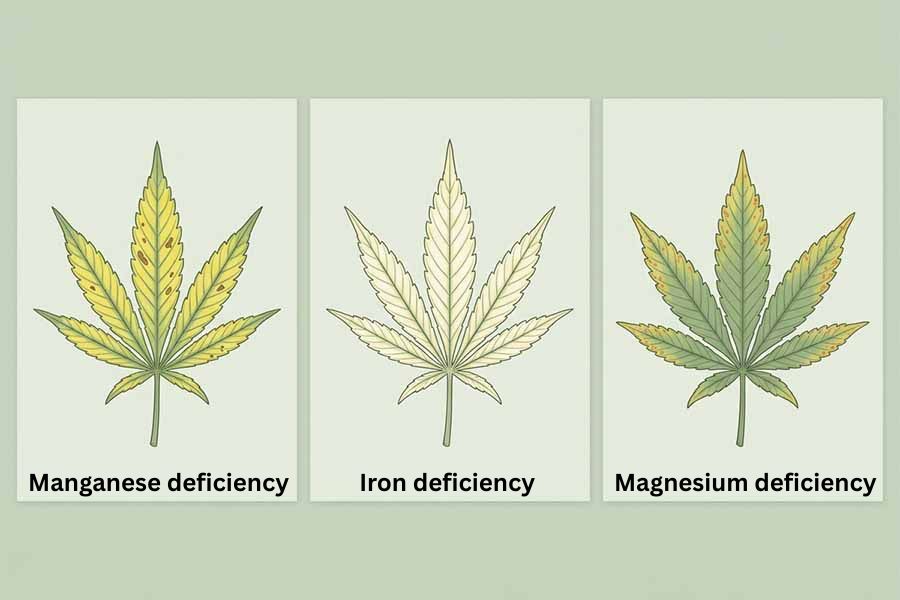
Manganese, iron and magnesium deficiencies compared - leaf location is the fastest way to tell them apart.
Reading where on the plant the yellowing starts is the fastest way to tell them apart.
|
Trait |
Manganese deficiency |
Iron deficiency |
Magnesium deficiency |
Reliability |
|
Leaf location |
New, top leaves |
New, top leaves |
Old, lower leaves |
High |
|
Yellowing pattern |
Mottled interveinal |
Smoother interveinal |
Interveinal, edges inward |
High |
|
Vein color |
Stay green |
Stay green |
Stay green |
Medium |
|
Brown spots |
Common, forms quickly |
Rare, bleaches instead |
Rusty spots late |
High |
|
Primary cause |
High-pH lockout |
High-pH lockout |
Depletion or lockout |
Medium |
The clearest separators: magnesium hits the lower, older leaves, so top-of-plant yellowing rules it out. Iron sits closest to manganese since both strike new growth under high pH, but a genuine iron deficiency tends to bleach the whole leaf rather than form the quick brown necrotic spots that mark manganese.
When new-growth yellowing appears with fast-forming brown spots and green veins, manganese is the strongest candidate.
Two other micronutrients round out the new-growth look-alikes worth ruling out. A zinc deficiency shares the interveinal yellowing and high-pH lockout cause, but it also shrinks new growth and shortens the spacing between leaves.
A molybdenum deficiency starts in the middle of the plant rather than the top, and it shows up when pH runs too low instead of too high. Reddish or orange leaf edges are its signature, something manganese never produces.
Frequently Asked Questions About Manganese Deficiency in Cannabis
Can a Cannabis Plant Recover From Manganese Deficiency?
Yes, cannabis plants can recover from manganese deficiency once you correct the root-zone pH and restore nutrient uptake. New growth should return to healthy green within days to a couple of weeks, but already-damaged leaves will not recover.
Why Do Manganese-Deficient Leaves Stay Damaged After I Fix the Problem?
Damaged leaves won't recover because lost chlorophyll and dead tissue cannot be restored. Once you fix the cause, the damage should stop spreading, so watch the newest leaves for healthy growth instead.
How Fast Does Manganese Deficiency Clear Up After Treatment?
Healthy new growth usually appears within 7–15 days after correcting pH and nutrient levels. Foliar sprays may show improvement within a day or two. If there’s no healthy new growth after two weeks, re-check your pH and diagnosis.
Is Manganese Deficiency Common in Cannabis?
No, manganese deficiency is relatively uncommon compared with nitrogen or magnesium deficiency. It most often occurs when root-zone pH is too high or excess iron blocks uptake, and its symptoms can be mistaken for other deficiencies.
Should I pH My Water in Organic or Living Soil?
Usually not. Living and organic soil naturally buffers pH, so you generally don't need to pH plain water. Reserve pH adjustments for coco, hydro, and synthetic-fed soil, while out-of-range living soil is corrected with amendments like lime or elemental sulfur.
Which Other Micronutrient Deficiencies Look Like Manganese Deficiency?
Zinc and molybdenum deficiencies can resemble manganese deficiency. Zinc causes smaller, shortened new growth and is linked to high pH, while molybdenum starts on middle leaves and is associated with low pH and reddish or orange leaf edges.