



How to Fix Cannabis Nitrogen Toxicity: Claw Leaves & Overfeeding
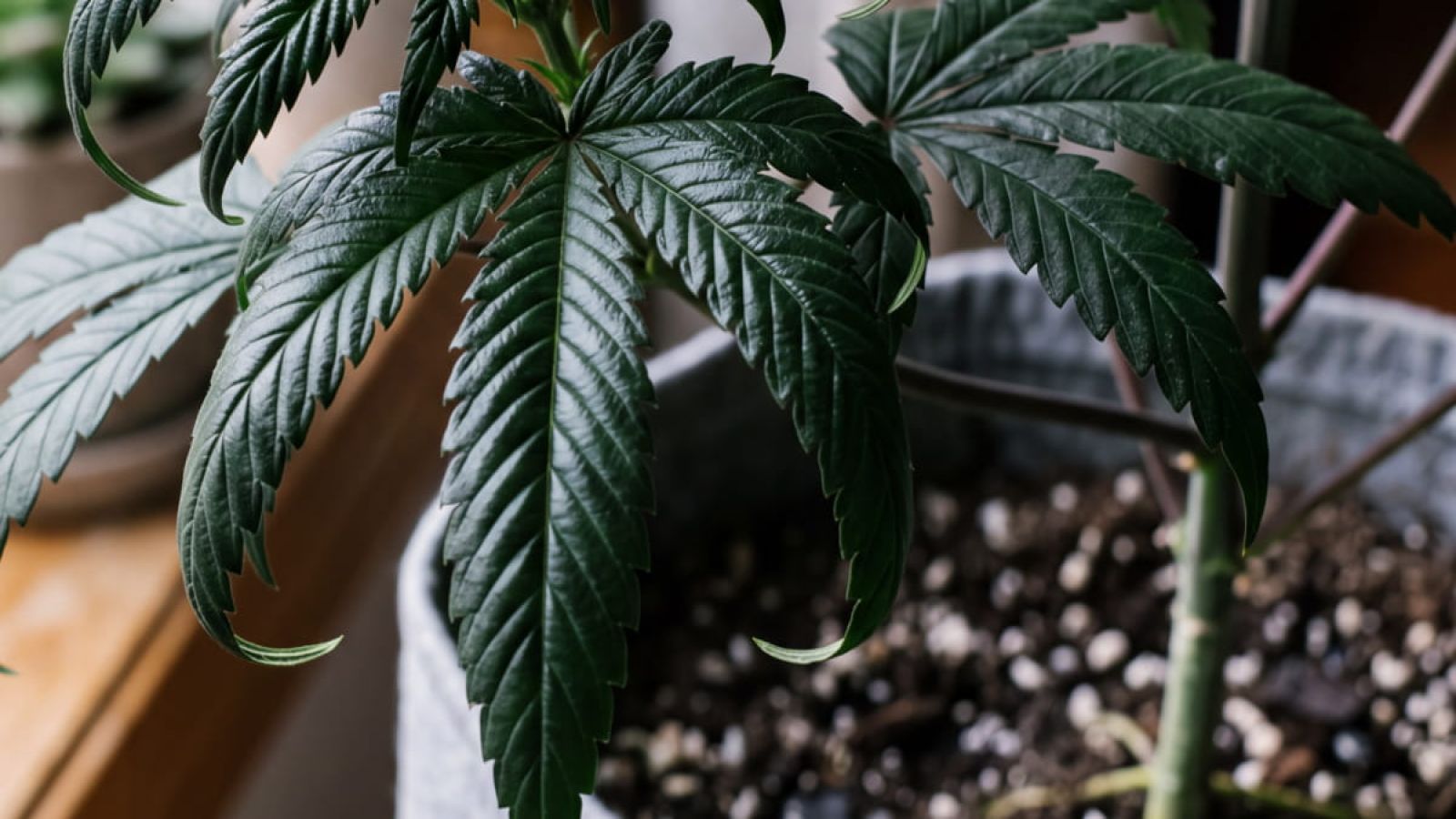
Cannabis nitrogen toxicity turns leaves an unnaturally dark green and bends the leaf tips into a downward claw. The cause is too much nitrogen, not too little, which is why feeding more makes it worse.
This guide shows you how to read the leaf signs, separate toxicity from nitrogen deficiency and overwatering, fix the plant, and handle nitrogen excess during flowering. You will also learn how to prevent it on the next grow.
The short version: Stop the high-nitrogen feeding, flush the medium with pH-balanced water, then feed back at reduced strength once new growth lightens. Watch for the opposite trap — yellowing that climbs from the bottom up is nitrogen deficiency, and it needs more nitrogen, not less.
What Is Cannabis Nitrogen Toxicity?
Cannabis nitrogen toxicity develops when a plant absorbs more nitrogen than it can use, forcing the surplus into leaf tissue. Nitrogen drives leafy green growth, so a small excess first reads as vigor, then tips into damage as levels keep climbing.
The condition is also called nitrogen excess or overfeeding, and growers often shorten it to "too much N."
Nitrogen toxicity is not the same as nutrient burn, though the two overlap. Nutrient burn is the tip-scorching that happens when total salts in the root zone run too high, and nitrogen is one common driver of it. Nitrogen toxicity is the broader picture of a plant carrying more nitrogen than its stage needs, with clawing and dark color appearing before any burn shows.
What Are the Signs of Too Much Nitrogen in Cannabis?
Cannabis plants signal nitrogen excess through several visible leaf changes, starting with unusually dark foliage and progressing to clawing and burnt tips. The signs appear in a rough sequence, so where a plant sits in that sequence tells you how far the excess has gone. Read the three signals below in order:
-
Dark green, shiny leaves - the earliest and mildest signal, easy to mistake for health.
-
The nitrogen claw - leaf tips bending downward, the clearest confirmation.
-
Nitrogen burn - brown, crispy tips that mark advanced excess.
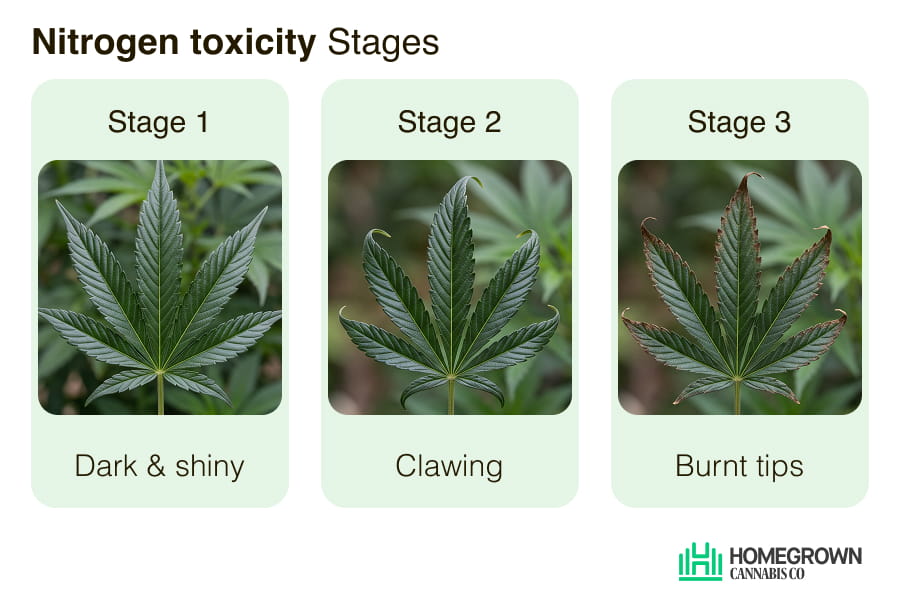
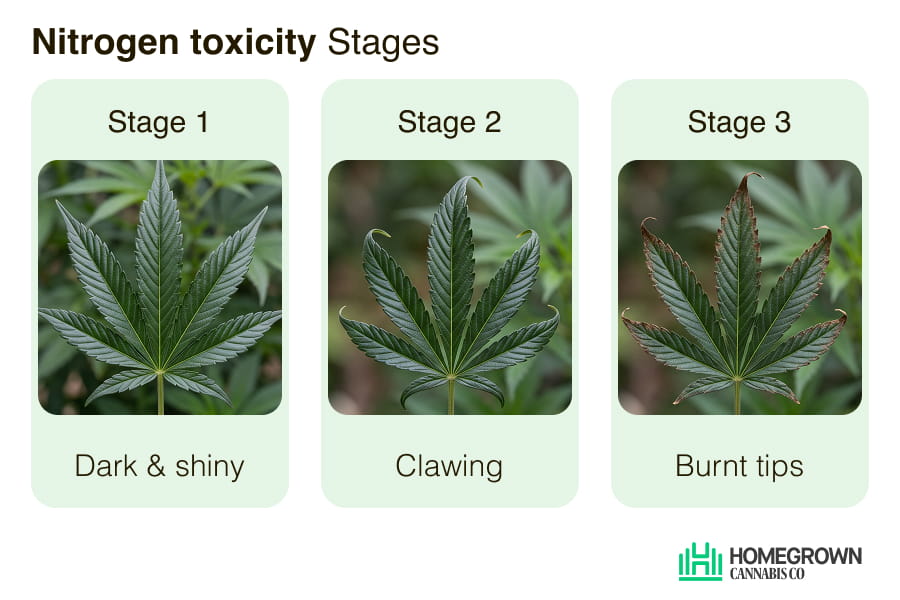
How nitrogen toxicity progresses if left unchecked - dark and shiny, then clawing, then burnt tips
Dark Green Cannabis Leaves and Shiny Foliage
Dark green cannabis leaves appear first because surplus nitrogen drives excess chlorophyll production. The foliage looks deeper than a healthy medium green and often takes on a waxy, shiny surface. On its own this signal is only moderately reliable, since vigorous plants in early veg can also look dark.
Treat dark green as a prompt to check the tips and the feeding history, not as proof by itself. If the color is dark and you have been feeding heavily, the reading strengthens. Dark color plus clawing confirms nitrogen toxicity far more reliably than color alone.
The Nitrogen Claw — Clawed and Curling Leaf Tips
The nitrogen claw develops when a leaf holds more nitrogen than it can process, and the tissue overgrows and cramps into a talon shape. The whole leaf can curl under, and the tips point at the soil rather than reaching outward. This clawing is a high-reliability signal, because few other problems bend healthy dark leaves this way.
The claw is your cue to stop adding nitrogen and start correcting, which the fix section below walks through step by step.
Nitrogen Burn and Brown Leaf Tips
Nitrogen burn is the late-stage signal, scorching leaf tips brown after concentrated salts have built up at the margins over time. The damage starts at the very tip and works inward, leaving dry, crispy edges that crumble when touched.
A plant this far along needs correcting quickly, since every day of continued feeding pushes the damage further up the leaf.
Burnt tissue does not recover, but the plant does once you correct the root zone. Focus on saving new growth rather than the damaged leaves, since those stay scorched even after the cause is fixed.
What Causes Nitrogen Toxicity in Cannabis Plants?
Nitrogen toxicity almost always traces back to a feeding decision rather than the plant itself. Two mistakes cause most cases: giving too much at once, and giving the wrong formula for where the plant is in its life cycle.
Overfeeding and Nutrient-Rich Soil
Overfeeding raises root-zone nitrogen faster than the plant consumes it, especially when growers follow bottle doses at full strength.
Pre-charged or "hot" soils compound the problem, because they already carry heavy nitrogen before you add anything. A plant in rich soil often needs little or no extra feeding for its first few weeks.
Wrong Nutrients for the Growth Stage
Vegetative-formula nutrients carry high nitrogen, and using them into flowering pushes more nitrogen in exactly when the plant needs less. Cannabis shifts its demand as it matures, so a feed that suited week three of veg overloads a plant weeks into bloom. Matching the formula to the stage prevents most stage-driven toxicity.
Nitrogen Toxicity vs Deficiency vs Overwatering
Nitrogen toxicity, nitrogen deficiency and overwatering produce different leaf patterns that you can separate by color, position and leaf feel. Confusing them is costly, because the fix for one worsens another. The table below rates each trait by how much diagnostic weight it carries.
|
Trait |
Nitrogen Toxicity |
Nitrogen Deficiency |
Overwatering |
Reliability |
|
Leaf color |
Very dark green, glossy |
Pale, yellowing |
Normal to dark, dull |
Medium |
|
Yellowing pattern |
Absent early; tips burn late |
Bottom leaves first, moves up |
Even, whole-plant |
High |
|
Leaf tips |
Claw down, then brown |
Yellow then brown, no claw |
Soft, no claw |
High |
|
Leaf posture |
Stiff, clawed |
Limp, thinning |
Puffy, drooping from base |
Medium |
|
Recent history |
Follows heavy feeding |
Follows underfeeding or a lean medium |
Follows frequent watering |
Medium |
.
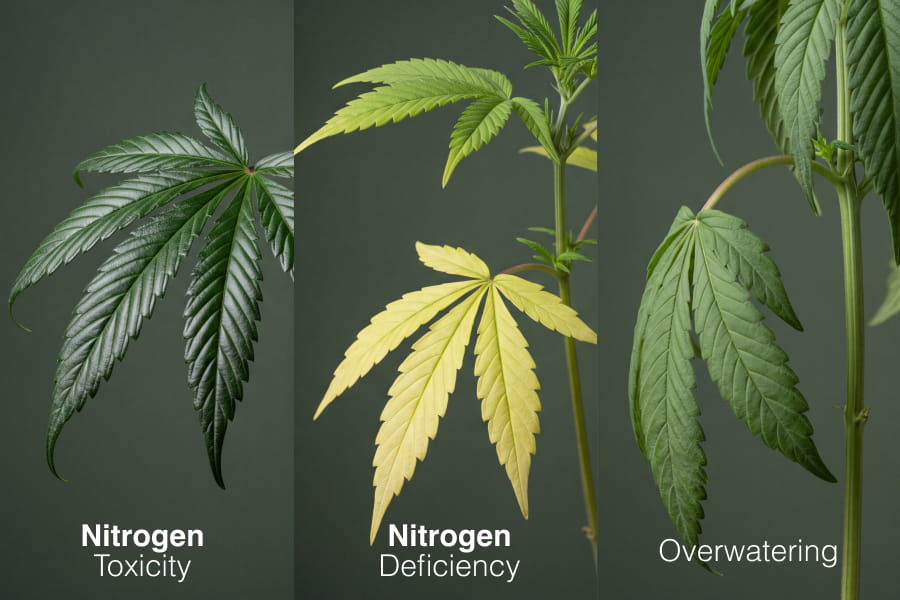
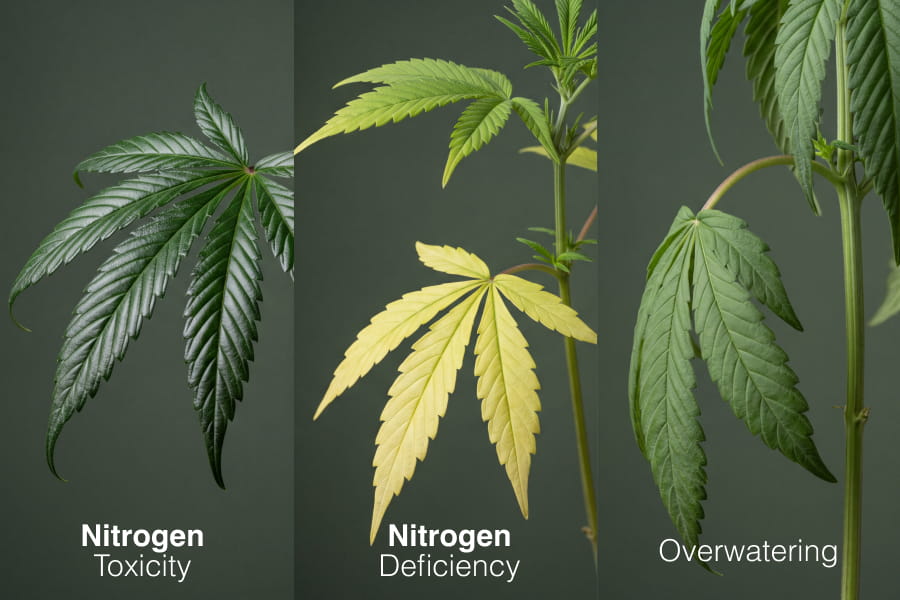
Three problems, three different leaves how to tell nitrogen toxicity from deficiency and overwatering
The reliability column tells you which trait settles the call. Yellowing pattern and tip shape are high-reliability, so lead your diagnosis with those.
Toxicity has no reliable top-or-bottom pattern, so identify it by the dark color and clawing rather than by where it appears. Deficiency is different: its yellowing dependably climbs from the bottom up, and it means the plant needs feeding rather than flushing.
Overwatering is not clawing either; it shows as a puffy, whole-plant droop that follows watering too often, and it calls for a drier schedule before any nutrient change.
How Do You Fix Nitrogen Toxicity in Cannabis?
You fix nitrogen toxicity by stopping high-nitrogen feeding and running enough pH-balanced plain water through the medium to leach the surplus out (aim for about 30 percent draining off). The goal is to lower root-zone nitrogen so new growth comes in normal, then feed back in gently. Work through the steps in order.
Flush the Medium and Pause Feeding
Before you flush, confirm the excess with a runoff EC (electrical conductivity) or TDS (total dissolved solids) reading. A number sitting well above what you fed tells you salts have stacked up and a flush is the right call.
Then run plenty of pH-balanced plain water through the medium until roughly 30 percent drains out the bottom, carrying the excess nitrogen with it, and hold all nutrients while the plant resets.
In synthetic-fed soil, one thorough flush usually does the job; in coco or hydro, you reset the reservoir to plain pH-balanced water instead.
Living or fully organic soil is the exception. Its microbes hold pH steady on their own, so you skip the pH'd flush there and pull the excess back through diluted plain water and lighter feeding instead.
Resume Feeding at Reduced Strength
Resume nutrients at roughly half your normal dose once new growth stops darkening. Watch the fresh leaves rather than the damaged ones, because only new growth reports the current nitrogen level. Step the strength back up slowly if the lighter growth holds a healthy green.
Nitrogen Toxicity Recovery Time
Nitrogen toxicity recovery takes several days to about two weeks, because damaged leaves do not heal and new growth shows whether levels dropped.
Existing clawed or burnt leaves stay that way, so judge progress by the leaves that emerge after the flush. Recovery time varies with medium, plant size and how far the excess advanced.
How to Fix Nitrogen Toxicity During Flowering
Nitrogen toxicity during flowering slows bud development, because the excess keeps the plant pushing leafy growth when it should be building flowers. Dense, nitrogen-fed foliage can also crowd bud sites and hold humidity around them.
Flowering cannabis needs less nitrogen and more phosphorus and potassium, so switch to a bloom nutrient and flush if clawing or dark color appears in early flower.
Fan leaves turning light green during flowering can read as a problem but is often normal. Late in bloom, a plant pulls nitrogen out of its fan leaves to finish the flowers, so a gradual fade from the bottom up is expected maturation rather than toxicity.
Dark green, clawing leaves in flower signal excess nitrogen; a soft, even fade late in bloom signals a plant finishing on schedule.
How Do You Prevent Nitrogen Toxicity?
You prevent nitrogen toxicity by matching feed strength to the growth stage and starting new plants at quarter-strength nutrients. Cannabis needs less than most nutrient labels suggest, so building up slowly beats correcting an overload later. Check runoff or reservoir readings when possible, and let the plant's newest growth guide each adjustment.
Stage awareness carries most of the prevention. Keep nitrogen higher through vegetative growth, then taper it as flowering begins and lean on phosphorus and potassium. A grower who feeds to the stage rather than the label rarely meets nitrogen toxicity at all.
Feeding mistakes rarely travel alone, and the same care that prevents nitrogen excess also guards against its opposite. Reading early nitrogen deficiency keeps you from over-correcting a toxic plant into a hungry one, and matching feed strength to the stage heads off nutrient burn from over-strong feed.
The same reading skills carry over to potassium deficiency and phosphorus deficiency, which show their own distinct leaf patterns.
Choosing Seeds and Setups That Resist Feeding Mistakes
Genetics set how much room you have to learn all this. Hardier, beginner-friendly strains tolerate a wider nutrient range before they show stress, which gives a new grower more margin while the feeding instincts develop.
That forgiveness turns nutrient management from a hazard into a routine, where growing is legal for you.
Feminized marijuana seeds are the easiest place to start. Every seed grows into a bud-producing plant, so there are no males to remove, and a hardy strain gives you room to catch a feeding slip and fix it before it costs you.
Autoflower weed seeds are built for speed. They flower on their own schedule with no light timing to manage and run from seed to harvest in weeks, and their lighter feeding needs pair neatly with everything you just learned about nitrogen.
You can browse the full range of cannabis seeds to match genetics to your setup and experience level.
Frequently Asked Questions
Is Nitrogen Toxicity or Deficiency Worse for Cannabis?
Neither is inherently worse, and both are correctable when caught early. Toxicity and deficiency call for opposite fixes, so the real risk is misreading one as the other. Toxicity needs a flush and lighter feeding, while deficiency needs more nitrogen, which makes correct diagnosis the priority.
Can a Plant Recover From Nitrogen Toxicity?
Yes, most plants recover once you flush the medium and cut back nitrogen. Damaged leaves stay clawed or burnt, but healthy new growth returns within several days to two weeks. Judge recovery by the newest leaves rather than the older, damaged ones.
What Is the Difference Between Nitrogen Burn and Nutrient Burn?
Nitrogen burn is tip-scorching caused specifically by excess nitrogen, while nutrient burn is the same scorching caused by high total salts from any nutrient. Nitrogen is one of the most common triggers, so nitrogen burn is a subtype of nutrient burn. Both are fixed the same way: flush the root zone and reduce feed strength.
Does Nitrogen Toxicity Happen to Seedlings?
Yes, seedlings are especially prone to it, because their small root systems need very little nitrogen. Rich soil or early full-strength feeding overwhelms them quickly. Start seedlings in mild medium and delay added nutrients until they show steady growth.
Do Autoflowers Get Nitrogen Toxicity More Easily?
Autoflowers show nitrogen excess more readily, because they are typically grown at lighter feed levels than photoperiod plants. Their compact size and short cycle mean their nitrogen demand stays low throughout. Feeding autoflowers at reduced strength from the start prevents most cases.