



How to Fix Cannabis Potassium Deficiency: Symptoms & Fixes
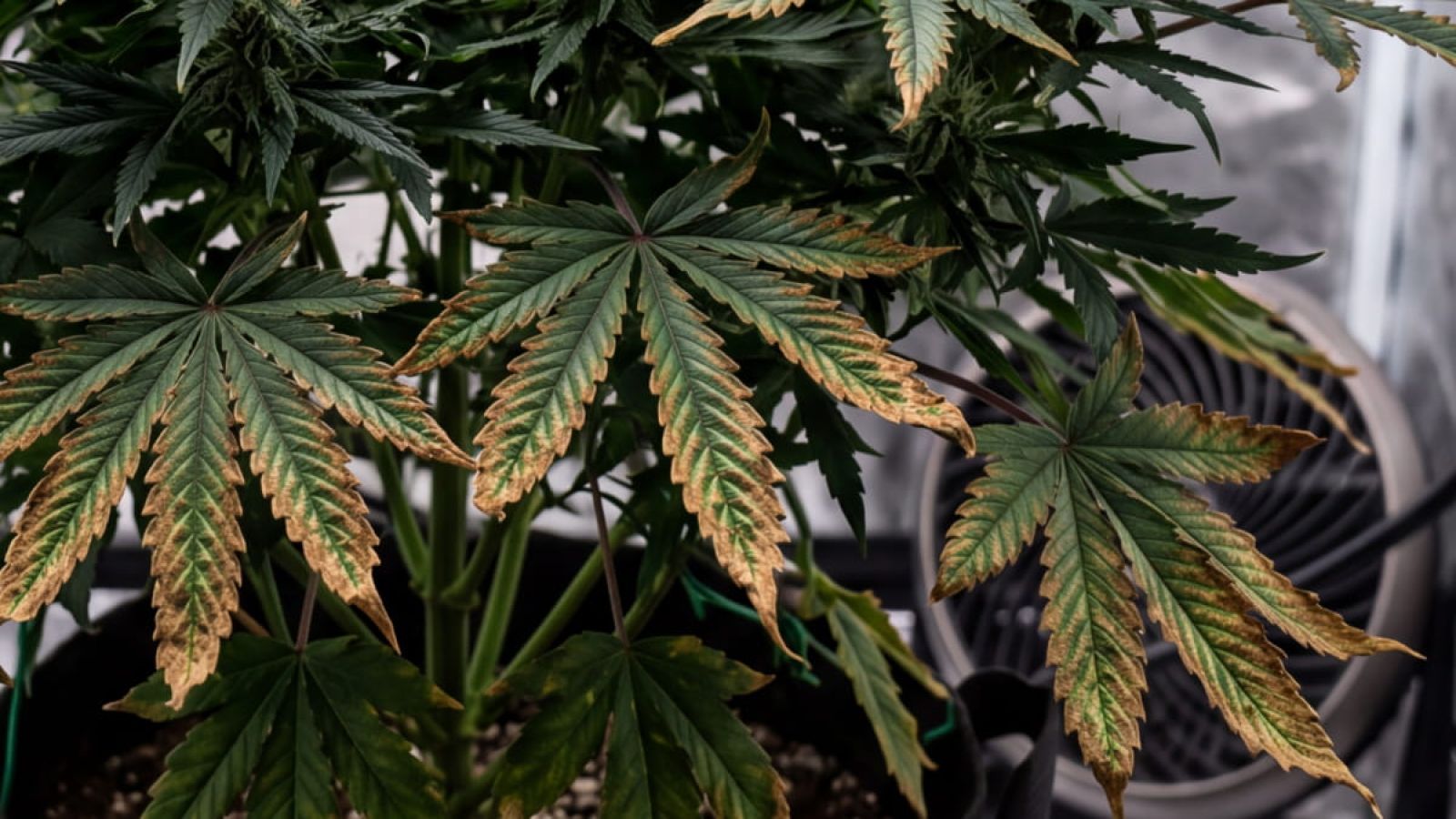
Your fan leaves are browning at the edges, the tips look burnt, and the buds seem to be stalling right when they should be filling out. That pattern usually points to a cannabis potassium deficiency, one of the most common nutrient problems growers hit in flower.
This guide shows you how to spot it from its look-alikes, what causes it, and how to fix it without over-feeding into a worse problem.
In short: potassium deficiency shows up as scorched, browning leaf margins on the older, lower leaves first. It hits hardest in flowering, when buds pull heavily on potassium. Check your root-zone pH first, feed second, and never chase it with a heavy dose, because too much triggers a lockout that looks like a brand-new problem.
What Is a Potassium Deficiency in Cannabis?
A cannabis potassium deficiency develops when the plant cannot draw enough potassium to move water and sugars through its tissue.
Potassium is a mobile nutrient, so the plant pulls it out of older, lower leaves to feed new growth up top. That is why the damage starts at the bottom of the plant and works upward, while the newest shoots still look healthy.
As a result, many growers miss the early stage and only notice once the edges turn crispy. Catching the pattern early saves the leaves that are still green.
What Does Potassium Do for Cannabis Plants?
Potassium runs several of the plant's core systems at once, from fluid balance to flower formation in cannabis.
It controls the stomata, the tiny pores that open and close to manage water and gas exchange. It also moves the sugars the plant makes during photosynthesis into the flowers, which is why weed plants lean on it so hard during bloom.
Without enough potassium, marijuana plants struggle to fill out dense, heavy buds.
The "K" in the N-P-K ratio printed on every nutrient bottle stands for potassium. That third number is the one that matters most once flowering begins.
Why Potassium Deficiency Gets Worse During Flowering
Flowering is the stage where cannabis plants demand the most potassium, since it's when buds pull heavily on the nutrient to swell and ripen. A feed that kept your plants healthy through veg can suddenly fall short once the flowers start stacking.
This is the stage where a mild, unnoticed shortage tips into visible edge burn. Bloom nutrients carry more potassium for exactly this reason. If browning edges appear in week three or four of flower, potassium demand is the first thing to suspect.
The vegetative stage isn't immune, though - a shortage can slow overall growth, so don't rule potassium out just because you're not in flower yet.
Potassium Deficiency Symptoms in Cannabis
Potassium deficiency shows up as brown, crispy edges and burnt tips on the older, lower leaves, often paired with mottled red and yellow patches between the veins and, sometimes, red or purple stems.
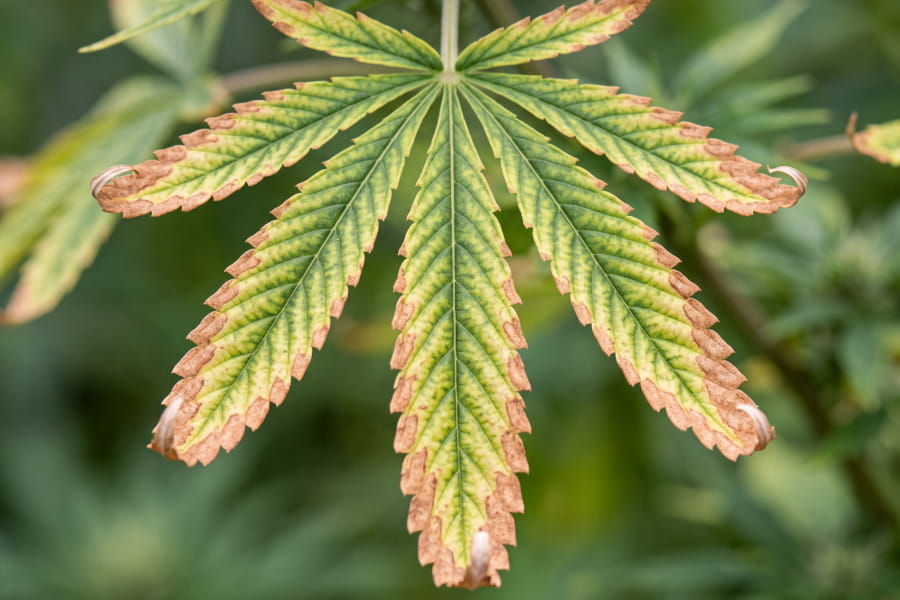
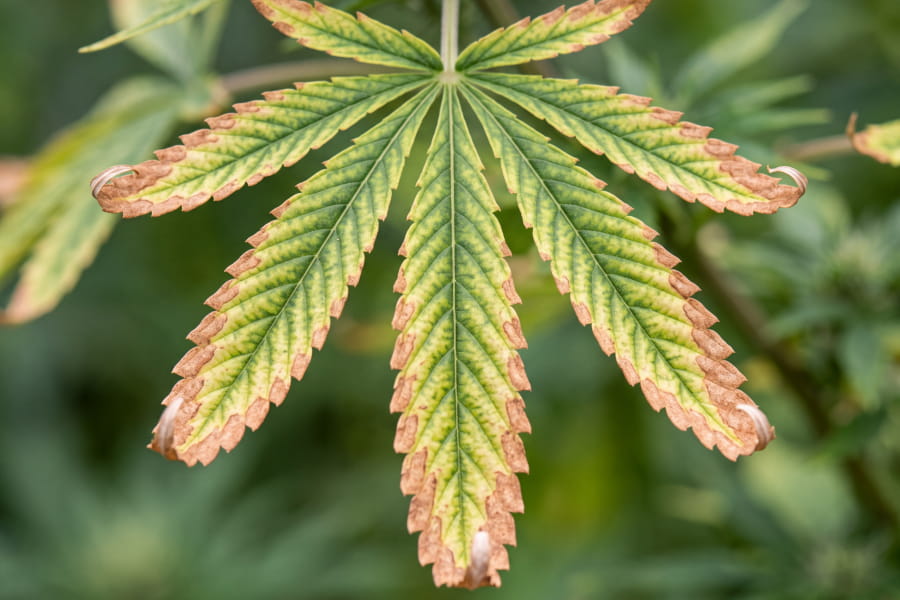
The tell-tale combo: brown, crispy edges creeping inward plus yellowing between veins that themselves stay green.
The damage starts at the leaf margins and works inward, while the center and veins stay greener for longer. Getting that progression right is what separates a real potassium problem from the look-alikes that send growers chasing the wrong fix.
Here is what each symptom tells you:
- Brown leaf edges and burnt tips — the strongest single signal of a potassium shortage.
- Red and yellow mottling between green veins — strengthens the case when it shows up alongside burnt tips and browning edges.
- Red or purple stems and petioles — carries little weight alone, but adds confidence when paired with the two potassium deficiency symptoms above.
Brown Leaf Edges and Burnt Tips
Brown, crispy leaf edges signal the classic potassium-deficiency pattern on older cannabis leaves. The burn starts at the very rim of the leaf and creeps inward, often with a rusty or bronze tint before it goes fully brown. The tips curl and dry out, and the affected leaves feel brittle.
This is the strongest single signal, but location does the real work: it's the older, lower foliage where potassium deficiency shows up first. The same crispy burn scattered randomly across the plant or sitting on the newest growth points somewhere else entirely.
Red and Yellow Mottling Between the Veins
Mottled red and yellow patches appear between the veins as potassium moves out of older cannabis leaves, usually alongside the edge burn. The veins themselves stay green while the surrounding tissue picks up the color - a blotchier, more varied look than the clean, uniform yellowing you get with other shortages.
On its own this sign carries medium weight, since other shortages can cause yellowing between the veins too. It becomes convincing once it lines up with the burnt leaf tips and margins.
Treat the red-yellowish mottling as a supporting clue, not a standalone diagnosis. Pair it with the edge burn before you commit to a potassium fix.
Red or Purple Stems and Petioles
Red or purple stems and petioles can appear with a genuine potassium shortage. But the same coloring shows up with phosphorus deficiency and plain genetics (where perfectly healthy plants have purple coloring, usually enhanced by cold nighttime temperatures).
On its own, stem color is one of the weakest signals in the diagnosis kit. It only adds real weight once you've already got the edge burn and the mottling. Read the leaves before you read the stems.
What Causes Potassium Deficiency in Cannabis?
Underfeeding or insufficient fertilization is the most common cause of potassium deficiency in cannabis, even in otherwise rich soil. pH lockout and competing nutrients (usually from overfeeding and salt buildup) account for a real share of cases too. That’s why identifying the actual culprit is what makes the fix work the first time.
- Underfeeding — not enough potassium reaching the roots in the first place.
- pH lockout — potassium present but chemically unavailable.
- Overfeeding — competing nutrients and salts that crowd out potassium at the roots.
Underfeeding (Insufficient Fertilization)
Even with a full feeding program, plants often run short simply because they're not getting enough potassium. In organic soil, this usually comes down to the inputs themselves: fertilizers like guano, fish emulsion, alfalfa, cottonseed meal, and animal manures carry only minor amounts of potassium compared to nitrogen and phosphorus.
A program built around those can quietly starve a plant of potassium while everything else looks fine.
Synthetic and store-bought fertilizers are formulated to a stated N-P-K ratio and don't usually run naturally light on potassium the way organic inputs can. Underfeeding still happens there, but it's a dosing issue rather than a formulation one, feeding below label rate, sticking with a vegetative formula that's light on K well into flower, or not scaling the feed up as potassium demand climbs through bloom.
This is the single most common cause of potassium deficiency in organic programs, and it's more common here than it is for most other nutrients. Check your inputs (organic) or your dosing and formula stage (synthetic) before assuming the problem is pH or salt buildup.
pH Lockout and Potassium Uptake
Wrong root-zone pH locks out potassium even when the nutrient is present in the soil or solution. Cannabis roots absorb potassium only within a specific pH band, and drifting outside it makes the nutrient chemically unavailable.
This is why so many "deficiencies" clear up the moment pH gets corrected, without adding a single extra nutrient. Checking pH is always the first move.
Potassium lockout from pH is far more common than genuine potassium starvation. pH also drifts on its own as the medium ages and salts accumulate, so it is worth rechecking every few waterings rather than only when problems appear.
Overfeeding, Salt Buildup and Competing Nutrients
Too much sodium, calcium or ammonium-based nitrogen crowds out potassium at the cannabis plant's roots. Heavy feeding leaves mineral salts building up in the medium, and those salts compete with potassium for uptake. Hard tap water high in calcium and sodium makes this worse over time.
Overwatering compounds it, because soggy roots absorb nutrients poorly no matter how well you feed.
The irony is that overfeeding can create the look of a deficiency. A heavy hand with nitrogen brings its own trouble, from dark, clawing leaves to the nitrogen toxicity that shows up when growers push feed too hard. More nutrients is not the answer when salts are already the problem.
How to Fix Potassium Deficiency in Cannabis
You fix a cannabis potassium deficiency by working in order: check what's going on, clear any salt buildup, get root-zone pH back in range, then feed only if a real shortage is left.
Acting in that order stops you from over-feeding a plant that simply could not access the potassium it already had. Rushing straight to a potassium dose is the mistake that turns one problem into two.
Follow the sequence:
- Step 1 - check EC/TDS and pH to see what you're dealing with.
- Step 2 - if salts have built up, flush them out with plain pH'd water.
- Step 3 - correct root-zone pH into range.
- Step 4 - feed potassium only if a true shortage remains, then watch the new growth for recovery.
Step 1 — Check EC/TDS and pH to Diagnose
Before you change anything, find out what you're actually dealing with. Test the runoff or feed solution for EC (electrical conductivity) or TDS (total dissolved solids) and pH.
A normal EC/TDS means there's no salt buildup to flush, so you go straight to correcting pH. An EC/TDS well above what you're feeding means salts have accumulated, and clearing those comes first, before any pH adjustment will hold.
Step 2 — Flush Salt Buildup if Present
Flushing is a separate job from pH correction, and it only applies when salts have actually built up, which you confirm with an EC/TDS reading well above what you're feeding, not by assumption.
When they have, run plain pH'd water (no nutrients mixed in) through the medium until roughly 30% drains out the bottom. That clears the accumulated salts and resets the root zone. The runoff reading is a warning light telling you buildup was there, not a number to keep chasing.
This step matters most when you have been feeding heavily or using hard tap water. After the flush, hold off on strong nutrients for a day or two.
Step 3 — Correct Root-Zone pH
How you correct pH depends on your medium. In living or fully organic soil, root-zone microbes hold pH where the plant wants it, so you don't pH your water. A genuinely off soil is corrected slowly with amendments (lime to raise, sulfur to lower).
In coco, in hydro, or in soil fed with synthetic salts, you do it yourself: mix your nutrients into the water first, then pH that solution before it goes in. In soil, keep it between 6.0 and 6.3 (anywhere from 5.5 to 6.5 is workable). In coco or hydro, hold it tighter, 5.8 to 6.2, with 5.6 to 6.4 as the outer edge.
For potassium specifically, drifting low is the bigger risk. General agronomy shows potassium availability is actually highest above pH 6.0 and drops at low pH — the opposite pattern from phosphorus and the micronutrients, which lock out at the high end. Still, staying inside the target band keeps every nutrient available at once, so it's the safer habit either way.
Step 4 — Feed Potassium and Watch for Recovery
Only feed once pH is back in range and any salt buildup is cleared. In flower, a bloom-stage nutrient with a higher potassium share does the job. In veg, reach for a straight potassium source instead, like liquefied kelp, potassium sulfate, potassium bicarbonate, or wood ash (so you don’t load up your vegging weed plant with nutrients it doesn’t need yet).
Either way, clean new growth usually follows within about four to five days.
The damaged old leaves won't turn green again, so judge success by the fresh growth up top, not the burnt lower ones. Do not strip and toss every damaged leaf at once. The plant still pulls some energy from them while it recovers.
Nutrient Burn vs Potassium Deficiency: How to Tell Them Apart
Nutrient burn starts at the very tips, while potassium deficiency starts along the whole leaf edge of older leaves. The two get confused constantly because both leave brown, crispy damage, but the location and the plant's history tell them apart.

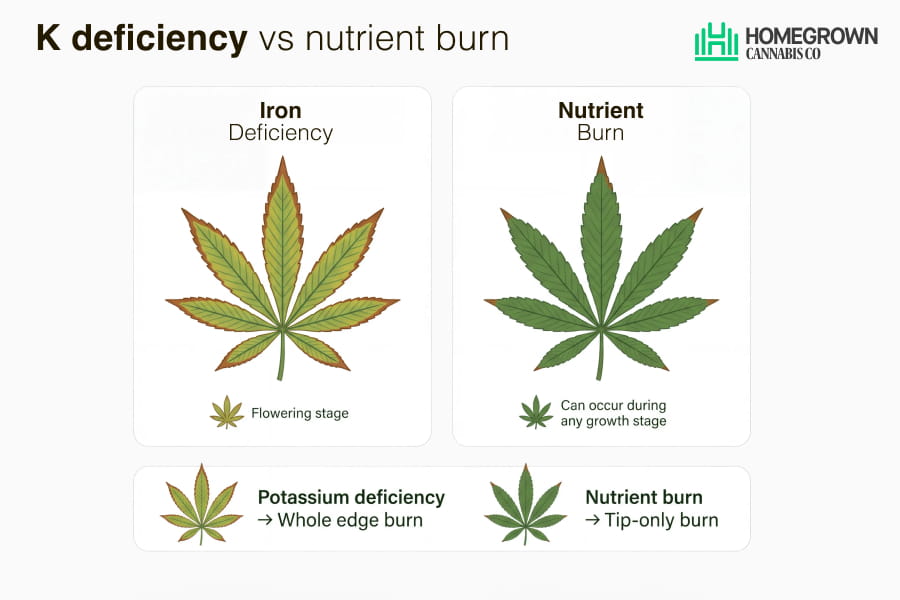
Edge burn on older leaves points to potassium; tip-only burn on newer, well-fed leaves points to nutrient burn.
This table maps each visible symptom to what it most likely means and how much to trust it on its own.
|
Symptom/trait |
Potassium deficiency |
Nutrient burn |
Look-alike (phosphorus/light/cold) |
Reliability |
|
Browning location |
Whole leaf edge and tips, older lower leaves |
Tips only, often the newest well-fed leaves |
Varies by cause |
High |
|
Leaf center and veins |
Stays green, edges die inward |
Green until the burn spreads |
Dark or purple tint suggests phosphorus |
High |
|
Yellowing pattern |
Interveinal plus edge, older leaves |
Little yellowing, mostly crisping |
Overall pale suggests nitrogen |
Medium |
|
Purple or red stems |
Occasional, not diagnostic |
Absent |
Common with cold, genetics or phosphorus |
Low |
|
White or bleached leaves |
Rare |
Absent |
Light burn on tops or a Cal-Mag shortage |
Low |
|
Worst stage |
Flowering |
Any stage, from over-feeding |
Varies |
Medium |
When the edge-burn-on-old-leaves pattern lines up with flowering timing, potassium is the strong call. When the signal is tip-only burn on well-fed new growth, the cause is nutrient burn instead, and the fix is to ease off feeding rather than add more.
Can You Give Cannabis Too Much Potassium?
Yes, too much potassium triggers a nutrient lockout that mimics other deficiencies in cannabis. This is the trap growers fall into right after reading about deficiency: they over-correct, dump in potassium, and create a second problem on top of the first.
Excess potassium does not show up as a tidy "too much potassium" sign. It shows up as a shortage of something else. The safe move is a light hand. Correct the cause, feed moderately, and let the new growth tell you whether you got it right.
Potassium Toxicity and Nutrient Lockout Signs
Excess potassium blocks calcium and magnesium uptake, so toxicity often looks like a different deficiency. You might see the yellowing, spotting or new-growth problems of a Cal-Mag shortage, when the real cause is too much potassium crowding those nutrients out at the root.
This is why blindly adding potassium is risky, because the symptoms it creates point you away from the actual problem. If you fed heavily and new issues appeared, suspect lockout before you suspect a fresh deficiency.
The fix for potassium toxicity is the same first move as the deficiency: correct pH and flush. Balance, not more nutrients, is what clears it.
How Cannabis Potassium Deficiency Fits the Bigger Nutrient Picture
Cannabis potassium deficiency hits some plants harder than others, and genetics decide how much stress a plant shrugs off before it shows damage.
A healthy grow starts long before the first leaf problem, and the strong genetics behind quality marijuana seeds for sale give a plant the vigor to recover fast once you correct the cause. Weaker stock buckles under the same pH swing or salt buildup that a resilient plant barely registers.
Growers who want a shorter, more contained bloom often start with auto cannabis seeds, which flower on their own schedule and spend fewer weeks in the window where potassium problems bite hardest. Growers who want every plant to reach flower, and to be worth the potassium they feed it, usually reach for feminized weed seeds so no space goes to a plant that never buds.
Good genetics do not make a plant immune to a nutrient problem, but they give it the headroom to bounce back once you fix the cause.
Cannabis Potassium Deficiency FAQ
Does Potassium Deficiency Affect All Plants The Same Way?
Potassium deficiency follows the same basic pattern across most plants: older, lower leaves brown at the edges first because potassium is mobile and gets pulled toward new growth. The exact look varies by species, but the edge-and-tip browning on old foliage is a reliable tell in cannabis, vegetables and most garden plants.
The fix logic is also shared, since pH and salt buildup block potassium uptake regardless of the plant.
How Long Does It Take Cannabis To Recover From Potassium Deficiency?
Cannabis typically shows recovery in new growth within about a week once the cause is corrected, often in as little as four to five days with a fast-acting feed.
The already-damaged leaves will not heal or turn green again, so the reliable sign of recovery is clean, healthy foliage coming in at the top. If new growth is still browning after two weeks, the underlying cause, usually pH, has not been fully resolved.
Can Potassium Deficiency Reduce Cannabis Yield Or Bud Size?
Yes, a potassium shortage during flowering can limit bud development because potassium moves the sugars that fill and swell flowers. Left uncorrected through bloom, it leads to lighter, airier buds and a smaller harvest. Catching and fixing it early in flowering protects the yield the plant is otherwise capable of producing.
What Is The Difference Between Potassium Deficiency And Potassium Lockout?
A potassium deficiency means the plant lacks potassium, while potassium lockout means the potassium is present but the plant cannot absorb it. Lockout usually comes from wrong pH or salt buildup, and it is the more common of the two in home grows. The distinction matters because lockout is fixed by correcting pH or flushing, not by adding more potassium.