



Cannabis Sulfur Deficiency: Spotting Pale New Leaves & Correcting the Feed
Pale, yellowing leaves at the top of your plant are easy to spot but easy to misdiagnose. Cannabis sulfur deficiency mimics nitrogen shortage closely enough that many growers treat the wrong one and watch the plant stall anyway. The fix is straightforward once you confirm the diagnosis and correct it in the way that matches your growing medium.
This guide walks through spotting sulfur deficiency, understanding what causes it, and fixing it in soil, coco or hydro without over-flushing or over-feeding.
Quick answer: Cannabis sulfur deficiency strikes the newest growth at the crown first. Check whether your medium actually holds enough sulfur, since it stays available across a wide pH range and a true shortage is often the real cause. Confirm the source, then feed sulfur (soil 6.0 to 6.3, coco and hydro 5.8 to 6.2 if you do need to check pH).
What Does Sulfur Deficiency Look Like in Cannabis?
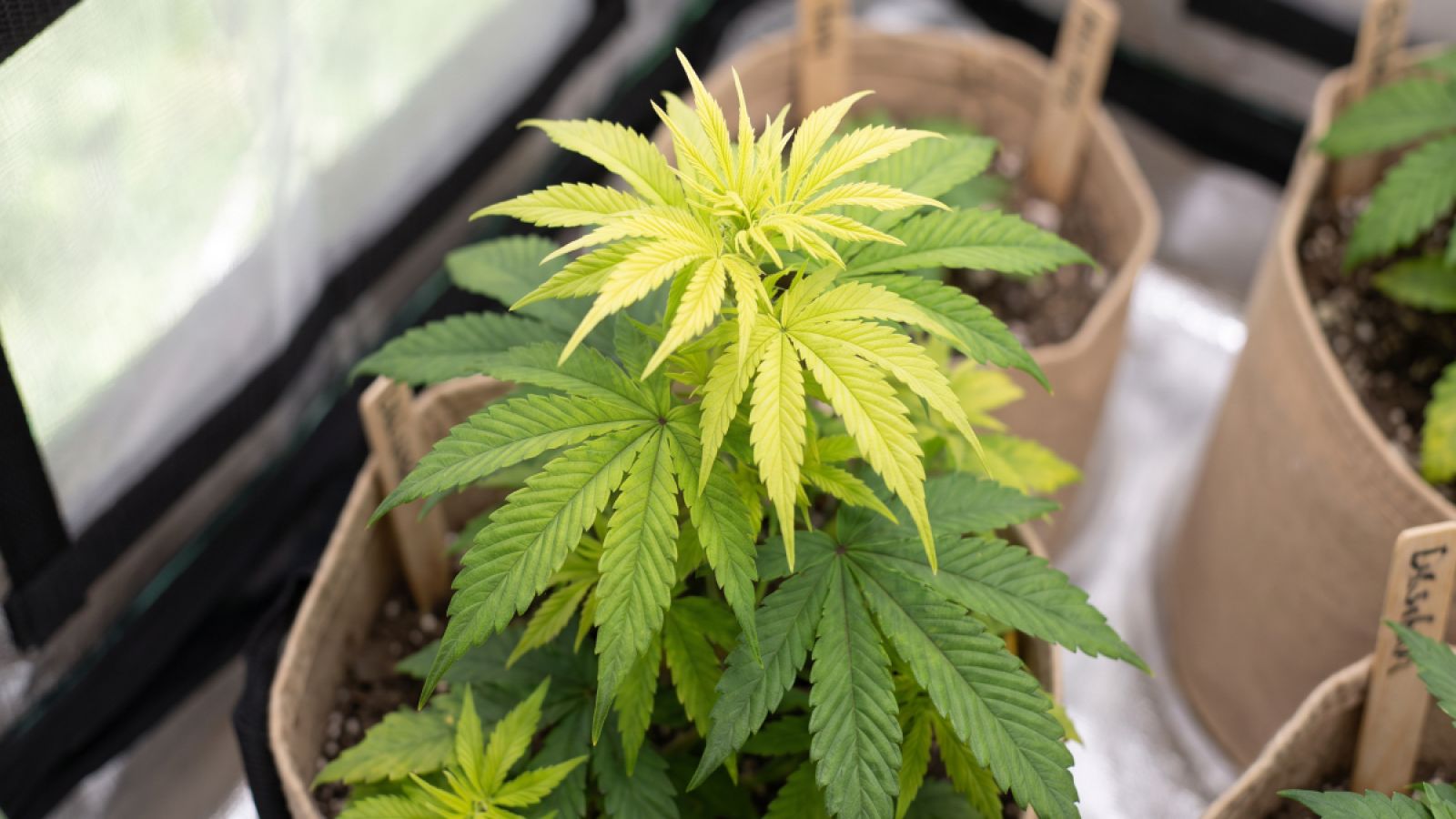
The clearest sign of cannabis sulfur deficiency is pale, fading color on the newest top leaves, while nitrogen deficiency does the opposite and yellows the old lower leaves first. This single distinction — top versus bottom, new versus old - is the fastest way to tell the two apart.
Sulfur moves poorly inside the plant, so a shortage strikes the newest leaves the plant is trying to build, while the older foliage stays comparatively green.
The yellowing tends to be uniform across the young leaf rather than confined to the spaces between the veins. As the deficiency deepens, the pale new leaves can stiffen, and stems and petioles sometimes take on a reddish or purple tint.
Growth slows because sulfur sits at the heart of protein and chlorophyll production, and the plant simply cannot assemble new tissue at full speed without it.
Early Signs on New Growth
What sets the early stage apart is how evenly the color fades: the young leaves turn pale green or yellow all over, with the veins staying much the same shade rather than standing out.
Because the change starts small and at the crown of the plant, it is easy to miss until several new leaf sets come in pale. Watching the freshest growth - not the old fan leaves - is the reliable early-warning habit.
Common early signals include:
- Pale green to yellow color on the youngest top leaves
- Uniform fading across the leaf rather than a vein-only pattern
- Slowed or stunted new growth at the crown
- Occasional reddish or purple tint on stems and leaf stalks
- Pink, orange or red coloring on the undersides of the affected leaves
How Sulfur Deficiency Differs From Nitrogen Deficiency
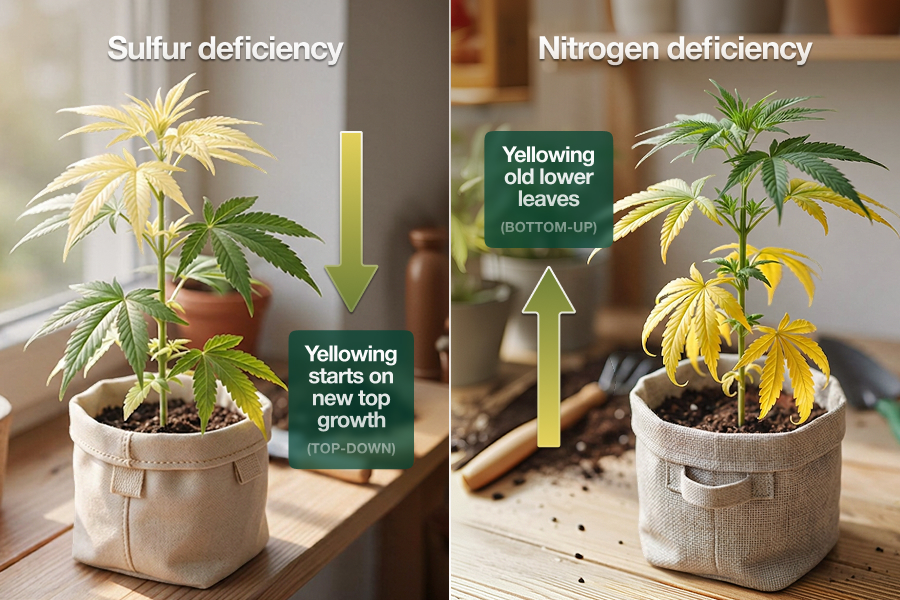
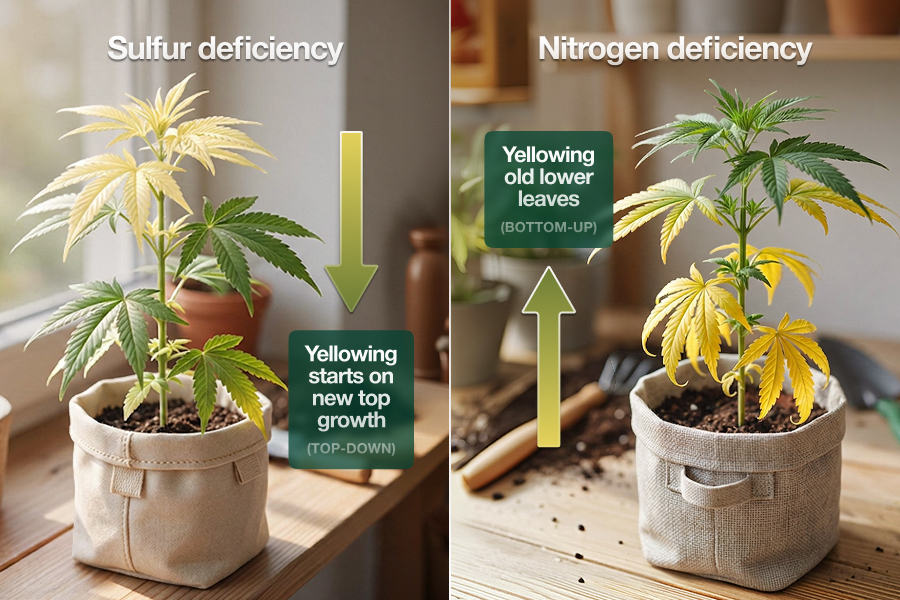
Sulfur vs. nitrogen: sulfur yellows the new top growth, nitrogen yellows the old lower leaves.
Sulfur deficiency and nitrogen deficiency both yellow the leaves, but sulfur starts on the new top growth while nitrogen deficiency starts on the old lower leaves. That difference comes down to mobility: nitrogen moves freely through the plant, so a nitrogen-starved plant cannibalizes its old leaves to feed new growth, yellowing from the bottom up.
Sulfur stays put, so the shortage shows from the top down. When you see the crown fading while the base stays green, sulfur is the far likelier culprit.
What Causes Sulfur Deficiency in Cannabis Plants?
Sulfur deficiency in cannabis develops when the plant cannot take up enough sulfur to build the proteins, enzymes and chlorophyll it runs on. It's a building-block nutrient, drawn on through veg and flower to form the compounds behind healthy growth and, later, aroma and resin.
Most cases trace back to a few things: a naturally low-sulfur growing medium, cold or waterlogged roots that slow uptake, low-sulfur or heavily filtered source water, or salt buildup that restricts what the roots can absorb.
Root-zone pH is worth a look too, but sulfur doesn't lock out at high pH the way other nutrients do, so it's a smaller factor than its usual billing suggests. Take pale new growth at face value and check what your medium is actually supplying before you assume lockout is the answer.
How Do You Fix Sulfur Deficiency in Cannabis?
Fixing cannabis sulfur deficiency starts with confirming the cause, most often a low-sulfur medium rather than a lockout, then correcting it in the way that matches your growing medium.
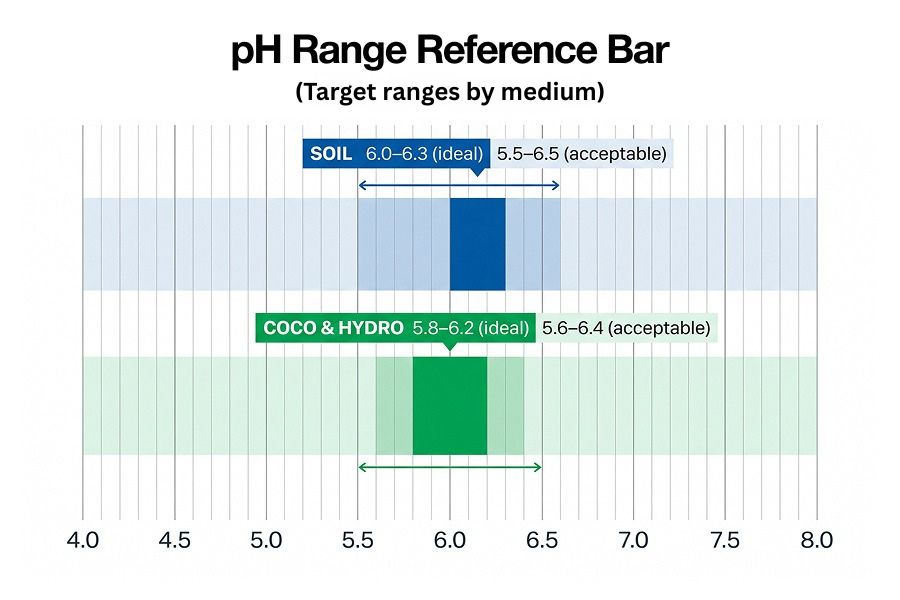
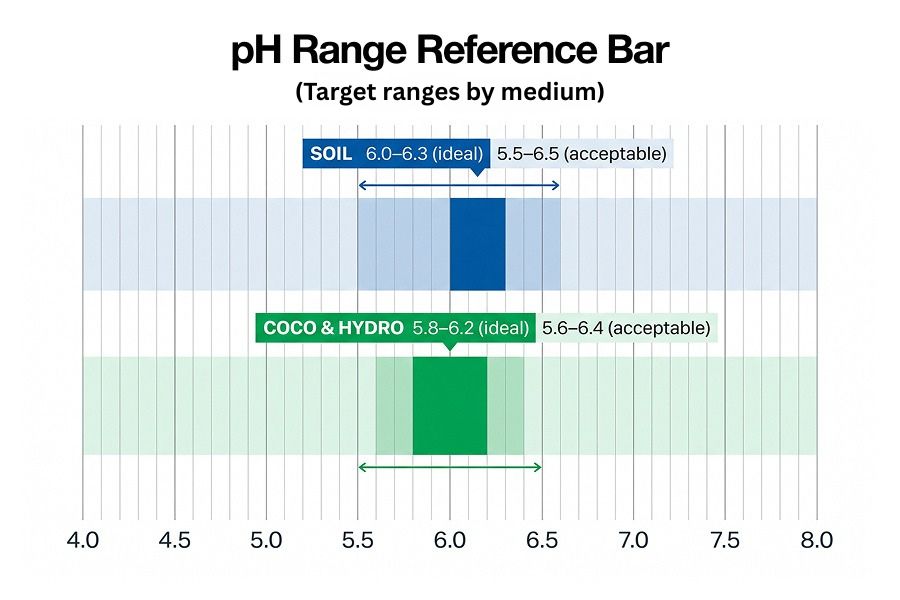
Keep root-zone pH in range to prevent sulfur lockout - 6.0–6.3 in soil, 5.8–6.2 in coco and hydro.
There is no single universal step, because what you do in living soil is almost the opposite of what you do in hydro. The three paths below cover the correction that fits your setup:
- Soil: support the medium's own pH buffering, or pH the input only if you feed synthetic salts
- Coco and hydro: pH the finished nutrient solution before it reaches the roots
- Supplementing: add sulfur only after confirming a real shortage remains
Fixing It in Soil (Organic / Living vs. Synthetic-Fed)
In organic or living soil, sulfur uptake recovers by supporting the soil's own pH buffering rather than by adjusting your water, because the root-zone microbes regulate pH to what the plant needs.
In a genuine living-soil program, you generally don't pH your water at all, and you don't reach for pH Up or pH Down - those tools work against the microbial buffer. When soil pH is genuinely out of range, you correct it slowly with amendments: calcium carbonate or garden lime to raise pH, and elemental sulfur plus acidic materials to lower it. These act over weeks, not hours.
One detail trips up many growers: the pH you feed has only a small, temporary effect on the substrate. What actually moves soil pH over time is water alkalinity, the carbonates and bicarbonates in your water, so chasing a perfect input pH in living soil is mostly wasted effort.
Synthetic salt-based feeds are the exception. They inhibit the soil's microbial buffering, so if you feed synthetic nutrients in soil, you do need to pH the input the way a coco or hydro grower would. The target range for soil is 6.0–6.3 for ideal uptake, with 5.5–6.5 being acceptable.
Fixing It in Coco and Hydro
In coco and true hydro, sulfur uptake recovers by mixing your nutrients into the water first, then adjusting the finished solution to the correct pH range before it reaches the roots.
The nutrients themselves shift the pH, so the number that matters is the one on the final solution - never the plain water. The target range for both coco and hydro is 5.8–6.2 for ideal uptake, and 5.6–6.4 still works.
Coco behaves as an organic soilless medium: mix the nutrient solution, check and set its pH, and monitor frequently, usually about weekly. True hydro systems like DWC, NFT, rockwool and LECA run closer to the edge, so adjust the solution daily to keep it inside the target range.
In every case, pH the solution the roots actually drink, because that reading is the one governing whether sulfur stays available.
When (and When Not) to Add a Sulfur Supplement
Add a sulfur-containing supplement only after confirming a genuine shortage.
If root-zone conditions check out and the new growth still comes in pale, a sulfur-bearing input — such as a magnesium-sulfate or a cal-mag product that includes sulfur — resolves a true shortage.
Reaching for a supplement while a waterlogged or salt-loaded root zone goes unaddressed usually just adds salts to a medium that already can't absorb what it has.
Salt Buildup, Flushing, and pH: Keeping Them Separate
Salt buildup, flushing and pH correction are three separate problems with three separate fixes, and treating them as one step is a common cause of stalled recovery.
Growers often flush a plant hoping to reset its pH or cure a deficiency, but flushing does neither; it just clears accumulated salts, and nothing more.
Confirm salt buildup with a reading, not a hunch: it exists when your runoff or solution EC/TDS sits well above the input you fed, which tells you salts have concentrated in the medium. A flush is plain, pH'd water only - no nutrients mixed in - run through until roughly 30% of what you poured drains out.
If both salt buildup and pH drift are in play, work in order: flush to clear the salts, correct the pH, then feed only if a true shortage remains.
Treat runoff as a warning light, not a dial to chase. A runoff reading tells you whether pH has drifted, which is useful diagnostic information. But the fix is adjusting your ongoing feed, not flushing and re-testing runoff over and over until a number lands in range.
Flushing is never the way to correct pH, and it is never the way to cure a deficiency.
How to Prevent Sulfur Deficiency in Cannabis
Preventing sulfur deficiency in cannabis comes down to keeping root-zone pH in range for your medium and giving the plant a stable environment to grow in. Get those two right and most cases never start, since a stable root zone is what keeps the sulfur already in your feed reaching the plant.
The rest is consistency. Avoid cold, waterlogged roots, keep an eye on EC so salts don't creep up between feeds, and check your source water if it runs very low in minerals. A grow that stays stable in pH, temperature and feeding rarely surprises you with a pale crown.
Is It Sulfur Deficiency or Something Else? (Look-Alikes)
Sulfur deficiency is easy to confuse with other cannabis problems because several deficiencies yellow the leaves, so the location and pattern of the yellowing decide which one it actually is. Sulfur fades the whole young leaf from the top of the plant, and a few common look-alikes separate cleanly once you know where to look.
Magnesium deficiency shows the opposite of sulfur's uniform fade: it yellows the tissue between the veins while the veins stay green, and it usually starts on older leaves.
Iron deficiency is the closest match, because it also strikes new top growth, though iron genuinely does drop out of availability as pH climbs where sulfur doesn't. The tell is that iron deficiency often shows sharper green veins against a yellowing new leaf, while sulfur fades more uniformly. Nitrogen, as covered above, yellows from the bottom up.
Can Cannabis Get Too Much Sulfur?
Yes, though sulfur toxicity is rare and usually the result of over-supplementing after a misdiagnosis.
Excess sulfur tends to show as darker, smaller leaves and can appear alongside the leaf-tip or margin damage that signals a broader nutrient or salt imbalance.
This is exactly why confirming a genuine shortage before adding a sulfur product matters, since chasing a suspected deficiency with more input can tip a plant from one problem into another.
How Long Does Cannabis Take to Recover From Sulfur Deficiency?
Cannabis recovers from sulfur deficiency within about one to two weeks once uptake is restored, but the leaves already damaged by the shortage stay discolored rather than turning green again.
The recovery signal to watch is the new growth: when the freshest top leaves come in green and grow at a normal pace, the correction has worked. Fix the root-zone conditions, give the plant a week or two, and let the new growth tell you the story.
Growing Resilient Cannabis From the Start
Healthy genetics grown in a stable environment resist nutrient problems like sulfur deficiency better than stressed or unstable plants, which makes seed choice the first line of defense. A vigorous plant with strong roots holds its pH buffer and feeds evenly, so it shrugs off the small swings that push a weaker plant into lockout.
Starting with quality genetics - grown, of course, within the rules that apply where you live - sets that foundation.
For growers who want predictable, beginner-friendly results, feminized cannabis seeds take the guesswork out of plant sex and let you focus on stable care. If you're working a short season or a fast turnaround, autoflowering seeds shorten the cycle without demanding light-schedule changes.
You can browse the full range of weed seeds to match genetics to your space and goals.
FAQs About Cannabis Sulfur Deficiency
What Does Sulfur Deficiency Look Like in Weed Plants?
Sulfur deficiency in weed plants shows as pale green to yellow new growth at the top of the plant, fading uniformly across the young leaves. Because sulfur barely moves inside the plant, the newest leaves suffer first while the old lower foliage stays comparatively green - the reverse of nitrogen deficiency.
What's the Difference Between Sulfur and Nitrogen Deficiency in Cannabis?
The difference is location. Sulfur deficiency starts on the new top growth because sulfur can't move to where it's needed, while nitrogen deficiency starts on the old lower leaves because the plant pulls mobile nitrogen upward to feed new growth. Top-down yellowing points to sulfur; bottom-up yellowing points to nitrogen.
Can Sulfur Deficiency Be Fixed by Flushing?
No, flushing clears accumulated salts from the medium. It does not correct pH and does not cure a deficiency. If a plant has both salt buildup and pH drift, flush first, then correct pH, then feed only if a genuine shortage remains. Flushing alone won't turn a sulfur-starved plant around.
Do I Need to pH My Water in Organic Soil?
No, not in a true organic or living soil, where root-zone microbes regulate pH to what the plant needs and pH Up or Down works against them. The exception is synthetic salt-based feeding in soil, which inhibits that buffering; if you feed synthetic nutrients, you do need to pH the input like a coco or hydro grower.
What pH Should I Run for Healthy Nutrient Uptake?
Keep root-zone pH at 6.0–6.3 in soil (5.5–6.5 acceptable) and 5.8–6.2 in coco and hydro (5.6–6.4 acceptable). Holding these ranges keeps the whole feed available at the roots. Sulfur stays available across a wide pH band, so this is really about protecting phosphorus and the micronutrients, which do lock out as pH climbs.
Can Cannabis Get Too Much Sulfur?
Yes, but sulfur toxicity is uncommon and usually follows over-supplementing after a misdiagnosis. It can show as darker, smaller leaves and margin damage. Confirming a real shortage before adding any sulfur product is the way to avoid tipping the plant from one problem into another.
How Long Until My Plant Recovers From Sulfur Deficiency?
About one to two weeks once uptake is restored. The recovery signal is fresh green new growth at a normal pace - the already-damaged leaves stay discolored and won't re-green, which is normal. Fix the root-zone conditions and let the new growth confirm the correction.
Is Sulphur Deficiency the Same as Sulfur Deficiency?
Yes. "Sulphur" is simply the British spelling of "sulfur," so sulphur deficiency in weed and sulfur deficiency in cannabis describe the identical problem: too little available sulfur reaching the plant, showing as pale new top growth.