



A Guide to Flushing Cannabis: How, When & Whether Flushing Weed Works
Flushing cannabis plants is all about giving them plain, pH-adjusted water in place of nutrients for the last stretch of flower, so built-up salts wash out of the medium. It's a popular habit with plenty of loyal fans, though it remains strongly debated. The evidence so far hasn't shown that pre-harvest flushing actually makes buds taste better or smoke smoother.
If you do flush, plan on roughly 7–14 days in soil, 3–7 in coco, or 3–4 in hydro. Work backward from the day you expect to harvest. Water until about 30% runs off, give the surface time to dry between rounds, and stop once runoff lands near your source-water reading.
Below, you'll find out why growers flush, what the science says, whether you need to, timing, and the steps. You’ll also learn how to get smoother, tastier buds either way — whether you’re growing from feminized weed seeds or autoflowers.
Flushing Cannabis: What It Means
Flushing cannabis means switching your plants from nutrient solution to plain, pH’d water for the final stretch of flower so excess salts are “flushed” out of your soil or other medium. Whenever your feed carries more minerals than the roots take up, those extra salts stay behind, piling up faster when you feed heavily or water with little runoff.
Each plain watering dilutes what’s left and carries some of it out the bottom with the runoff. That’s why a cannabis flush shows up on your meter, with runoff EC dropping a little further after every pass.
Why Do Growers Flush Their Weed Plants?
Some growers flush their weed plants in late flower to supposedly improve smoothness, flavor, aroma, or ash color. Many growers also run one mid-grow to clear a salt problem, usually from overfeeding.
So, Does Flushing Weed Work?
No, flushing weed doesn’t work for improving taste, smoothness, potency, or ash, according to the available science. But a flush does work for clearing heavy salt build-up from nutrient burn, heavy feeding, or a runoff EC that’s crept too high.
To Flush or Not to Flush: What the Evidence Says
The research so far finds no quality benefit from a pre-harvest flush:
- Rx Green Technologies trial (2019): Marijuana plants grown in coco were flushed for 0, 7, 10, or 14 days. Lab tests found yield, THC, and terpene levels statistically similar across the groups.
- The same trial's blind tasting: A panel compared buds from each group without knowing which was which. They couldn't reliably tell the groups apart on taste, smoothness, or ash color.
- University of Guelph thesis (2017): Jonathan Stemeroff found that flushes of up to two weeks left the harvested flowers' mineral and cannabinoid content unchanged.
- 2024 multi-cultivar study: Saloner, Sade, and Bernstein compared flushed and unflushed weed plants across five medicinal cultivars. Flushing had no consistent effect on cannabinoids or terpenes.
Together, these studies cover only a handful of strains and growing systems, so they can't vouch for every grow. That’s partly why flushing remains a hotly debated practice. Plenty of experienced growers swear by it, and the good bud in their jars is real. The credit more likely belongs to a careful dry and cure and sensible feeding through flower, though.
Is Flushing Necessary? Start With How You Feed
Whether you need to flush comes down to whether salts are building up in your root zone. That hinges on your feed and your medium:
| Your setup | Salt buildup risk | Should you flush? | Good alternative |
| Bottled salt nutrients in coco or a soilless mix | Higher, especially with little runoff | Worth considering | Step feed strength down across the final couple of weeks |
| Bottled salt nutrients in potted soil | Moderate | Optional | A gradual taper works well here too |
| Hydro reservoir | Builds up in the solution itself | A reservoir change covers it | Refill with fresh water at the right pH |
| Organic amendments or living soil | Low | Usually skip it | Keep feeding the soil life, since heavy plain watering can disturb it |
| Outdoor plants in the ground | Hard to judge | Not practical | Lighten the feed through the last few weeks |
Flushing isn’t only an end-of-grow question. If salts build up in the medium, or that buildup starts locking the roots out of nutrients that are already there, a mid-grow flush can clear things out and give you a clean starting point.
When to Start Flushing Cannabis & How Long It Takes
Your growing medium sets how long the flush should run, and if you choose to flush, start that many days before your expected harvest. It comes down to two numbers: the timeline for your medium and your estimated harvest date.
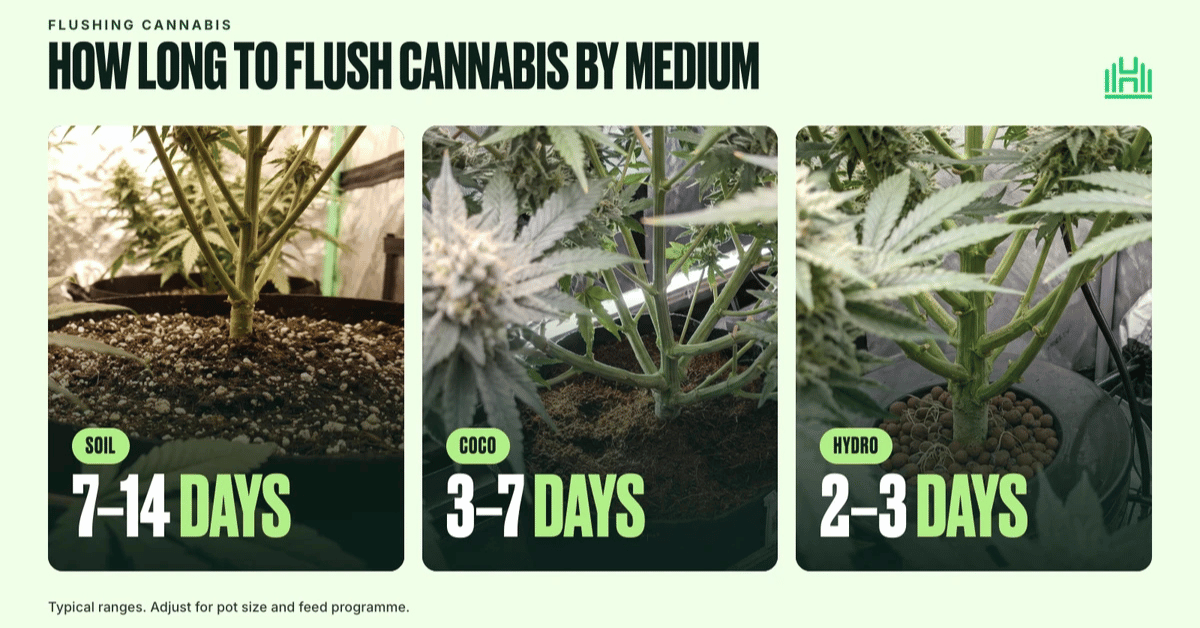
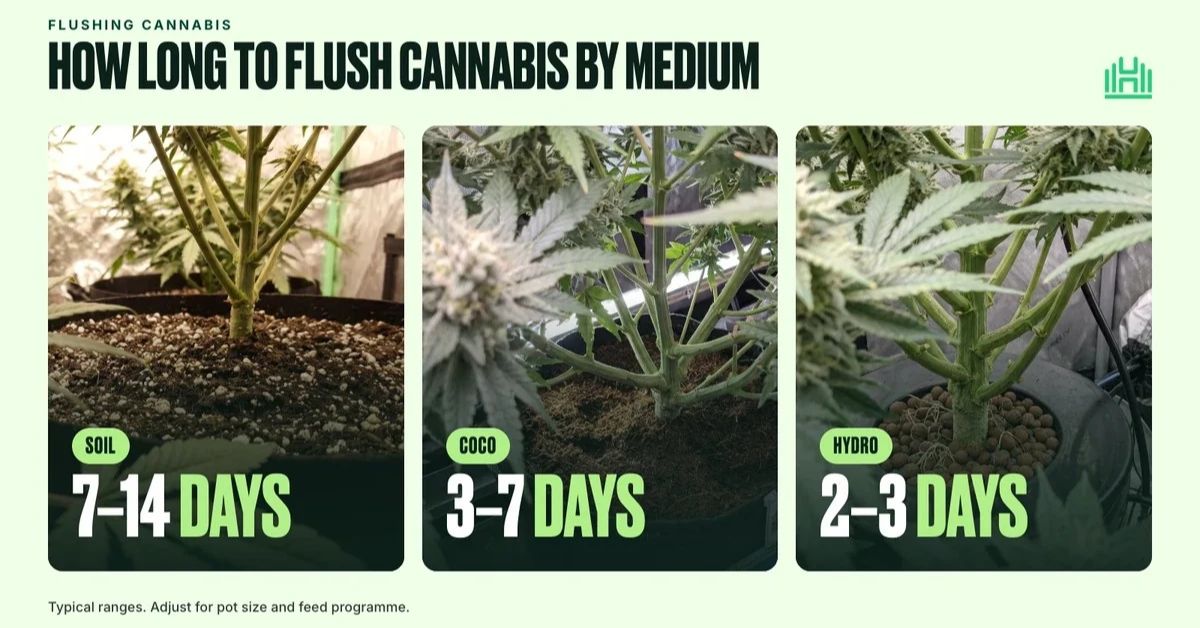
| Medium | Typical flush length | Why it takes this long | Lean toward the longer end if… |
| Soil | 7 to 14 days | Soil keeps a good share of dissolved salts in reserve and gives them up gradually over several waterings | Your pot is large or you've fed heavily through flower |
| Coco coir | 3 to 7 days | Coco is inert and free-draining, so a few plain waterings move most of the salt out | Your waterings have produced little runoff |
| Hydro (DWC, RDWC, NFT) | 2 to 3 days | A full reservoir swap replaces the whole root environment in one go | You ran your feed strong late in flower |
To set your start date, first calculate your harvest date by checking the trichomes, not by the breeder's flowering time. Plants are usually close once most heads look cloudy with a few gone amber. Give your weed plants their final feed the day before you switch to plain water.
Unsure of your date? Begin a little later. Switching to plain water too soon can hold back buds that are still developing, while a slightly late start costs you very little.
Coco and hydro grows easily fit within a 1-week flushing window. In soil, a week sits at the short end and suits smaller pots or lighter feeding. But don’t go beyond your medium's upper limit — it won't buy you anything extra.
How to Flush Cannabis: 6 Steps to Do It Right
To flush cannabis plants, give them plain, pH'd water until about 30% runs off, let the surface dry between rounds, and track your runoff as your EC reading falls. Here’s the full step-by-step breakdown:
1. Check your water's starting point. Before anything else, measure the EC or PPM of the water you'll be using. That reading is your baseline and the number your runoff will gradually close in on. Jot it down somewhere for reference.
2. Mix and pH your flush water. Soil-grown weed plants like their water at pH 6.0–6.3, though 5.5–6.5 is still in the safe zone. Coco or hydro water does best at 5.8–6.2 (5.6–6.4 also works). Use plain water only, with pH Up or pH Down as the sole additions. If you grow organically or in living soil, you can skip this step.
Marijuana plants grown in coco and hydro like water temperatures at roughly 68–72°F, while water for soil-grown plants can run up to 75°F. Stay within these limits so the roots don't get a cold shock.
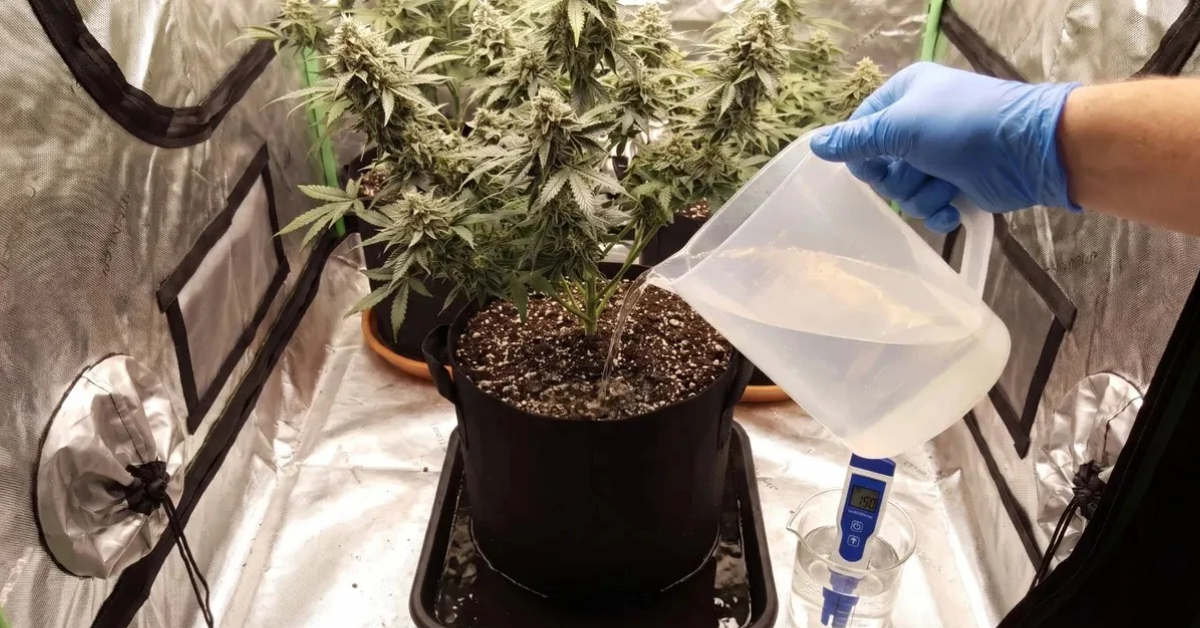
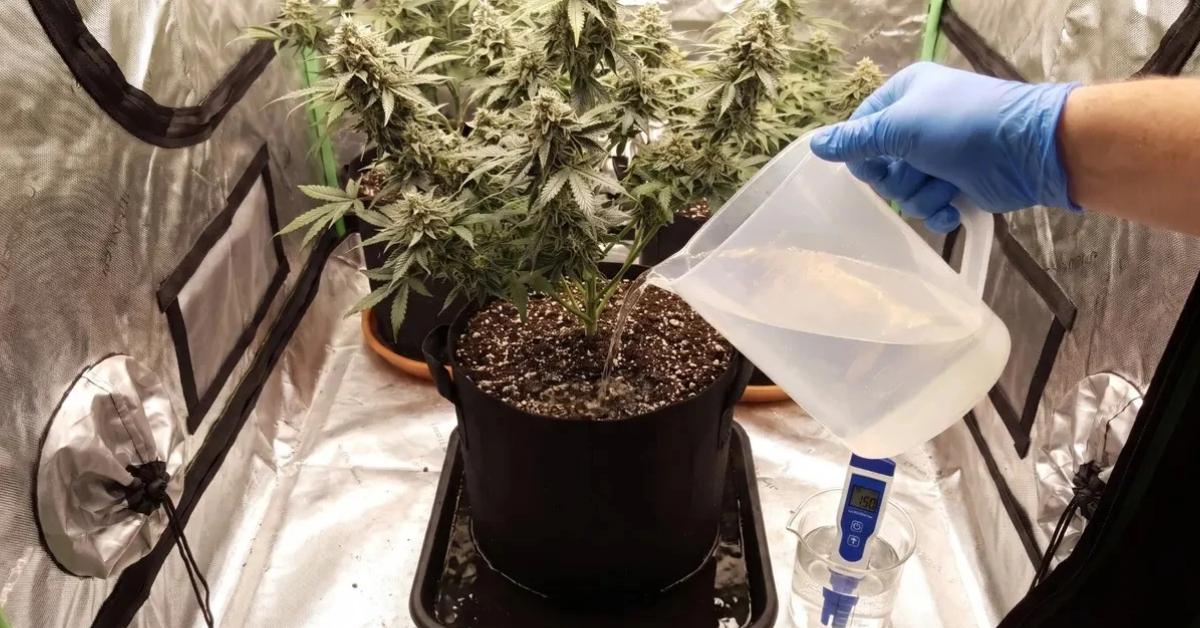
3. Water slowly until about 30% runs off. Pour gently over the whole surface so water reaches every part of the root zone. That way it doesn't race down one channel past dry pockets. If your usual coco routine skips runoff, this is the time to change that. In hydro, drain and refill the reservoir with plain pH'd water.
Soaking the pot with several volumes at once drops readings fast but leaves roots waterlogged. Don’t risk it.
4. Wait for the top inch or two to dry. Should you flush your plants every day? No. Knowing how often to water during a flush depends on the dry-back, so check with a finger before each round. A pot that stays wet cuts the oxygen roots need and raises the risk of root disease.
5. Measure your runoff EC every time. Catch a sample once the runoff is flowing steadily, and test it the same way each round. Write the reading down so you can follow the trend.
6. Keep conditions steady. Late-flower weed plants don’t handle sudden changes well, and a swing in temperature, humidity, or light can stress them enough to turn into hermie plants or throw out nanners just before harvest. Keep airflow, humidity, temperature, and your light schedule exactly as they’ve been.
All that extra water also raises the humidity in the room, and in dense colas that’s an open invitation to bud rot, so keep the air moving.
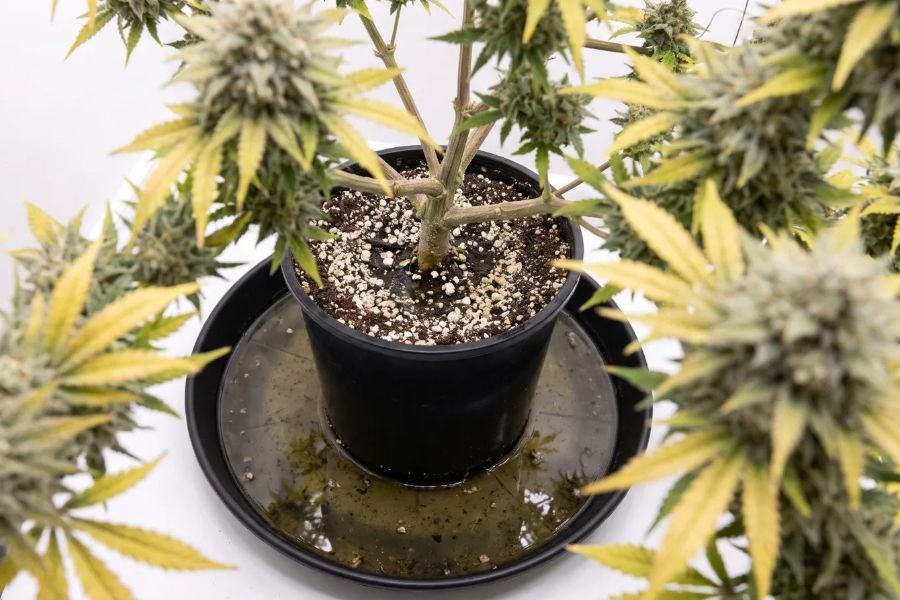
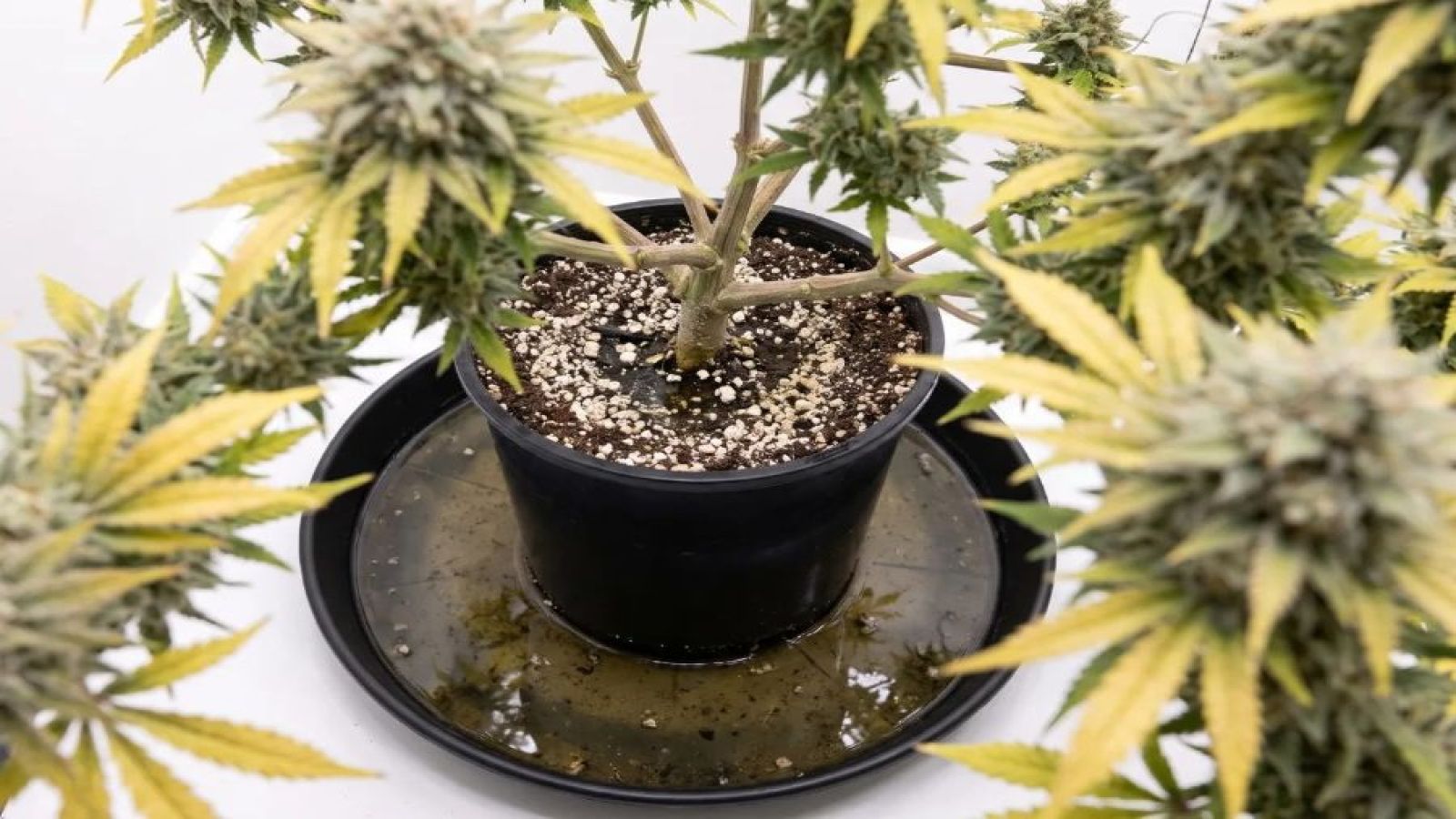
That’s the whole routine, and it works the same for one pot or a full tent. The only thing that changes at scale is managing the water. Make sure every container drains freely and nothing sits in a saucer of runoff — roots left standing in water can’t breathe.
In a full tent, flush your weed plants early in the lights-on period so the extra moisture has the whole day to clear before the room goes dark and humidity climbs.
Keep a Cannabis Flush Log to Know When You're Done
You'll know you’re done flushing when your runoff readings stop dropping and sit close to your source-water number, or your planned window runs out, whichever comes first. A quick log makes that easy to see:
| Day | Water in (EC/PPM, pH) | Runoff (EC/PPM) | Approx. runoff % | Plant notes |
Keep your eye on the gap between the two reading columns, not on any single number. When it stops shrinking from one watering to the next, the medium has given up most of its stored salt. Hydro growers can watch for the reservoir holding steady near its fresh-fill reading between changes.
No meter? No problem. Go by your planned window and how healthy the plant looks. And hang on to the log, because comparing it with your next grow shows how your feeding habits play out at the finish.
After the Flush: Harvest Timing & the Final Days
Finishing your flush doesn't mean the plant is ready for the chop. Trichomes still decide when to harvest. Inspect them with a jeweler’s loupe or phone lens and cut when most have turned from clear to cloudy and about 15% have turned amber. If they need a few more days, keep using plain pH’d water until they get there.
Buds won’t swell from the flush itself. Controlled trials found flushed and unflushed plants yielded the same, so any late bulking you see is just the plant maturing on schedule. Yellowing leaves are normal at this point, too. That's the plant drawing on reserves in its older leaves while the buds finish, and it happens with or without a flush.
Try not to chop early just because the calendar says it's time. A couple of extra days on plain water won't hurt the plant, and it gives the buds the finish you've been working toward.
Flushing Weed Plants Mid-Grow to Clear Salts & Fix Lockout
Only flush cannabis plants mid-grow when excess salts have caused nutrient burn or nutrient lockout. Both usually start with overfeeding. With burn, the plant takes in too much and the damage shows directly. With lockout, the buildup stops roots from absorbing nutrients that are already in the medium.
Yellowing leaves, scorched tips, spotting, and clawing are the usual signs of both. Real nutrient deficiencies can look almost identical, though, and flushing an underfed plant strips out what little it has left. Check the table to confirm what you’re dealing with:
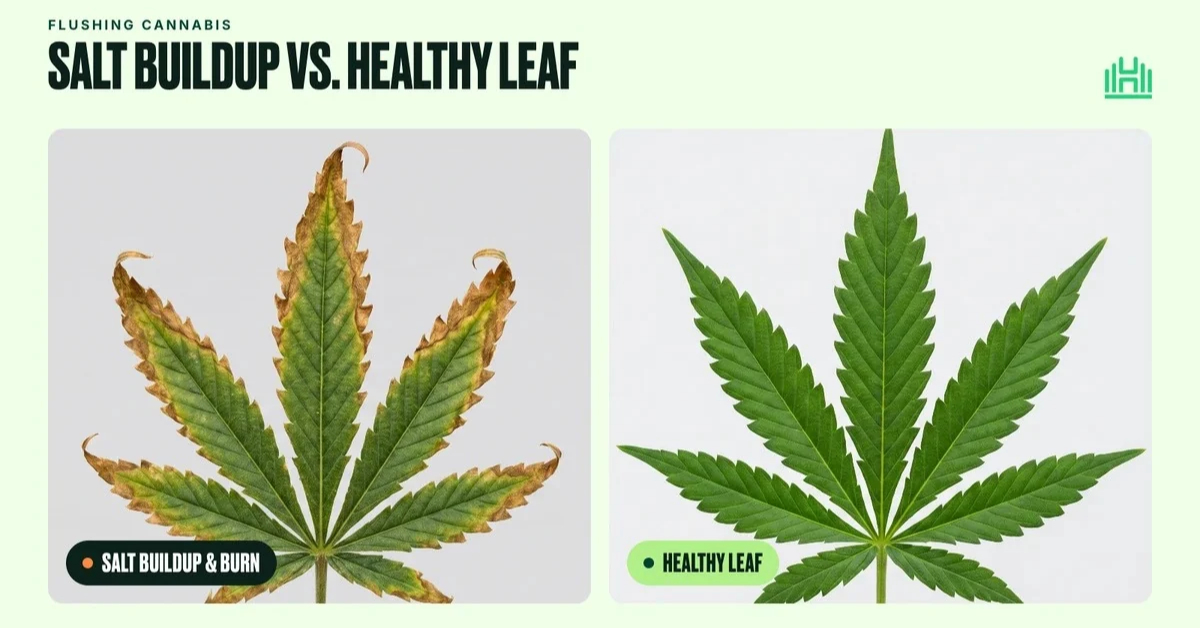
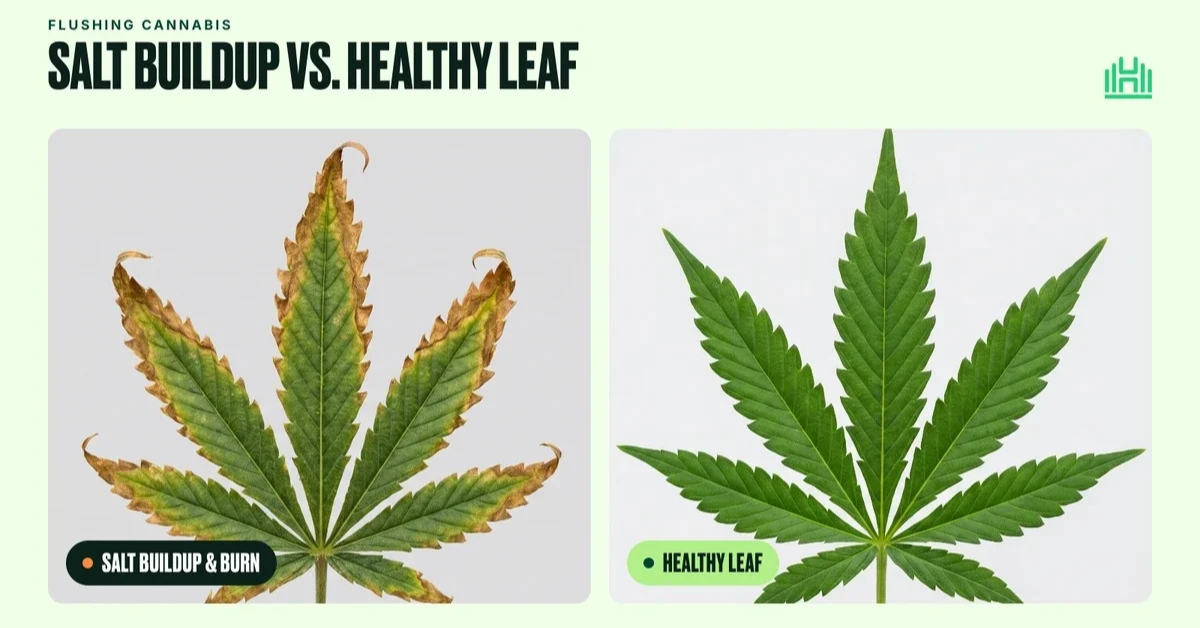
| Signs it's salt buildup | Signs it's something else |
| Tip burn soon after you raised feed strength | Deficiency signs while runoff EC sits at or below feed EC |
| Runoff EC well above your feed EC | Trouble that started after your pH meter drifted |
| A white crust on the medium surface | Living-soil plants, which run on soil biology |
| Deficiency signs despite a full-strength feed | Drooping while the medium is still wet, which points to overwatering |
If the left column matches what you’re seeing, follow steps 2 to 4 above until about 30% runs off. Give the medium a day or two to dry out and correct your feed pH. Then restart at about half strength and build back up across the following few feeds.
Tapering Your Feed Instead of Flushing Your Weed Plants
Tapering your feed means stepping your nutrient strength down over the last week or two of flower, so the plant eases onto plain water gradually. Many growers see it as the middle ground. The plant keeps a steady supply while it ripens; you use less fertilizer, and the root zone reaches harvest without a huge amount of salts.
A simple taper for a plant about two weeks from harvest typically looks like this:
- Days 1 to 5: feed at about three-quarters of your usual strength.
- Days 6 to 10: drop to half strength.
- Final 3 to 4 days: drop to quarter strength, and switch to pH’d water right at the end.
Keep an eye on the canopy as you go. If the upper leaves yellow fast while the trichomes are still mostly clear, the plant is running short too early, so hold the current strength a few days longer. Fading in the lower fan leaves near the end is expected.
Living soil is the exception. Its biology handles feeding on its own, so there’s nothing to taper. Keep watering as normal right up to harvest.
How to Finish Without Flushing for Smoothness, Aroma & Flavor
If you want smoother smoke, better flavor, and a stronger aroma, the good news is you can improve all three directly — without flushing your cannabis plants. They mostly come down to your feeding through flower, your harvest timing, and the care you put into drying and curing.
| What you want | What actually shapes it | What to do |
| Smoother smoke | Overfeeding, plus a hurried dry and a short cure | Feed toward the bottom of the label range, taper over the final 1-2 weeks, and give the dry and cure time |
| Better flavor | Harvest timing, plus terpenes lost to heat, rough handling, and fast drying | Harvest on trichomes, handle buds gently, and dry them cool and slow |
| Stronger aroma | How well terpenes are protected after the chop | Cure in sealed jars and store them somewhere cool and dark |
| Cleaner burn and lighter ash | Moisture and cure quality | Let buds dry fully before jarring, then give the cure time |
| No salt buildup at the finish | Feed strength and runoff habits | Let about 10–20% run off each feed and check runoff EC every week or so |
Most of these wins happen after harvest, so give drying and curing all the patience they deserve. Terpenes lost to a rushed dry don’t come back, no matter how long the cure runs. A slow start protects everything you grew for, and the cure then brings out the full flavor.
FAQs About Flushing Cannabis
Should You Flush With Tap Water or RO Water?
Both tap water and RO water work, as long as it's pH-adjusted and at a comfortable temperature. RO water reads close to zero, so your runoff numbers are easy to interpret. Tap or well water carries its own minerals, which makes the starting reading the number your runoff closes in on. Neither makes the flush work better, so use whatever you normally water with.
Are Flushing Additives Better Than Plain Water?
No, flushing additives aren’t better than plain water in any proven way. They're sold on clearing salts faster, but plain pH'd water gets you to the same end point. In hydro, a fresh reservoir already does the job at once. If you're curious about one, let your flush log judge it by the runoff readings, not the label.
Do Autoflowers Need a Different Flush to Photoperiods?
No, autoflowers use the same flush method as photoperiod plants according to your medium. The difference is timing. Autoflowers start flowering with age, so use the breeder's seed-to-harvest time to know when to begin checking trichomes. From there, count back from your harvest estimate just as you would for any plant.