



Cannabis Deficiencies: A Complete Visual Guide to Symptoms and Fixes

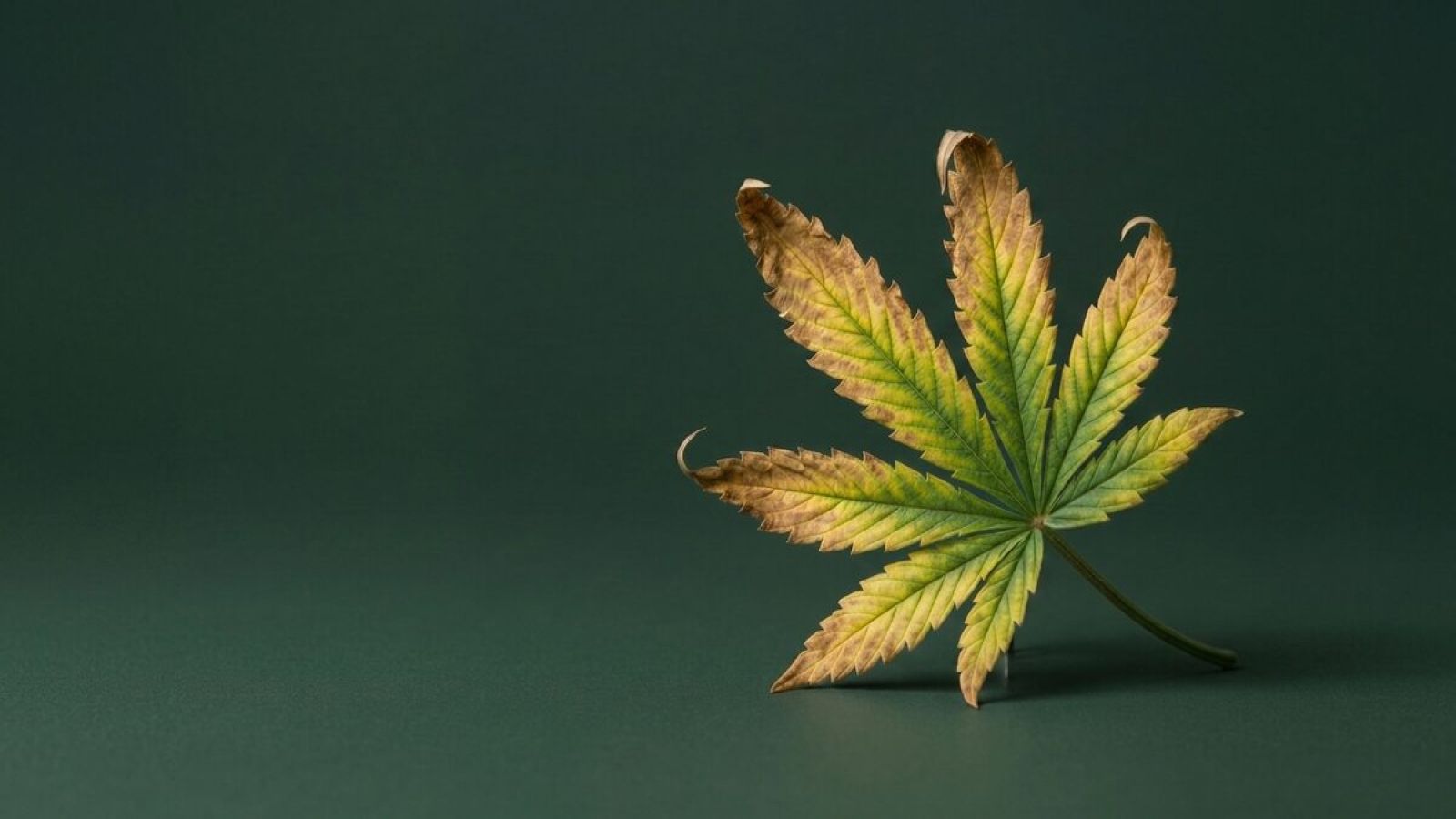
Cannabis deficiencies show up the moment your plant runs short on a nutrient it needs. The good news is your plants tell you what's wrong through their leaves. This guide covers every common cannabis nutrient deficiency, from yellowing nitrogen leaves to twisted zinc growth. You'll get a quick deficiency chart, the leaf symptoms to look for and the simple fixes that work.
Read where the damage starts first, because that single clue points you to the cause.
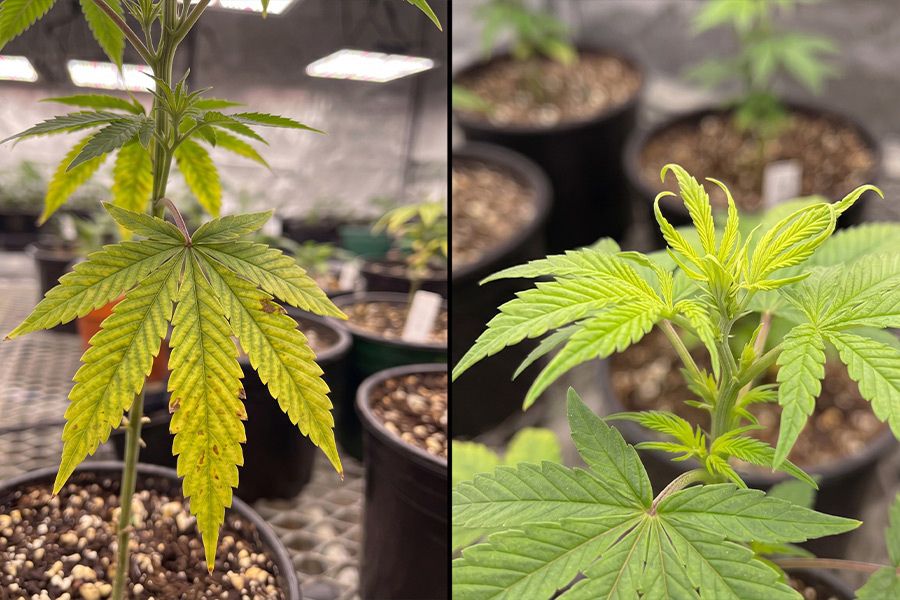
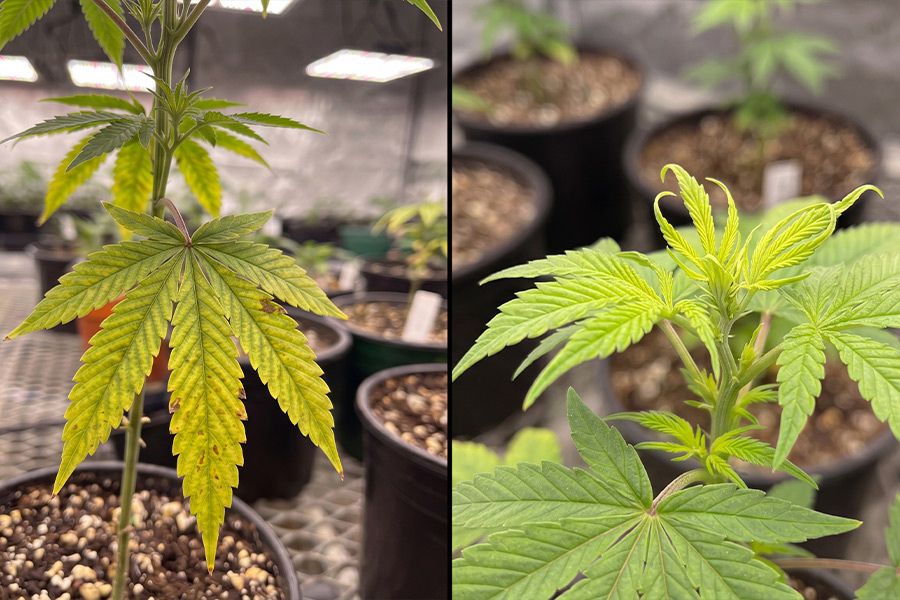
Check the lower, older leaves first. Damage that starts there usually means a mobile nutrient is short, like nitrogen, phosphorus or potassium. Damage on new top growth points to an immobile nutrient instead, like calcium, iron or zinc. Confirm your pH is in range before you feed anything, because most deficiencies are lockout in disguise.
What Are Cannabis Deficiencies?
Cannabis deficiencies happen when your plant can't take up enough of a nutrient it needs to grow. Even a balanced feed fails if the roots can't absorb what's there. A shortage drains bud quality and yield, and in bad cases it can kill the plant. Your weed plants flag the problem early through their leaves, so learning to read them pays off.
How Do You Read Cannabis Leaf Deficiencies?
You read cannabis leaf deficiencies by checking where the damage starts and what shape it takes. Two clues do most of the work: the location of the damage and your root-zone pH. Get those right and you'll narrow thirteen possible nutrients down to one or two fast.
Here’s what you’ll learn in this section:
- Mobile vs immobile nutrient deficiencies: why old leaves and new leaves tell different stories.
- Why pH causes nutrient lockout in cannabis: how the wrong pH starves a well-fed plant.
- Old growth vs new growth symptoms in cannabis: where to look first for a fast read.
Mobile vs Immobile Nutrient Deficiencies
Mobile and immobile nutrients show their deficiencies in different places on the plant. Mobile nutrients like nitrogen, phosphorus, potassium and magnesium move from old leaves to feed new growth.
So a mobile nutrient shortage shows on the lower, older leaves first. Immobile nutrients like calcium, iron, zinc and manganese stay put, so their shortages hit new top growth first.
Why pH Causes Nutrient Lockout in Cannabis
pH locks out cannabis nutrients when the root zone drifts too acidic or too alkaline. The nutrients sit right there in the medium, but the roots can't pull them in.
Soil grows should keep pH between 5.5 and 6.5, with 6.0 to 6.3 the sweet spot.Climb much past 6.5 and you start locking out iron, manganese, boron and phosphorus, the very shortages you are trying to avoid. Coco and hydro run a touch lower, 5.6 to 6.4, dialed in around 5.8 to 6.2.
Old Growth vs New Growth Symptoms in Cannabis
Old growth and new growth tell you which group of nutrients is short. Yellowing or spotting that climbs from the bottom up points to a mobile nutrient. Damage that starts at the top, on the newest leaves, points to an immobile one.
Check both ends of the plant before you take any action.
Cannabis Nutrient Deficiency Chart
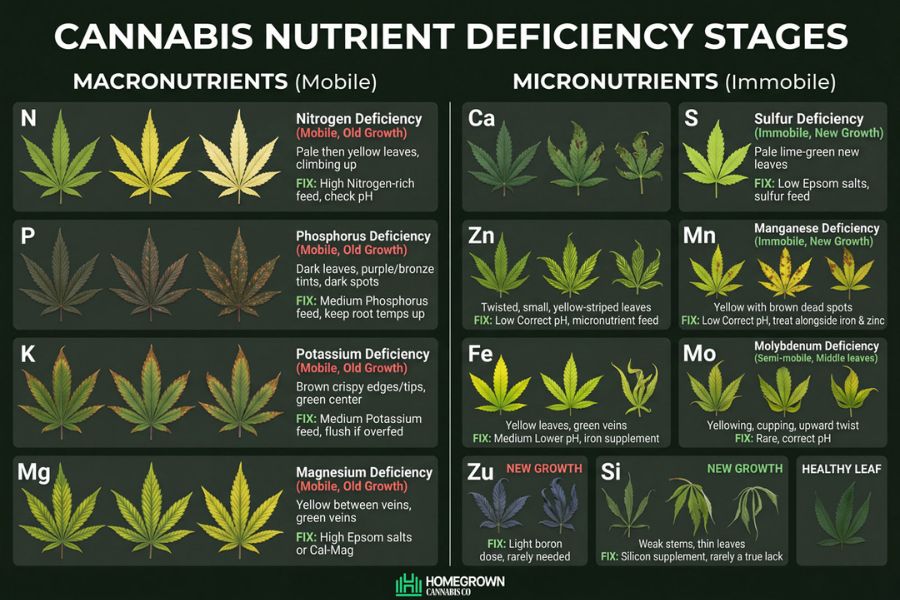
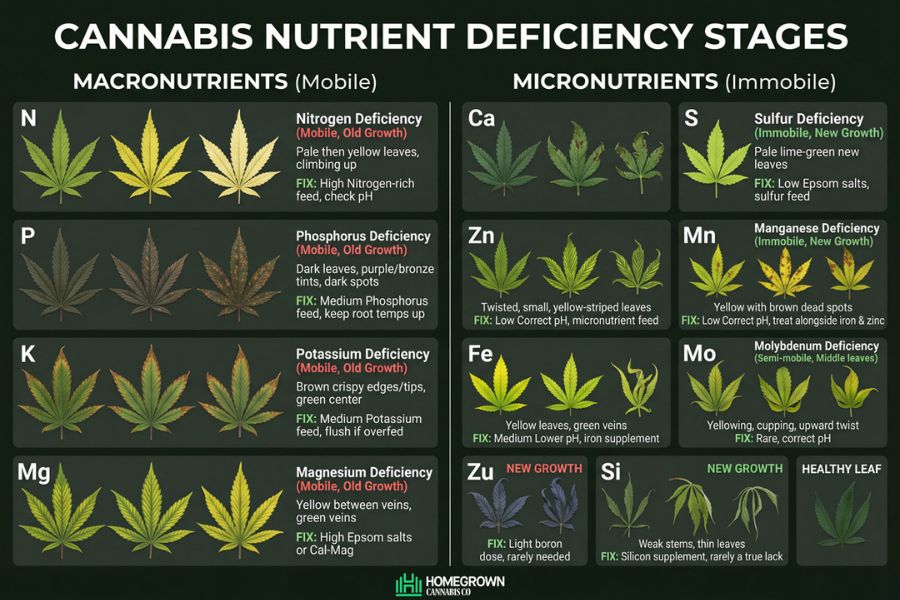
This cannabis nutrient deficiency chart pairs each nutrient with its top symptom, where it shows first and the fix. Use it as a quick shortlist, then confirm with the detailed sections below. The reliability column tells you how much to trust that single symptom on its own.
| Nutrient | Shows First On | Leaf Symptom | Readability | Common Fix |
| Nitrogen (N) | Old lower leaves | Pale then yellow leaves, climbing up | High | Nitrogen-rich feed, check pH |
| Phosphorus (P) | Old lower leaves | Dark leaves, purple or bronze tints, dark spots | Medium | Phosphorus feed, keep root temps up |
| Potassium (K) | Old lower leaves | Brown crispy edges and tips, green center | Medium | Potassium feed, flush if overfed |
| Magnesium (Mg) | Old lower leaves | Yellow between the veins, green veins | High |
Epsom salts or Cal-Mag |
| Calcium (Ca) | New top growth | Deformed new growth, brown spots | Medium | Cal-Mag, correct pH |
| Sulfur (S) | New top leaves | Pale lime-green new leaves | Low | Epsom salts, sulfur feed |
| Iron (Fe) | New top leaves | Yellow leaves, green veins | Medium | Lower pH, iron supplement |
| Zinc (Zn) | New top leaves | Twisted, small, yellow-striped leaves | Low | Correct pH, micronutrient feed |
| Manganese (Mn) | New top leaves | Yellow with brown dead spots | Low | Correct pH, treat alongside iron & zinc |
| Boron (B) | New growth | Twisted, brittle new growth | Low | Light boron dose, rarely needed |
| Copper (Cu) | New growth | Bluish-gray and curling, limp leaves | Low | Rarely needed, prevention only |
| Molybdenum (Mo) | Middle leaves | Yellowing, cupping, upward twist | Low | Rare, correct pH |
| Silicon (Si) | New growth | Weak stems, thin leaves | Low | Silicon supplement, rarely a true lack |
Most problems on that list trace back to nitrogen, phosphorus, potassium, magnesium or pH. Start there before you chase the rare ones.
What Are the Main Macronutrient Deficiencies in Cannabis?
The main macronutrient deficiencies in cannabis are nitrogen, phosphorus and potassium deficiencies. These three do the heavy lifting in growth and bud development, so your plants need them in large amounts.
They're also the most common shortages, and the easiest to fix once you spot them:
- Nitrogen deficiency in cannabis: yellowing that climbs from the bottom leaves up.
- Phosphorus deficiency in cannabis: dark, purple-tinged older leaves and slow growth.
- Potassium deficiency in cannabis: burnt brown edges on older leaves.
Nitrogen Deficiency in Cannabis
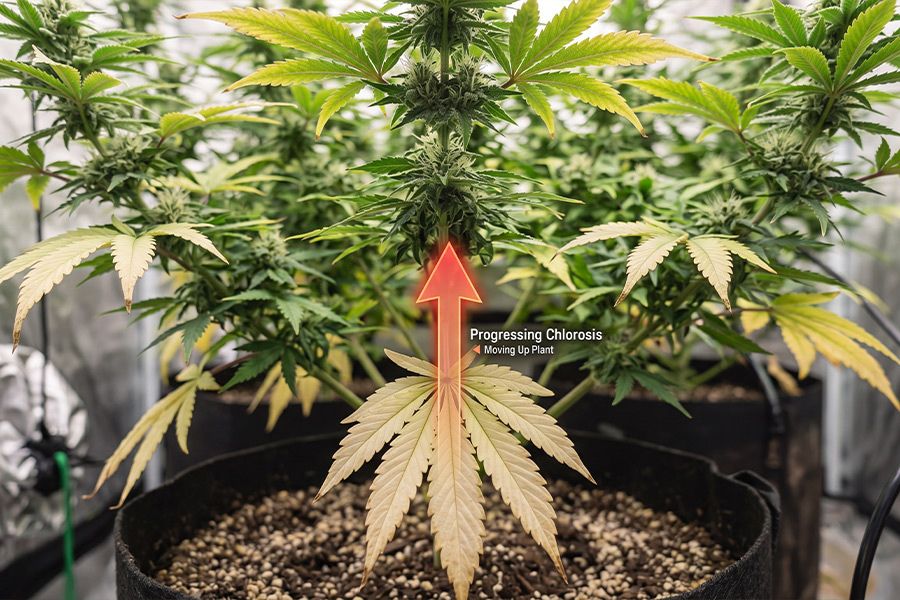
Nitrogen deficiency yellows the lower, older leaves first. The pale color creeps upward as the plant pulls nitrogen from old growth to feed new shoots. Leaves fade, curl and drop, and bloom can rush forward with smaller buds. Fix it with a nitrogen-rich feed, and check your pH so the roots can actually absorb it.
Phosphorus Deficiency in Cannabis
Phosphorus deficiency darkens older leaves and adds purple or bronze tints. Dark spots and dead patches spread, and growth slows in both height and width. Petioles (small stalks that join leaf to stem) can turn purple too.
Cold roots make it worse, so keep temperatures up and feed your plants with a phosphorus source. Water-soluble bloom fertilizers act fastest, while rock phosphate and greensand release more slowly.
Potassium Deficiency in Cannabis
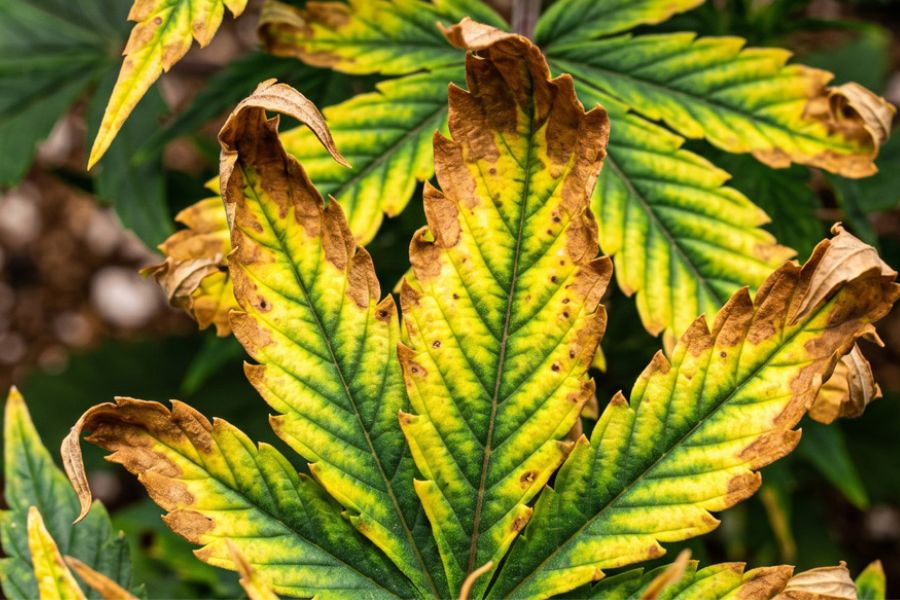
Potassium deficiency burns the edges and tips of older leaves. The edges turn brown and crispy while the center stays green, and plants may stretch. Overfeeding often blocks potassium, so a gentle flush can help before you add more. Then feed a potassium source like a bloom fertilizer, liquefied kelp or wood ash and recheck your pH.
Secondary and Micronutrient Deficiencies in Cannabis
Secondary and micronutrient deficiencies in cannabis show up less often but still wreck leaves and buds. Calcium, magnesium and sulfur are secondary nutrients your plants use in real quantities, while trace elements like iron and zinc are needed in tiny amounts.
Either way, a true shortage is often a pH problem in disguise. Fix your root-zone pH first, then treat the specific nutrient if symptoms stick around:
- Calcium deficiency in cannabis: deformed new growth and brown leaf spots.
- Magnesium deficiency in cannabis: yellowing between the veins on older leaves.
- Sulfur deficiency in cannabis: pale new leaves that fade to lime green.
- Iron deficiency in cannabis: yellow new leaves with green veins.
- Zinc and manganese deficiencies in cannabis: twisted, spotted new growth.
- Rare deficiencies: boron, copper, and molybdenum are uncommon in healthy soil.
Calcium Deficiency in Cannabis
Calcium deficiency deforms new growth and spots older leaves. New leaves curl or twist, and brown spots with darker edges spread over time. Roots suffer too, so the whole plant can stall. Use a Cal-Mag supplement and correct your medium’s pH to turn this deficiency around.
Magnesium Deficiency in Cannabis
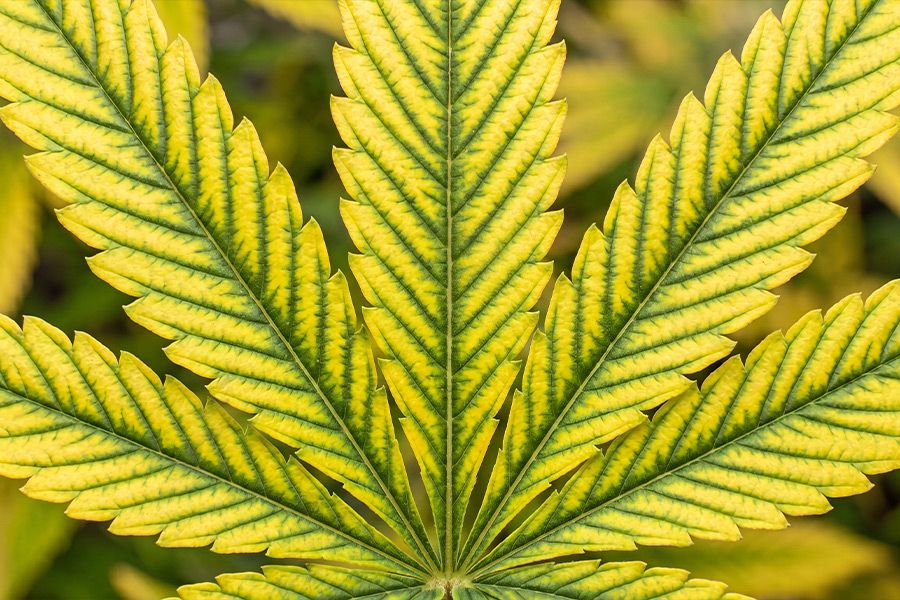
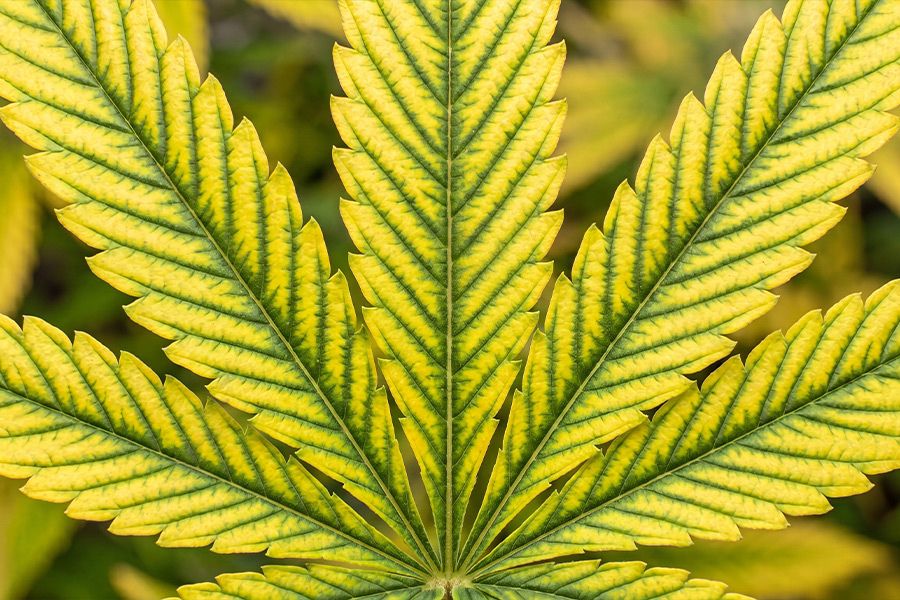
Magnesium deficiency yellows the area between the veins on older leaves. The veins stay green while the spaces between them fade, a pattern called interveinal chlorosis. Lower leaves go first, then the yellowing climbs if you leave it. Epsom salts or a Cal-Mag feed at the right pH fix it fast.
Sulfur Deficiency in Cannabis
Sulfur deficiency pales the newest leaves to lime green. It looks a lot like nitrogen deficiency, but sulfur hits new growth instead of old. The whole leaf fades evenly, sometimes with purple stems. It's rare, and Epsom salts or a sulfur feed usually clear it.
Iron Deficiency in Cannabis
Iron deficiency yellows new top leaves while their veins stay green. It often follows a high pH that blocks iron uptake, not a real lack of iron. Too much zinc, manganese or copper can crowd iron out as well. Lower your pH first, then add an iron supplement like chelated iron or iron sulfate if needed.
Zinc and Manganese Deficiencies in Cannabis
Zinc and manganese deficiencies twist and spot the newest leaves. Zinc shortage shrinks new growth and stripes it with yellow between the veins. Manganese shortage yellows the newest leaves between the veins, then spreads small brown dead spots while the veins stay green. Both trace back to high pH most of the time, so fix that before dosing.
Rare Deficiencies: Boron, Copper and Molybdenum
Boron, copper and molybdenum deficiencies rarely appear in healthy soil grows. Most quality soil and complete feeds already carry enough of these trace minerals. Boron shortage twists and hardens new growth, while copper shortage darkens and curls leaves. These are low-confidence calls, so rule out pH and overfeeding before you suspect them.
Is It a Cannabis Deficiency or Something Else?
A cannabis deficiency isn't always the real cause of yellow or curling leaves. Often the culprit is watering, heat, light burn or simple pH lockout. Rule those out before you start dosing nutrients, because the wrong fix makes things worse.
The sections below cover:
- Is it nutrient burn or a deficiency: even brown tips versus a clear pattern.
- What nutrient deficiency causes purple leaves: phosphorus, or just cold and genetics.
- Why your cannabis leaves droop or curl: water and heat before nutrients.
Is It Nutrient Burn or a Deficiency?
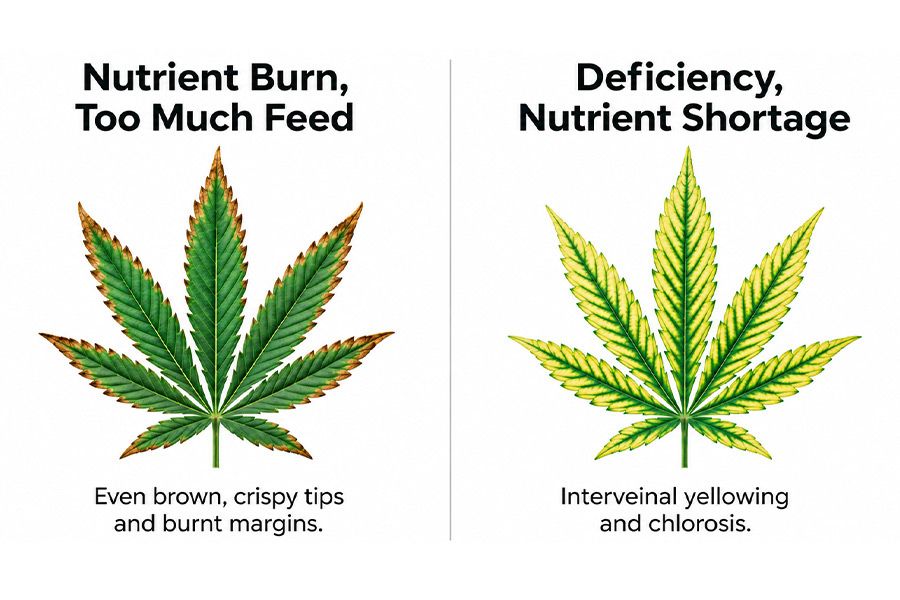
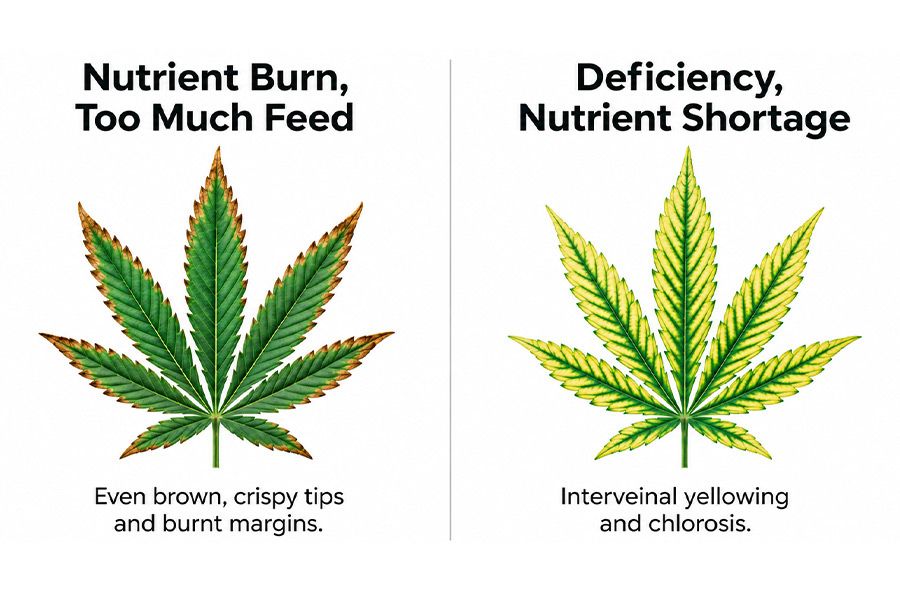
Nutrient burn browns leaf tips evenly, while a deficiency follows a pattern. Burn comes from too much feed, so tips go brown and crispy across many leaves at once. It can be especially noticeable in the fast-growing top canopy, where active tissue pulls in plenty of water and feed.
A deficiency behaves differently. Nutrient mobility helps determine whether shortage symptoms appear on older or newer growth. Flush first and ease off the nutrients when many tips burn together after a heavy feed.
What Nutrient Deficiency Causes Purple Leaves?
Purple leaves often point to phosphorus deficiency, but cold or genetics can do it too. Phosphorus shortage adds purple or bronze tints to darkening older leaves. Cold nights and some strains turn stems and leaves purple with no problem at all. Check your temperatures and genetics before you treat purple coloration as a deficiency.
Why Are Your Cannabis Leaves Drooping or Curling?
Drooping or curling cannabis leaves usually signal watering or heat stress before any deficiency. Overwatering droops leaves and packs the roots, while heat curls the edges up like tacos. Low humidity and strong light can curl leaves too. Fix the environment and watering first, then look at nutrients if the curl sticks around.
What Causes Cannabis Deficiencies and Excesses?
Cannabis deficiencies and excesses trace back to pH, water, feed strength and medium quality. Out-of-range pH locks nutrients out even when the medium is full of them.
Too much of one nutrient causes excess, which then blocks others and triggers fresh shortages. Too much manganese, for example, locks out iron and starves new growth even though enough iron is available.
How Do You Prevent Cannabis Deficiencies?
You prevent cannabis deficiencies by getting the medium, feed and pH right before problems start. Quality soil and a larger container give roots a bigger reserve to draw from. Feed on a balanced schedule and check pH at every watering. A balanced cannabis fertilizer paired with steady pH keeps most shortages from starting.
How Healthy Genetics Lower Cannabis Deficiency Risk
Healthy genetics give your plants more resistance to deficiencies and stress. Hardy plants start with high-quality marijuana seeds bred for vigor — whether you’re after high THC seeds, high CBD seeds, or high-yielding seeds.
Most growers chasing flower plant feminized cannabis seeds, so every healthy plant counts toward harvest. Compact plants from indica seeds handle tight spaces and steady feeding well. Long-flowering plants from sativa seeds lean on consistent nutrition through a stretched bloom.
As for cloning, cannabis clones share their mother's genetics, so they start with her strengths and her problems. A sick or pest-ridden mother can pass diseases and pests straight to every cutting, and weak stock roots and recovers slower.
If you want lab-verified pathogen-free plants, you can buy cannabis clones from a trusted source like Homegrown Cannabis Co.
Strong stock won't cancel a pH mistake, but it gives your grow a sturdier starting point. These genetics are sold to eligible adult buyers where permitted by law.
FAQs About Cannabis Deficiencies
How Do You Tell Nutrient Burn From a Potassium Deficiency?
Nutrient burn typically browns the tips of newer leaves in the top canopy, while potassium deficiency starts on older leaves and spreads along tips, edges, and as necrotic spots. A potassium shortage also causes red stems or petioles. If damage follows heavy feeding and concentrates on the upper tips, nutrient burn is more likely.
Can a Cannabis Plant Recover From a Nutrient Deficiency?
Yes, most cannabis plants bounce back once you fix the cause early. Damaged old leaves won't turn green again, and that's normal. Watch new growth instead, because healthy new leaves mean the fix is working. Correct the pH or feed, then give the plant about a week to respond.
Do Cannabis Deficiencies Look the Same in Soil and Hydro?
Yes, most cannabis deficiencies and leaf symptoms match across both soil and hydro grows. The difference is the pH range and how fast problems show. Hydro runs a lower pH and reveals shortages within days, while soil buffers and reacts more slowly. Check the pH that fits your medium before you treat anything.