



Cannabis Leaf Guide: What a Pot Leaf Looks Like and Why Points Vary
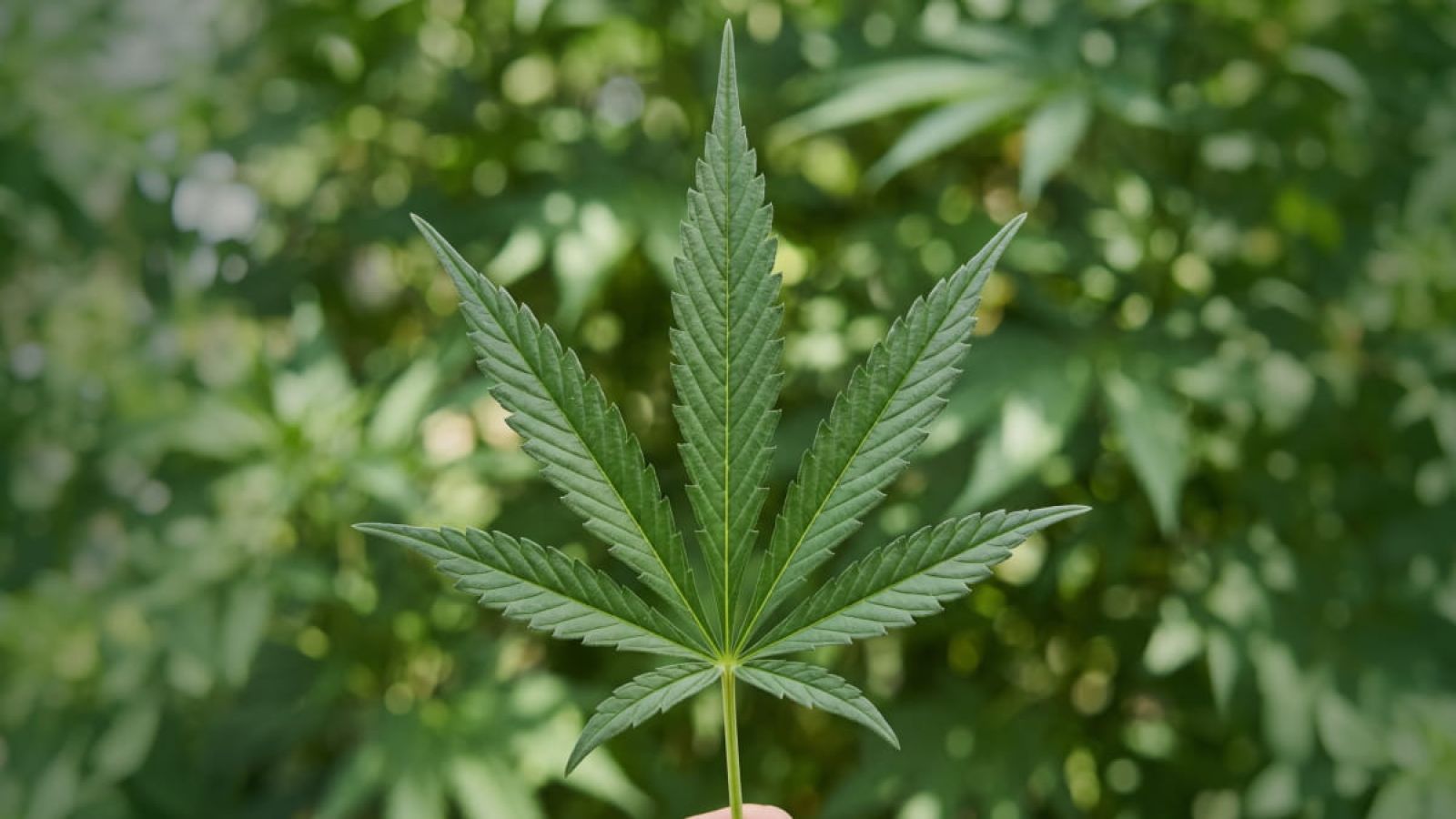
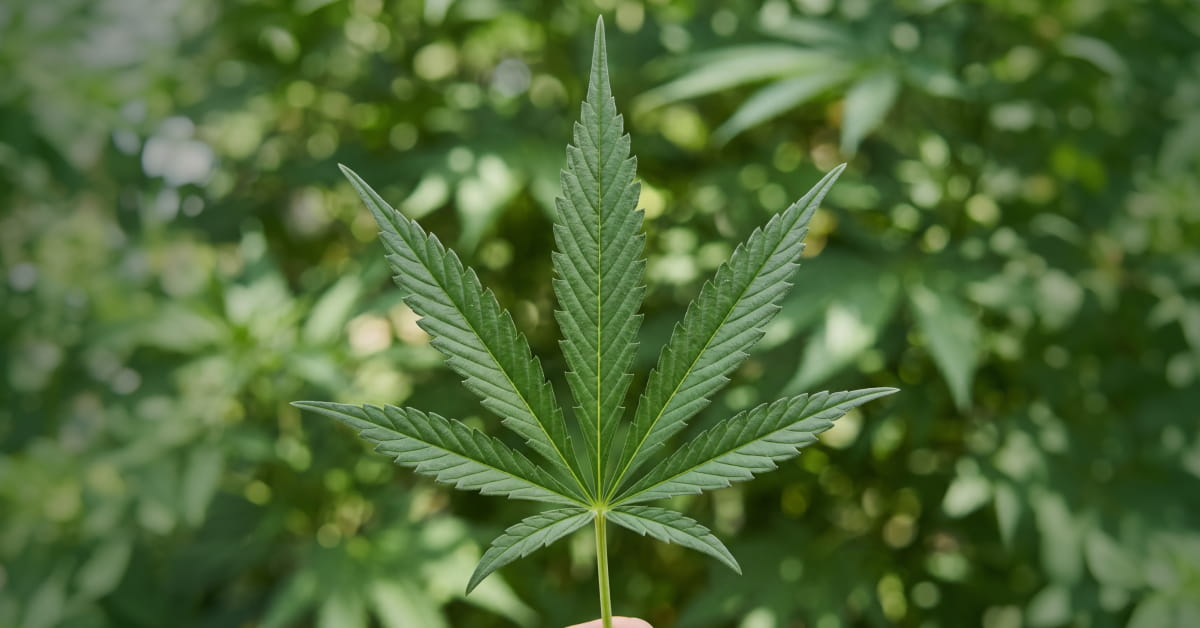
A cannabis leaf is made of several separate, slender, saw-toothed leaflets that fan out from one point at the end of a stalk, like fingers on an open hand. Most mature fan leaves carry five to nine leaflets, usually an odd number, and that count shifts with the plant’s age, genetics, and position on the stem.
Below, we cover how the leaf is built, why point counts change, what shape can and can’t tell you, and how to rule out lookalikes. You’ll also learn about the two leaf types on a flowering plant, what leaves reveal about plant health, and what growers do with them after harvest.
What a Pot Leaf Actually Looks Like
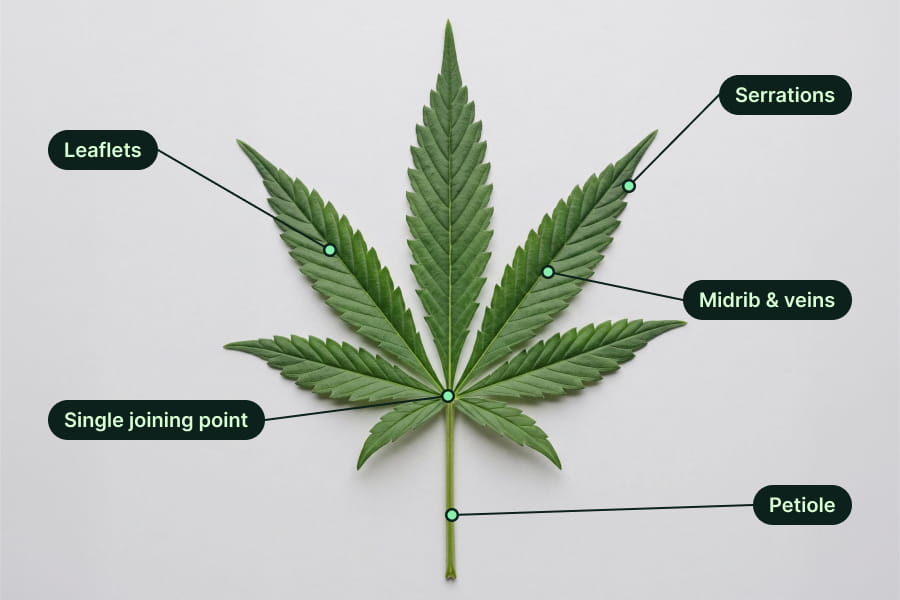
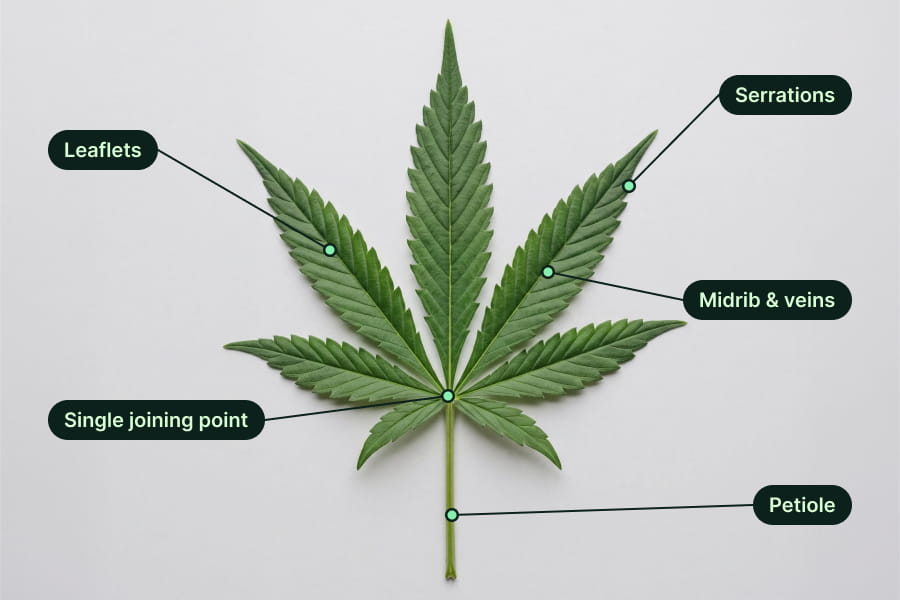
A pot leaf is a single leaf made of several separate blades, called leaflets, that all attach at one point and spread out like an open hand. Botanists call this a palmately compound leaf, and each part has a name:
- Petiole: the stalk that carries the leaf and attaches it to the stem.
- Leaflets: the separate blades most people count as points or fingers.
- Serrations: the saw-tooth notches along each leaflet’s edge, all angled forward toward the tip.
- Midrib and veins: the raised center line down each leaflet and the branching network that runs off it.
- Stipules: small pointed growths at the base of the petiole, where it meets the stem.
Each leaflet is lanceolate and acuminate, which means it’s shaped like a lance blade and tapers to a fine point. The center leaflet is the longest, with progressively shorter ones on each side, so a healthy leaf looks balanced from left to right.
In vegetative growth, weed leaves come in opposite pairs, and each new pair sits rotated about 90 degrees from the pair below it. That’s why a young plant looks like a cross when you view it from above. Once flowering begins, new growth commonly switches to an alternating pattern.
Up close, a healthy leaf is mid to deep green with a slight sheen, and fine hairs on the surface can make it feel faintly rough. Leaves near flowering sites can also feel sticky from resin. That resin comes from separate glandular structures, and the hairs themselves don’t produce it.
How Many Points a Marijuana Leaf Has (And Why the Number Changes)
Odd counts are the norm on mature fan leaves, but the number isn’t fixed. Each new leaf reflects the plant’s growth stage, genetics, position on the stem, vigor, growing conditions, and any stress it’s been through.
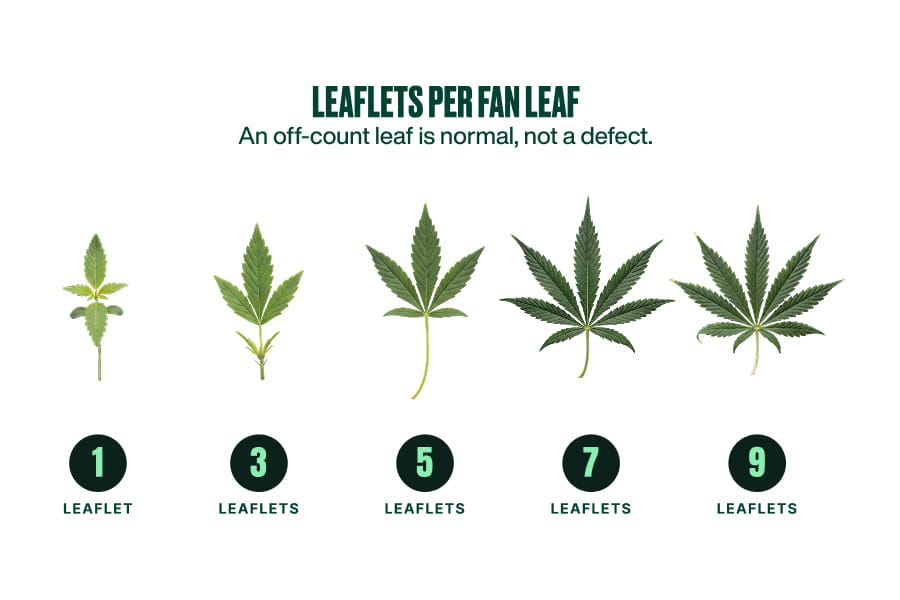
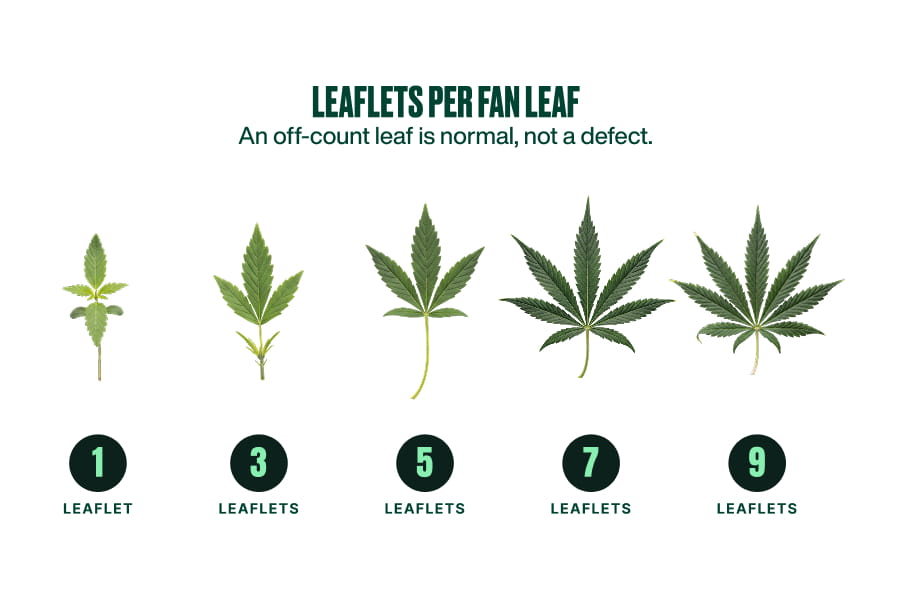
Growth stage drives the clearest shifts:
| Growth Stage | Typical Leaflets Per New Leaf | What’s Happening |
| Seedling | 1, then commonly 3 | The rounded first pair are seed leaves (cotyledons). The first true leaf often carries a single blade before three-leaflet sets appear. |
| Veg stage | 5, 7, or 9 | Leaves reach full size, and the classic fan shape emerges. |
| Flowering | Often 3, then 1 near bud sites | New leaves forming around flower clusters come in smaller and simpler than veg-stage foliage. |
Counts as low as one and as high as eleven to thirteen do turn up, but the high end is uncommon and reflects vigorous, mature growth. An even-numbered or lopsided leaf here and there is normal too. Leaflet count isn’t a quality, potency, or health score, so a plant throwing nine-point leaves isn’t outperforming one throwing sevens.
The total amount of leaves a marijuana plant carries depends on genetics, how long the plant stays in veg, how much it branches after topping or training, and how much foliage the grower removes. Two plants from the same pack can finish with very different leaf counts when grown in different spaces.
What Leaf Shape Can and Can't Tell You About a Weed Plant
Leaf shape tells you how the leaves on that one plant look, and almost nothing else. Width, length, and leaflet count won’t reveal cannabinoid content, how a finished product will feel, final height, plant sex, or whether the plant is hemp or high-THC cannabis.
| Trait | Does Leaf Shape Show It? |
| Leaflet width and length | Yes, for that individual plant |
| Broad-leaf (indica-leaning) or narrow-leaf (sativa-leaning) form | Yes, as a description of the leaves only |
| Leaf color depth | Yes, as a description only |
| Stretched or compact growth | Partly, when read alongside other signs |
| Cannabinoid type or amount | No |
| How a product will feel to a consumer | No |
| Plant height or final structure | No |
| Plant sex | No |
| Hemp versus high-THC classification | No |
| Autoflowering or photoperiod | No |
The broad-leaf and narrow-leaf labels stick around because they’re easy to repeat, and the two leaf types really do exist. Research in the cannabis literature, though, indicates that the assumed links between leaf appearance and traits like cannabinoid content, height, and sex lack a shared genetic basis.
Modern commercial genetics are also heavily crossbred. Plenty of hybrids sit in neither visual camp, and two phenos grown from the same pack of weed seeds can look vastly different.
Better evidence gives you better answers. Listed genetics from your seed bank tells you what you bought, pre-flowers at the nodes show the sex, and lab testing is what establishes cannabinoid content. Most seed banks list this, too.
Flowering behavior is also genetic. Autoflowers start flowering according to age without waiting for a change in the light schedule, and no leaf outline can show you that. The occasional claim that ruderalis-influenced plants show three prominent leaflets comes from a single source, so it can’t be relied on as an identifier.
Weed Leaves vs Lookalike Leaves From Other Plants
To tell a cannabis leaf from a lookalike, check whether it’s compound or lobed. Cannabis leaflets are fully separate and meet at one point, while most lookalikes have a single blade cut into deep lobes that stay joined. These are the plants most often mistaken for cannabis. Their outlines pass at a few steps away, but up close, you can quickly spot the differences:
| Lookalike Plant | Why It Looks the Same | What Gives It Away |
| Japanese maple | Pointed, deeply cut leaf outline | One blade with lobes, no separate leaflets |
| Japanese hops | Same plant family (Cannabaceae), serrated and hand-shaped | Lobed blade, climbing growth habit |
| Cleome (spider flower) | Genuinely palmately compound, the closest visual match | Smooth or finely edged leaflets instead of coarse saw teeth, different flowers and stems |
| Kenaf | Palmate outline on an upright stem | Lobed blade and distinct flowers |
| Roselle or cranberry hibiscus | Lobed, serrated, sometimes red-toned | Lobes stay joined, red coloring, hibiscus flowers |
| Texas star hibiscus | Narrow pointed lobes | Single blade, large red flowers |
| Virginia creeper | Compound with five leaflets | Vine growth, climbing tendrils, different leaf margins |
If you want to identify a cannabis plant, work through these checks in order:
- Look for separation. Trace the gap between two neighboring blades down to the junction point. A gap that runs all the way down points to cannabis, and a connected blade points away from it.
- Check margins, stipules, and arrangement. Look for consistent forward-pointing teeth, small stipules at the base of the petiole, and paired leaves on vegetative growth.
- Check several leaves and the whole plant. Young plants carry one or three leaflets, damaged leaves mislead, and unrelated three-leaflet plants get mistaken for seedlings in both directions.
- Use smell as a supporting cue only. A crushed cannabis leaf has a resinous, herbal scent, but smell alone can’t confirm the plant.
A single leaf can’t establish species or legal status with certainty. When the identification really counts, look at the stems, growth habit, and flowers before you commit to an answer.
Fan Leaves and Sugar Leaves: Two Leaf Types, Two Jobs
Fan leaves are the large, iconic leaves along stems and branches, and they handle photosynthesis for the whole plant. Sugar leaves are the small leaves poking out of and wrapped around the buds, named for the frosted look of their dense trichomes.
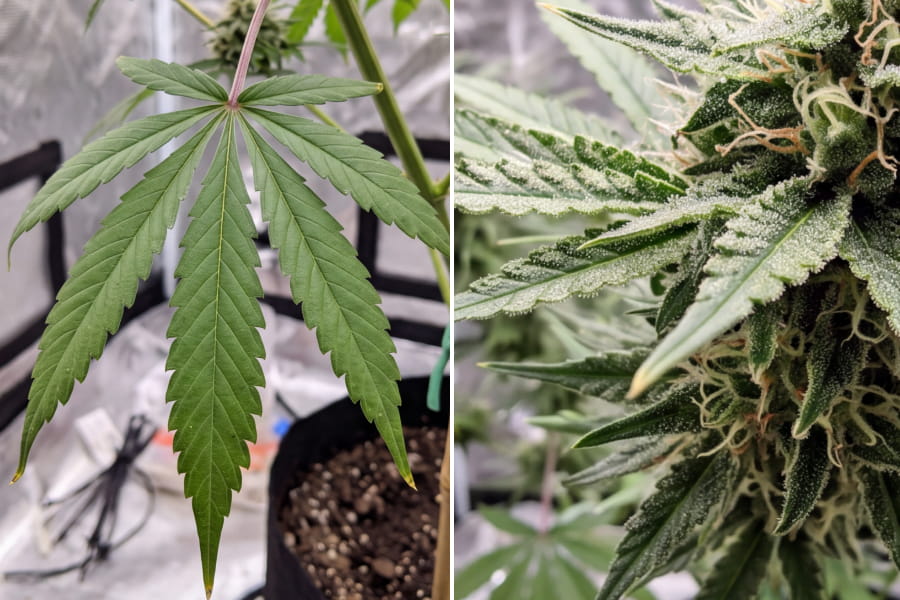
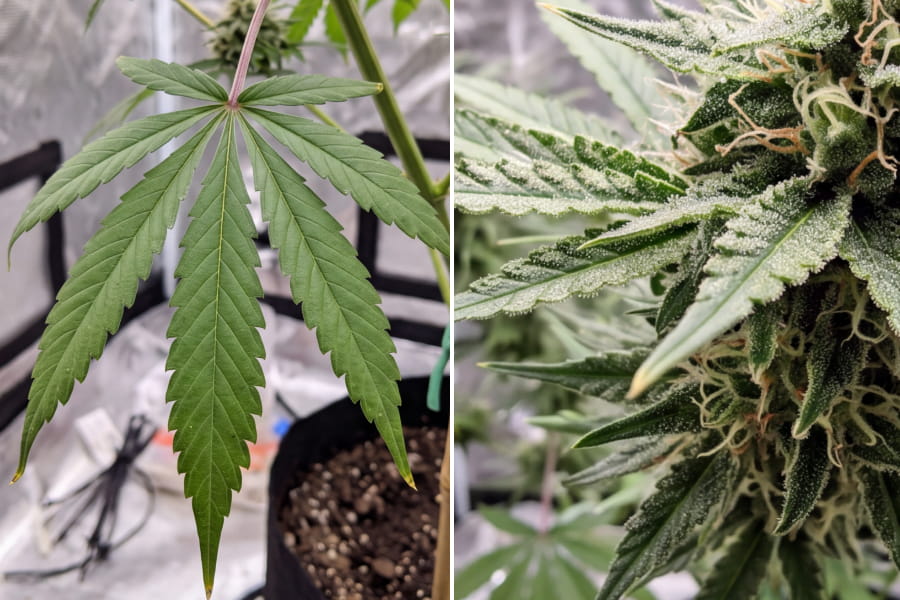
Telling the two leaf types apart quickly helps at two points: when you’re pruning cannabis during a grow and when you’re sorting what to keep at harvest.
| Feature | Fan Leaf | Sugar Leaf |
| Where it grows | Along stems and branches, below and between flower sites | In and around the buds themselves |
| Size and look | Large, broad, the classic shape, usually plain green | Small and tight, often with fewer leaflets, visibly frosty |
| Main job | Capturing light and powering growth and flower development | Growing within the flower cluster |
| Resin level | Lowest on the plant | Noticeably higher than fan leaves, still below the flower |
Trichomes are the structures that produce cannabinoids and terpenes, and their density runs on a gradient. It’s highest on the flower, lower on sugar leaves, and lowest on fan leaves, with cannabinoid concentration following the same order. So leaves do carry cannabinoids, just far less than the flower does. That gradient is also why growers check trichome appearance on the buds themselves when they’re judging harvest timing.
Reading Leaf Color and Condition for Plant Health
Leaves are usually the first place a cannabis plant shows that something has changed, but a visible symptom only narrows the list of possible causes. A healthy baseline looks like an even mid to deep green, firm and symmetrical leaflets, clean margins, and no distortion.
Leaf color itself comes from pigments. Green is chlorophyll, yellow tones show up as chlorophyll declines and carotenoids become visible, and purple or red usually comes from anthocyanins.
| What You See | Where It Shows Up | What It Could Mean | What to Check Next |
| General yellowing | Often lower, older leaves first | Natural aging, root-zone problems, watering extremes, or a nutrient issue | Whether it’s spreading upward and how fast |
| Brown, crisp tips or margins | Tips first, often on strong growth | Overfeeding, heat, low humidity, or root stress | Recent changes to feed strength, temperature, and airflow |
| Curling or clawing | Newer growth or upper canopy | Heat, light intensity, overwatering, or excess nutrients | Canopy temperature, lamp distance, and watering routine |
| Spotting or mottling | Scattered, any height | Pests, fungal issues, or an uptake problem | Leaf undersides and whether spots spread between leaves |
| Drooping | Whole plant or lower branches | Overwatering, underwatering, or root issues | Substrate moisture at depth, not just the surface |
| Purple or red tones | Stems, petioles, or whole leaves | Genetics or growing conditions such as temperature | Whether the plant is otherwise growing normally |
| Fade late in flower | Upper and lower leaves together | Normal senescence as the plant finishes | Flower maturity against the expected finish window |
A leaf chart alone can be misleading, because the same symptom can have several different causes. To narrow it down, look across several affected leaves and check three things:
- Pattern: which leaves are affected, and whether they’re old or new, upper or lower.
- Distribution: whether the symptom covers the whole leaf, sits between the veins, or shows only on the tips.
- Timeline: whether it appeared suddenly or developed gradually.
Confirm the cause before you correct anything. Many cannabis deficiencies produce early signs that look a lot like watering, heat, or root-zone problems, and treating the wrong one leaves the real problem in place.
What Growers Do With Cannabis Leaves After Harvest
Most growers save the sugar-leaf trim and compost the fan leaves, and the split comes down to resin content. Trim gets collected during trimming and set aside as raw material. Here’s how each leaf type is usually handled:
- Sugar-leaf trim: carries trichomes and can be used as raw material for concentrates, infusions, and other trim-based preparations where that’s legal.
- Fan leaves: carry very little resin and are typically composted, used as mulch, or discarded as plant biomass.
Some growers also juice raw leaf material or use it in other ways. That’s a personal preference though. Whatever you do, only keep leaf material from plants with a clean, known history. Don’t keep or use it if the plant had mold or mildew, was treated with products not intended for consumable material, or came from unknown growing conditions or poor storage.
When a plant’s history is unclear, compost the leaves. Rules on keeping and processing plant material also vary by location, so check what applies where you live.
Why the Cannabis Leaf Became a Global Symbol
The weed leaf became shorthand for cannabis because its silhouette is unmistakable at any size. A symmetrical fan of pointed, toothed leaflets reproduces cleanly on a flag, a sticker, or a shop sign, which helped it spread through culture, activism, retail, and merchandise faster than any other part of the plant.
The icon simplifies things, though. Stylized versions almost always show a tidy five- or seven-point leaf, while real weed plants move through a whole range of counts and rarely settle on one number. The symbol also puts a leaf in the spotlight, even though the flower is the part most people care about.
Either way, the leaf is still the most recognizable image in cannabis. And if you’re a home grower, you get something the logo can’t give you: the real thing, unfolding new leaflets on a plant you started yourself.
Frequently Asked Questions
Should I Remove Fan Leaves During Flowering?
Yes, but only selectively: taking off fan leaves that are dead, dying, or heavily shading bud sites is routine cleanup. Stripping healthy ones in bulk is heavy defoliation, a deliberate technique with its own timing and risks, because those leaves supply the energy the buds need to fill out.
Do Cannabis Leaves Grow Back If They’re Damaged or Removed?
No, an individual cannabis leaf doesn’t grow back. Once it’s been removed or badly damaged, it stays that way. A healthy plant replaces the lost leaf area by pushing new leaves from the nodes as it keeps growing.
Why Do Some Cannabis Leaves Have Fused or Webbed Leaflets?
Fused or webbed leaflets come from a leaf mutation that keeps neighboring blades joined along part or all of their length. Some genetics carry it as a consistent trait, and an isolated webbed leaf can also turn up on an otherwise ordinary plant. Because the blades don’t separate, a webbed leaf can fail the separation test used to spot lookalikes, so check the rest of the plant too.
Why Are My Cannabis Leaves Pointing Upward?
Leaves usually point upward because a vigorous plant is reaching toward good light, most often during the lights-on period. Growers call this praying, and it’s generally a healthy sign, but judge plant health by leaf color and condition too. Leaves that fold up along the midrib, sometimes called tacoing, are a different sign and can point to heat or light intensity.