



What Does Weed Smell Like? Terpenes & Cannabis Aromas Explained
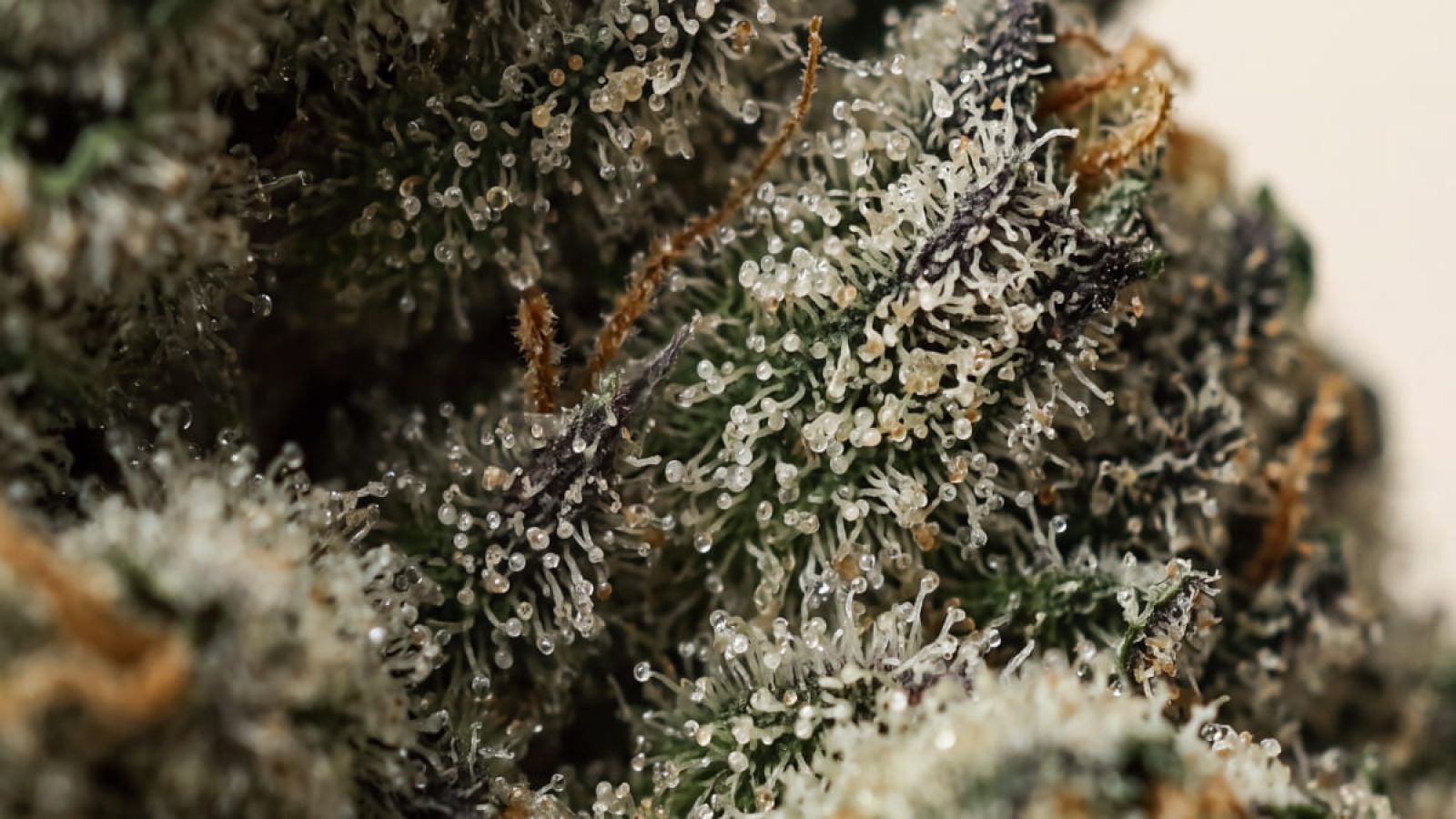
Weed smells earthy and herbal, often with a skunky edge and top notes ranging from sweet, lemon, or pine-like to floral, diesel, or spice. The exact mix depends on the cultivar, how it was grown, and how well it was dried and cured — which is why two jars rarely smell the same.
Two groups of compounds build weed’s aroma. Terpenes are behind familiar notes like citrus, pine, floral, and spice. Volatile sulfur compounds drive the skunky funk, and other trace compounds add fruity, sweet, or savory notes in certain strains.
This guide covers the main scent families, why cannabis smells the way it does, and how the aroma changes from a growing plant through drying, curing, and smoking.
What Does Marijuana Smell Like?
Marijuana’s base aroma is earthy and green, like damp soil and crushed green stems, and it carries much further than you’d expect from a small amount of dried flower. What sits on top of that base changes from strain to strain, and it’s what growers and consumers compare. One jar reads as lemon and pine, the next as fuel and pepper.
The primary scent families you’re most likely to pick up:
- Earthy and musky, close to damp forest floor.
- Herbal and green, like crushed garden herbs.
- Woody, closer to cedar or dry bark.
- Pine and forest, the smell of broken conifer needles.
- Citrus, usually lemon or orange peel.
- Fuel, diesel or gas, sometimes with a chemical-like edge.
- Pepper and spice, like cracked black peppercorn.
- Floral and sweet, sometimes berry or stone fruit.
Some well-known strains make these easy to spot: Super Lemon Haze for citrus, Sour Diesel for fuel, Skunk #1 for that classic loud funk and Blueberry for sweet berry.
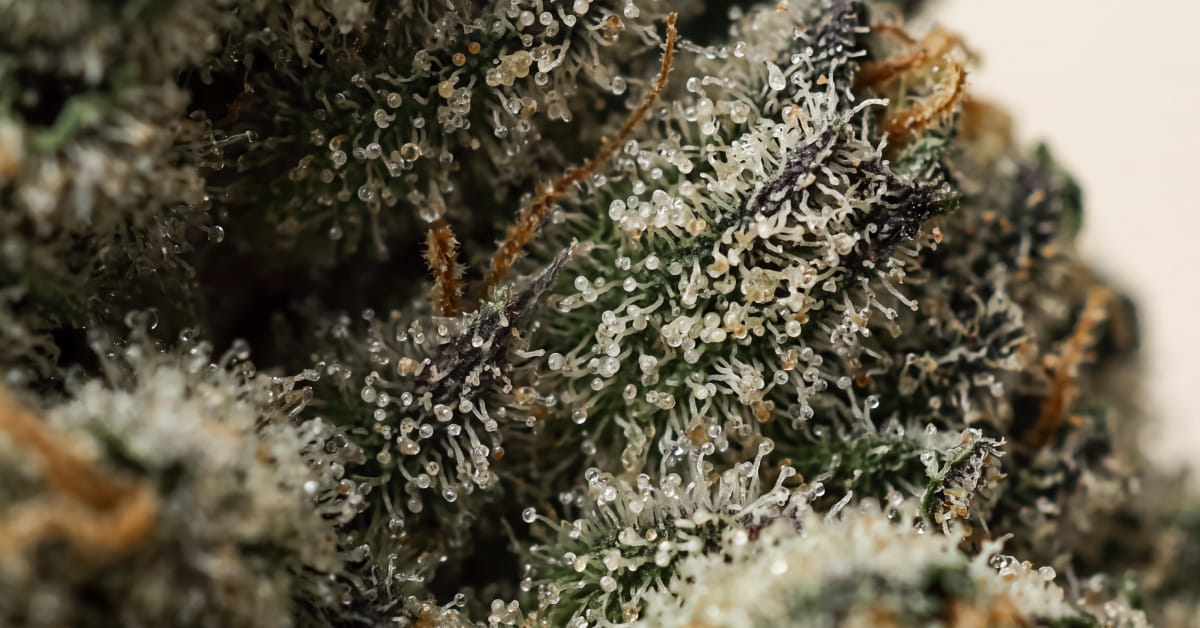
Rarely does a bud present just one of these scents. Most give you three or four at once, stacked in layers. Breaking or grinding a bud sharpens the mix because it ruptures the trichome heads (those tiny resin glands), which releases far more aroma.
Why Does Weed Smell Like Skunk?
Weed smells like skunk because of volatile sulfur compounds (VSCs), the same chemical family behind skunk spray. And yes, plenty of cannabis genuinely smells skunky.
What makes it smell that way:
- Prenylthiol is the main culprit. Its full name is 3-methyl-2-butene-1-thiol, and it’s the same compound behind "skunked" beer that has sat in sunlight.
- A tiny amount goes a long way. Thiols register at extremely low concentrations, so a little flower in a bag can scent a whole room. That’s also why weed can smell so bad to some people.
- Myrcene is not the cause. It often takes the blame because it brings an earthy, musky funk, but chemical analysis ties the skunk note to the sulfur compounds.
Whether skunk reads as offensive or appealing is personal. Many growers take a loud, sulfurous nose as a sign of good growing and curing, but plenty of strains sit low in VSCs and lean citrus, floral or sweet instead. A mild nose alone says nothing about quality.
What Are Terpenes and How Are They Structured?
Terpenes are volatile, strong-smelling compounds made in the glandular trichomes that coat cannabis flowers and sugar leaves, the same resin glands that produce cannabinoids. Every terpene is built from small five-carbon units called isoprene, and the number of units decides the type:
- Two units make a monoterpene, a small, light molecule such as myrcene, limonene, or pinene.
- Three units make a sesquiterpene, a larger, heavier molecule such as caryophyllene or humulene.
That size difference affects how long the aroma lasts. Monoterpenes are more volatile, so they evaporate first when flower is exposed to heat, airflow, light, or time, while heavier sesquiterpenes hang around longer. That's a big part of why identical genetics can smell vivid in one grower's jar and flat in another's.
When a terpene picks up oxygen, it becomes a terpenoid. Linalool and eucalyptol are common examples in cannabis, though the term "terpenes" is often used to cover both.
Cannabis shares its terpenes with pine forests, citrus groves, and the spice rack. In plants generally, terpenes act as chemical signals, discouraging animals that feed on the plant and drawing in useful insects. Analysts have identified more than 150 terpenes in cannabis, though only a small group shows up at levels a nose can pick out.
Common Cannabis Terpenes & the Aromas They Create
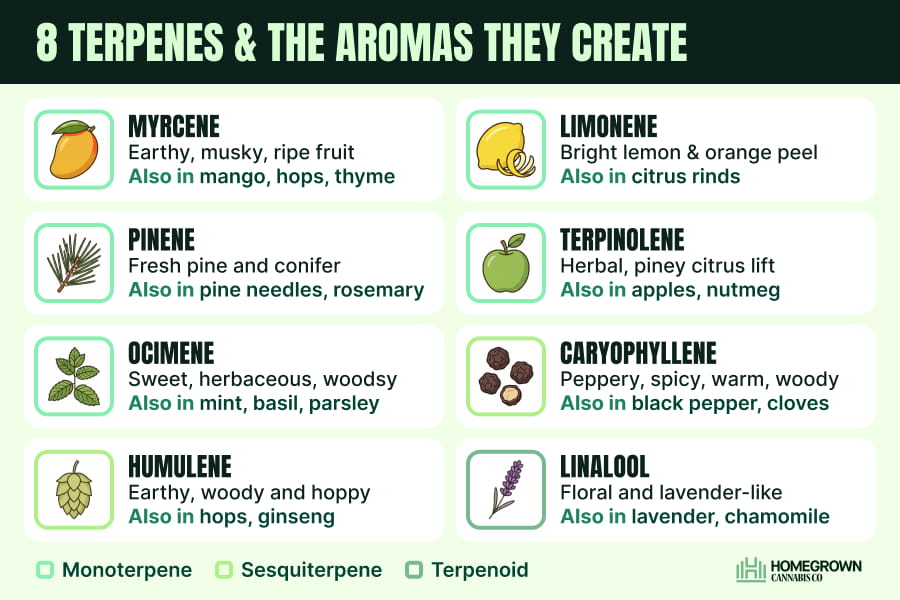
The terpenes you’ll smell most often in cannabis are the eight below: myrcene brings the earthy funk, limonene the citrus, pinene the pine, caryophyllene the pepper, and linalool the floral side, while terpinolene, ocimene, and humulene add herbal, sweet and woody touches. You already know most of them from the kitchen or the garden.
| Terpene | Class | What it smells like | Reference to sniff first |
| Myrcene | Monoterpene | Musky and earthy, with a ripe, slightly fruity edge | Fresh whole-cone hops |
| Limonene | Monoterpene | Sharp citrus, mostly lemon and orange zest | Lemon rind scratched with a fingernail |
| Pinene (alpha and beta) | Monoterpene | Resinous pine, cool and green | A rosemary sprig rubbed between your fingers |
| Terpinolene | Monoterpene | Herbal and piney with a sweet, floral lift | Freshly grated nutmeg or faint tea tree oil |
| Ocimene | Monoterpene | Sweet, green, and lightly woody | Torn fresh basil |
| Linalool | Terpenoid | Soft floral, lavender-like | Dried lavender buds |
| Caryophyllene | Sesquiterpene | Warm pepper and spice | Freshly cracked black peppercorns |
| Humulene | Sesquiterpene | Dry, woody, and bitter-herbal | Dried sage leaves or fresh hops |
No flower runs on a single terpene. Every bud carries a dozen or more at once, and the ratio between them creates its signature scent. That's why two cannabis strains with the same dominant terpene can still smell nothing alike.
The table's other columns put this to practical use. The ‘class’ column lets you read an aging jar: if the citrus and pine have faded but the pepper is still there, the lighter monoterpenes have already evaporated.
The ‘reference’ column is the fastest way to train your nose. Crush a rosemary sprig, split a peppercorn, or open a bag of hops, and the matching note in cannabis becomes much easier to pick out.
Why Does Every Cannabis Strain Smell Different?
Genetics are the main reason — they decide which terpenes and sulfur compounds a plant can make and in what proportions. That mix is the cultivar's scent signature. Aroma is heritable, so breeders select for it the same way they select for yield or flowering time. Some lines get pushed toward maximum funk and gas, others toward a clean citrus or floral profile.
Indica and sativa labels won’t tell you which way a strain leans. Nearly all modern cannabis cultivars are hybrids after generations of crossing, and those labels say more about a plant's build and heritage than about its chemistry. The dominant aromatic compounds are a far better guide to what a jar will smell like.
There’s movement inside a single strain too. Two plants from the same seed line can throw different phenotypes, and scent is one of the places that shows up, where one can lean sweeter and another sharper.
For anyone growing, that makes cultivar choice the earliest and most decisive aroma decision on the table. No amount of technique will put citrus into a fuel-dominant plant.
What Does a Cannabis Plant Smell Like While It's Growing?
A cannabis plant doesn’t smell the same in week one as it does at the chop. Seedlings and plants in veg are faint and green, closer to a tomato plant or a herb bed than to anything in a jar, and most people would walk past one without a second thought. Real pungency is a flowering-stage event.
How the smell builds through a grow:
- Seedling: barely anything, and what’s there smells vegetal.
- Vegetative: mild, green, and herbal, strongest when you brush the leaves.
- Early flower: a noticeable lift as bud sites form and trichome coverage fills in.
- Late flower: the loudest point of the cycle, climbing week on week until the plants come down.
Aroma tracks resin development, so the curve follows trichome coverage rather than plant size. Handling moves it as well. Brushing past a plant in late flower ruptures trichomes on contact and releases a burst of scent that hangs in the room long after you’ve left, and outdoor plants broadcast much further on warm, still days.
The environment works inside the limits genetics set, and the clearest lever is avoiding terpene loss. Sustained heat and strong airflow aimed straight at the colas drive volatile terpenes off the plant, so aroma is something to protect rather than push. Smell isn’t a ripeness signal either. Trichomes and pistils tell you when to harvest cannabis, not your nose.
How Drying, Curing, and Storage Change Weed’s Smell
Drying decides how much aroma survives, curing sharpens it, and storage decides how long it lasts. Most of cannabis’ aroma is set at harvest, though the skunk compounds keep building into the cure.
- Drying: this is where most aroma is lost. A fast, hot dry strips out the light monoterpenes and leaves a flat hay or cut-grass smell that no amount of storage will fix. A slow dry in a cool, dark room with moderate humidity and gentle, indirect airflow keeps far more of the scent intact, though bud density and room climate shift the timing.
- Curing: this is where the skunk note peaks. Curing cannabis in sealed jars also clarifies the aroma. A 2021 study found prenylthiol and related sulfur compounds topping out during the cure, then dropping sharply within about a week to ten days of storage, so a freshly cured jar is at its loudest in its first days.
- Storage: light, heat, oxygen, and time keep wearing terpenes down, so keep flower cool, dark and airtight.
What an off-smell is telling you:
| Off-smell | What it usually means |
| Hay or fresh-cut grass | Dried too fast or too warm |
| Musty, mildewed or damp basement | Moisture problems and possible mold |
| Sharp ammonia | Jarred while still too wet, with anaerobic breakdown underway |
| Flat and faint | Terpenes degraded by heat, light, or age |
Treat anything showing mold or ammonia signs as spoiled and discard it. A clean smell isn’t proof of clean flower, though, because some contamination gives off no odor at all, so a close visual check still matters.
What Does Weed Smoke Smell Like?
Weed smoke smells skunky, earthy and burnt, with a harsh, acrid edge that unburnt flower doesn’t have. The strain's own notes, whether citrus, pine or gas, still come through, but they arrive rougher and mixed with the smell of combustion.
Those two layers are worth separating. One comes from the flower and still carries the cultivar's citrus, pine, or pepper character. The other comes from combustion itself and is broadly the same regardless of what’s burning. This is why smoke from two very different cultivars still shares an obvious common signature.
Smoke also lingers in a way raw flower doesn’t. Close the jar and the flower smell fades, but smoke leaves a residue on fabric, upholstery, and hair, so the smell keeps coming back after the air itself has cleared.
Vaporizing typically smells less pungent and clears faster, since it heats the flower without burning it and produces far fewer combustion by-products. How long any of it hangs around depends heavily on airflow. A ventilated room clears in a fraction of the time an enclosed one takes, and room size, soft furnishings, and how much was burned all stretch it further.
How to Control the Smell of Cannabis at Home
Odor control works by capturing air at the source, not by covering a smell that has already spread. For anyone growing indoor cannabis seeds, the standard approach is a sealed space with an inline fan pulling air out through an activated carbon filter, and the reason it works is pressure. When the space runs at slight negative pressure, air can only leave through the filter, so there’s no untreated route out.
Where control actually happens:
- Cultivar choice comes first. Low-pungency genetics emit less to begin with, which makes selection the cheapest odor control available.
- Seal the space before buying anything. A filter can’t scrub air that escapes through a gap.
- Treat the carbon filter as a consumable. Activated carbon has a finite service life and fades gradually, so a returning smell often points at the filter rather than the plants.
- Give the drying space the same treatment. Aroma output peaks around harvest and early cure, and the dry room is the step most growers overlook.
- Masking products are not filtration. Gels and neutralizers change the ambient air while the source keeps emitting.
For smoke, ventilation and air movement are the main ways to shorten how long it hangs around. Good odor control is also a courtesy to your neighbors. Always grow within the laws where you live.
Frequently Asked Questions
Does CBD or Hemp Flower Smell Like Regular Weed?
Yes, hemp and CBD-rich cultivars typically make the same families of aromatic compounds, so they share the earthy, pungent base and the same range of citrus, pine and floral notes. How loud a given jar is depends on its genetics, not its cannabinoid ratio, and CBD lines run from barely noticeable to every bit as strong in aroma as THC-rich flower.
Do THC and CBD Have a Smell?
No, purified THC and CBD are essentially odorless, and everything you smell in flower comes from terpenes and sulfur compounds. That’s why a potency number on a label tells you nothing about aroma, and why two cultivars testing at similar levels can smell completely different.
Does a Stronger Smell Mean Stronger Weed?
No, a stronger smell doesn’t mean stronger weed because aroma intensity reflects terpene and sulfur compound content plus how the flower was grown, dried, cured and stored, not cannabinoid concentration. A loud nose suggests an aromatic strain that was handled well after harvest, but it is not a potency measurement.
What Else Smells Like Weed?
Hops come closest as they belong to the same plant family as cannabis and share terpenes such as myrcene and humulene, so a freshly opened bag of brewing hops surprises a lot of people. Skunk spray and light-struck beer overlap with it on the sulfur side.