



How to Fix Cannabis Calcium Deficiency: Brown Spots, New Growth Damage & Cal-Mag
Cannabis calcium deficiency shows up as large brown or rust-colored necrotic blotches on new top growth, often with twisted young leaves and weak stems. Either the plant genuinely isn't getting enough calcium (RO or distilled water and coco or hydro setups all fall short here), or calcium is present but the roots can't take it up.
The fix depends on which one you're dealing with and your growing medium.
Quick Diagnosis: Confirm it's a calcium or cal-mag deficiency, then work out whether it's a genuine shortage or a lockout since the fix is different. Lockout means correcting pH and feed conditions for your medium, while a true shortage means supplementing regardless. A high EC reading points to salt buildup, which requires a full flush.
What Is Cannabis Calcium Deficiency?
A cannabis calcium deficiency develops when a plant can't draw enough calcium to build new cell walls. The shortage weakens the structure of fresh growth and leaves brown, dead patches where cells collapse — sometimes from a genuine lack of calcium in the water or medium, other times because the calcium is there but locked out.
What Does Calcium Deficiency Look Like on Cannabis Leaves?
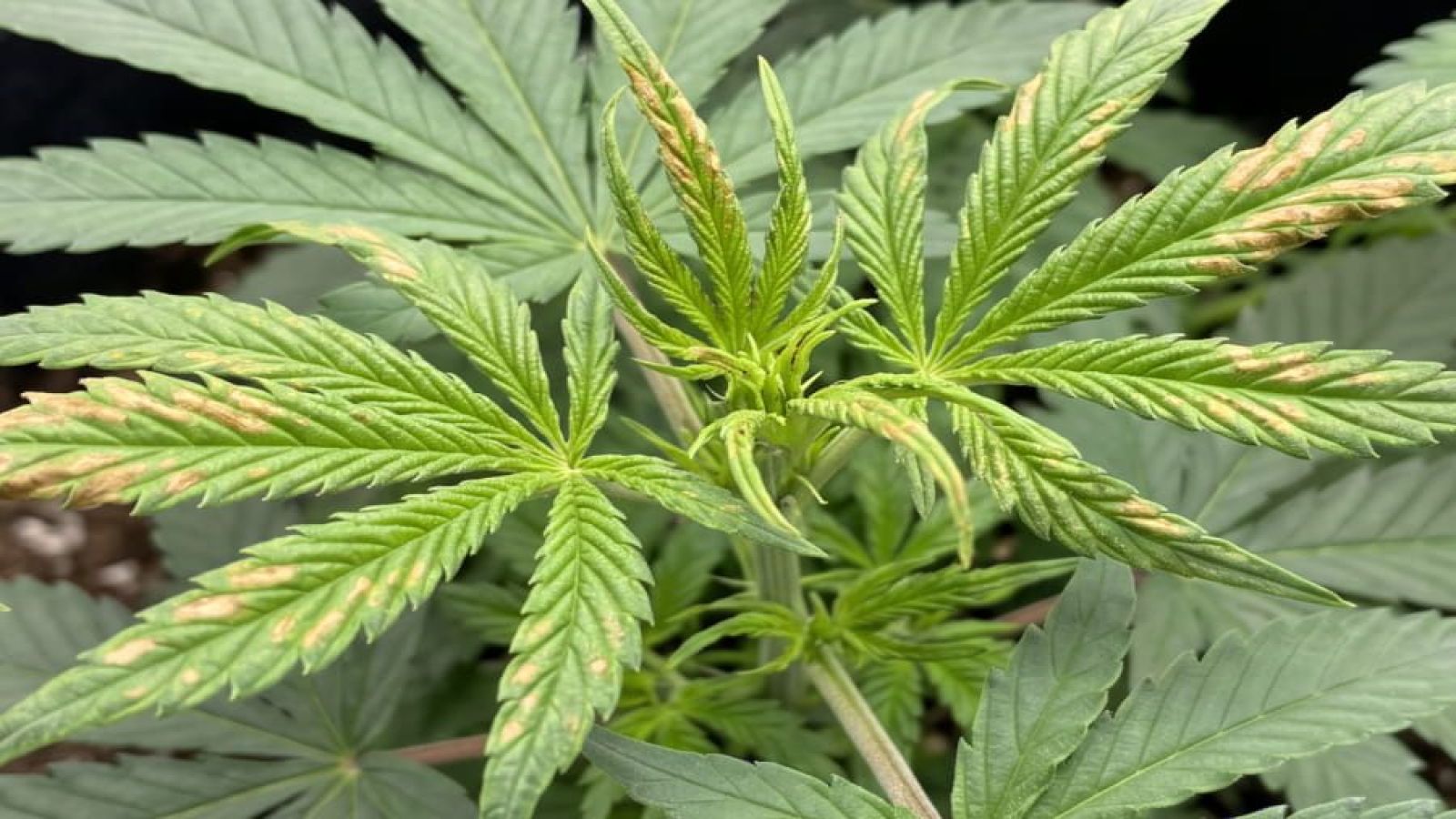
Large brown, irregular-shaped blotches on cannabis leaves are an early and unmistakable sign of calcium deficiency. As a semi-mobile nutrient (sometimes classified as immobile), calcium shows up on newer growth first.
Left uncorrected, the damage can spread to older leaves too, but the top-down start is a clear signal for diagnosis. Reading the symptoms in the right order tells you whether you're looking at calcium, magnesium or something else entirely. Here’s the full rundown:
- Damaged young leaves — the earliest sign of a calcium deficiency
- Brown blotches — the signature necrotic marks on young leaves
- Yellowing leaves — why and when a cal-mag deficiency shows up
Damaged Young Leaves With Twisted, Hooked Tips
Calcium-starved new growth curls, hooks and deforms because calcium builds the cell walls that hold leaf shape. Young leaves may cup upward, twist at the tip or emerge crinkled and stunted at the top of the plant, often signaling a calcium problem before anything else. It's the earliest warning you'll get, while the brown splotches are the more definitive confirmation.
Large Brown Spots on Weed Leaves: Calcium's Signature Deficiency Symptom
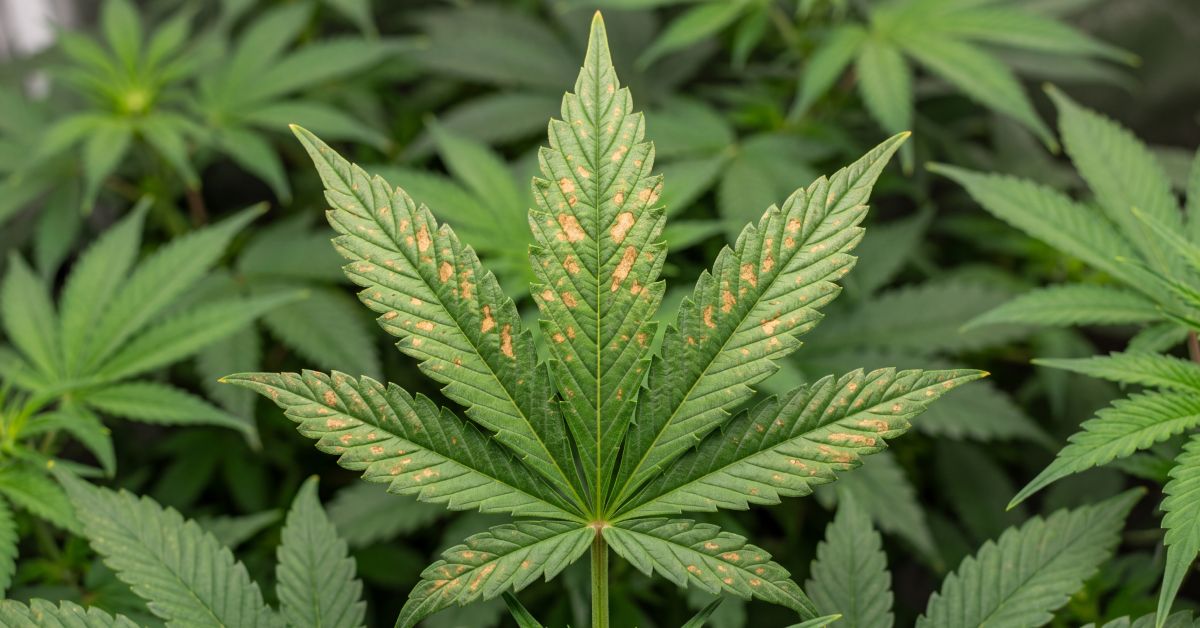
Cannabis leaf showing brown, rust-colored spots from calcium deficiency on new top growth.
Large, brown, splotchy spots from calcium deficiency appear near the leaf edges and tips, then darken into dead, sunken patches.
These necrotic blotches mean fresh cells are collapsing as calcium runs short. The blotching doesn't creep outward the way a fungal lesion does, but if you leave the deficiency uncorrected, the damage will eventually show up on older leaves as it progresses.
Yellowing Leaves With Brown Spots: Is It Cal, Mag or Cal-Mag?
Yellowing between the veins alongside brown spots usually points to a combined cal-mag deficiency rather than calcium alone. Pure calcium deficiency shows little yellowing, mostly brown necrotic spotting on new growth.
When you see interveinal yellowing with rust spots on older leaves at the same time, magnesium is likely short too. Calcium shows on new top growth while magnesium shows on the older lower leaves, so the location tells you which is leading. Correcting only one leaves the other in play, which is why growers treat them as a pair.
Calcium shows on new top growth while magnesium shows on the older lower leaves, so the location tells you which is leading. Correcting only one leaves the other in play, which is why growers treat them as a pair.
If the yellowing dominates and spots are minor, work through the signs of magnesium deficiency to confirm which nutrient leads.
Where Calcium Deficiency Appears on the Plant
Calcium deficiency hits the top of the plant first because calcium can't move from old leaves to feed new growth. This top-down pattern is the master signal for diagnosis and separates calcium from most other deficiencies.
Magnesium and potassium shortages, by contrast, start on the old lower leaves and work upward. Let location carry the most weight, since it narrows the diagnosis faster than color does.
What Causes Calcium and Cal-Mag Deficiency in Cannabis?
Cannabis calcium deficiency has two major causes: the calcium is genuinely lacking or it's there but locked out of range due to the wrong pH. A magnesium shortage often co-occurs because it shares the same root causes as a calcium deficiency — growers call this a cal-mag deficiency.
- pH and uptake - the range roots absorb calcium in, set by your medium
- Water and medium - why shortages are real with RO water, coco, and hydro
- Magnesium overlap - why the two show up together as a cal-mag deficiency
How pH Locks Out Calcium (& the Correct pH by Grow Medium)
Calcium uptake stalls when root-zone pH sits outside the range your specific medium needs. The correct target depends entirely on how you grow, so there is no single number that fits every setup.
| Medium | Ideal pH | Acceptable range | How you manage it |
| Soil (synthetic-fed) | 6.0–6.3 | 5.5–6.5 | pH the input, like coco/hydro |
| Organic / living soil | 6.0–6.3 | 5.5–6.5 | Don't pH water — soil self-buffers |
| Coco | 5.8–6.2 | 5.6–6.4 | pH the nutrient solution, check weekly |
| True hydro (DWC/NFT) | 5.8–6.2 | 5.6–6.4 | pH the solution, adjust daily |
The table sets the targets, but the method matters as much as the number. In a fully organic living soil, root-zone microbes regulate pH to what the plant needs, so you generally don't pH your water at all and skip pH Up/Down entirely.
Genuine out-of-range organic soil is corrected slowly with amendments: calcium carbonate or lime to raise pH, elemental sulfur plus acidic materials to lower it. One point growers miss: input water pH has only a small, temporary effect on soil pH, while water alkalinity from carbonates and bicarbonates is what actually shifts soil pH over time.
One point growers miss: input water pH has only a small, temporary effect on soil pH, while water alkalinity from carbonates and bicarbonates is what actually shifts soil pH over time.
Synthetic salt-based feeds change the rules in soil. These feeds inhibit the microbial buffering that living soil relies on, so a synthetic-fed soil grower does need to pH the input like a coco or hydro grower.
In coco, mix your nutrients into the water first and then pH the finished solution to the range above, checking it about weekly. In true hydro, pH the final solution and adjust it daily, since the nutrients themselves shift the reading that reaches the roots.
Treat runoff or reservoir readings as a warning light that flags drift, not as a number to chase up and down until it lands in range.
Soft Water, RO Water and Coco — Why Cal-Mag Supplements Exists
Reverse-osmosis water, coco coir, and true hydro setups all fall short on calcium in their own way, which is exactly why cal-mag supplements exist.
RO and soft water carry almost no dissolved calcium or magnesium to begin with. Coco coir has no natural mineral reserves either, so it depends entirely on what's in your feed. On top of that, coco actively binds calcium and releases potassium and sodium in its place, so even a well-balanced feed can arrive short.
True hydro has no growing medium at all to fall back on — whatever calcium is in the reservoir water is the entire supply, so a low-calcium water source leaves nothing to make up the gap. Growers on any of these setups usually use cal-mag as routine input, not as an emergency fix.
Why Calcium & Magnesium Co-Occur As a Cal-Mag Deficiency
Calcium and magnesium deficiencies cluster because they share the same common root causes (not because one triggers the other). RO water, distilled water, coco, and hydro all fall short on magnesium the same way they fall short on calcium, so a grower dealing with one is usually set up for the other too.
That shared vulnerability is what earned the pair the nickname ‘cal-mag deficiency.’
Calcium Deficiency vs Look-Alike Problems
Calcium deficiency is often confused with leaf septoria, boron deficiency, and potassium deficiency because these cannabis problems can cause similar markings and weakened growth. Location, spot pattern, and leaf symptoms are the fastest ways to tell them apart.
Direction is the giveaway: calcium works top-down, while septoria and magnesium start on the lower leaves and climb.
| Cannabis Plant Issue | Starts | Spot shape and color | Leaf symptom | How else it differs |
| Calcium Deficiency | New, upper leaves | Larger tan, brown, rust or bronze, irregular blotches | Curled, hooked | Twisted young leaves, weak stems |
| Leaf Septoria | Old, lower leaves | Smaller dark specks with a yellow halo | Normal | Spots rapidly expand and multiply |
| Boron Deficiency | New, upper leaves | Smaller brown necrotic speckling | Twisted, scorched look | Brittle, hollow stems and petioles |
| Potassium Deficiency | Old, lower leaves | Tan or brown necrotic spots | Browning tips and edges | Red-yellowish mottling between green veins |
Location is the strongest signal: calcium and boron start on new growth at the top, septoria and potassium start on old growth at the bottom, and fungus gnats don't follow a leaf pattern at all since the damage begins in the root zone.
What Is the Difference Between Leaf Septoria and Calcium Deficiency?
Leaf septoria is a fungal disease that spreads rapidly while a calcium deficiency is a nutrient problem that doesn't. Septoria spreads upward and outward — and even plant to plant — as it worsens, driven by humidity and wet foliage. Calcium spots are fixed dead tissue that won't grow larger, although new necrotic patches can eventually appear on older leaves if the deficiency progresses.
If new spots are appearing quickly across the plant week to week without any letup, that points to septoria rather than a feeding problem. Calcium damage plateaus once you fix the uptake or shortage behind it.
Are Black Dots and Spots on Weed Leaves a Deficiency or Pests?
No, black dots on weed leaves usually mean pests, not a feeding problem, especially if tiny flies hover over the soil. Fungus gnats and their larvae cause damage near the soil line and leave tiny dark specks, often with small flies hovering over wet medium.
Calcium and cal-mag deficiency produce brown or rust necrosis on new growth, never true black dots at the base. Check for flying insects around the pot before you reach for a supplement.
How Do You Fix Cannabis Calcium and Cal-Mag Deficiency?
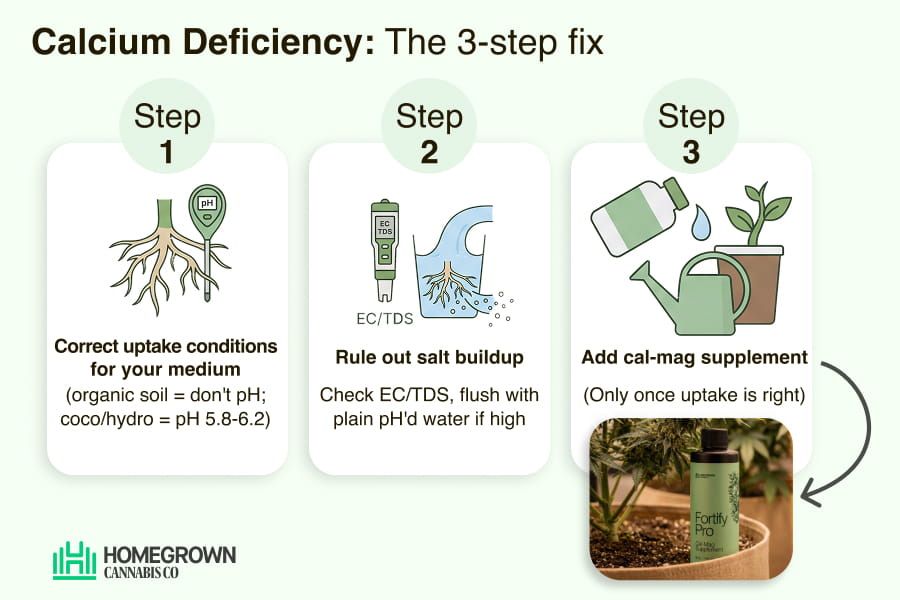
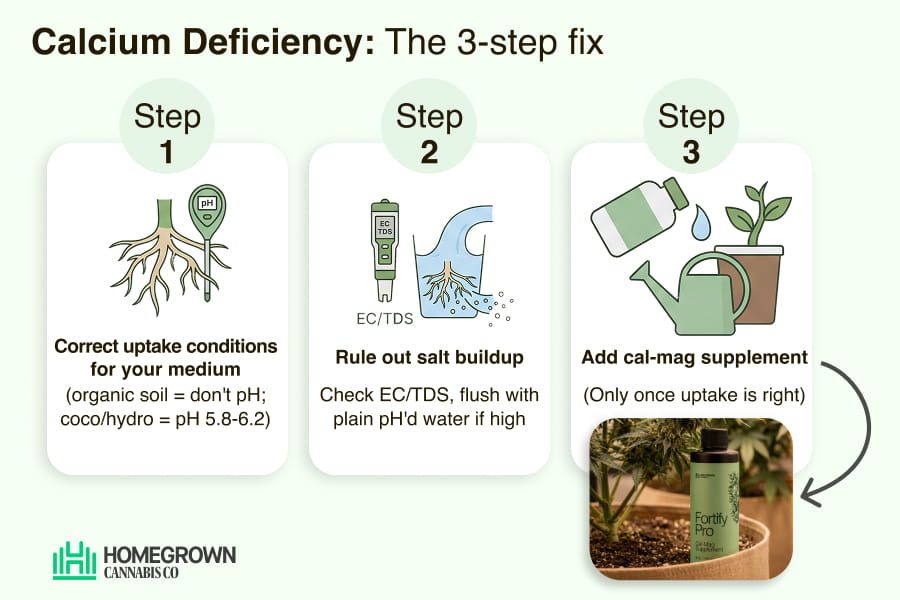
Fix uptake first, rule out salt buildup, then add cal-mag — the order matters for every growing medium.
You fix a cannabis calcium deficiency by matching your response to your growing medium, correcting uptake conditions first and supplementing only if a real shortage remains.
Working in the wrong order wastes nutrients and can create new problems, so follow the sequence below.
- Step 1 - correct uptake conditions for your medium
- Step 2 - rule out salt buildup before you assume a shortage
- Step 3 - add a cal-mag supplement only once uptake is right
Step 1 — Correct Uptake Conditions for Your Medium (How to Fix pH)
Fixing uptake conditions clears most calcium deficiencies before any supplement is needed. In organic living soil, don't start pH'ing your water, check first whether the soil pH is genuinely off, then correct it slowly with lime to raise or sulfur to lower.
In coco, mix your nutrients into the water first and pH that solution to 5.8–6.2, checking about weekly. In true hydro, pH the final solution to that same range but adjust it daily, and if you feed synthetic nutrients in soil, pH the input the same way but aim for the slightly higher, 6.0–6.3.
Step 2 — Rule Out Salt Buildup (When and How to Flush)
A salt buildup shows up as an EC (electrical conductivity) or TDS (total dissolved solids) reading well above your input, not as something you simply assume. When the runoff reads far higher than what you fed, dissolved salts have accumulated in the root zone and can block uptake.
A flush uses plain, pH'd water only with no nutrients mixed in, run through until roughly 30% drains out the bottom. Keep flushing separate from pH work, flushing clears salt, it does not correct pH and it does not cure a deficiency on its own.
When both salt buildup and pH drift apply at once, order matters. Flush first with plain pH'd water to clear the excess salts, then correct your pH going forward, and only then feed if a true shortage still remains. Running these as one blurred step leaves the underlying cause unfixed.
Watch for crispy brown tips right after a heavy feed, which usually signal nutrient burn from too-strong nutrients rather than any calcium shortage.
Step 3 — Add a Cal-Mag Supplement (What Cal-Mag Does for Weed Plants)
A cal-mag supplement delivers the calcium and magnesium that soft water and coco can't provide, but only after uptake is right. Cal-mag matters most for growers on RO water, soft tap water or soilless setups like hydro or coco coir, where the medium alone can't supply enough. Add it to the nutrient solution at the label rate, then watch the newest growth for improvement.
Damaged leaves won't heal or shed their spots, but healthy new growth should appear within one to two weeks once the fix takes hold.
Cal-Mag Deficiency in Flowering vs Veg vs Autoflower
Cal-mag demand climbs during flowering, which is when a shortage is most likely to surface. How fast a shortage develops, and how well the plant recovers, depends on both its stage and whether it's a photoperiod or autoflower plant.
- Flowering - peak calcium demand as buds build
- Veg and early stage - deficiency on the newest frame growth
- Autoflowers - a shorter window to correct
Cal-Mag Deficiency During Flowering
Flowering raises calcium demand as plants build dense buds, so deficiencies tend to surface in early-to-mid bloom. Bud sites demand heavy calcium to form firm, structured flowers, and a shortage here directly limits final quality. Late-stage cal-mag deficiency in flower shows brown spotting on the upper fan leaves closest to the colas.
Pay attention to catch it early, because the plant has less time to recover the closer it gets to harvest.
Cal-Mag Deficiency in Veg and Early Stage
Cal-mag deficiency in veg is the easiest to bounce back from, since the plant still has its whole flowering stretch ahead to grow out healthy tissue. Spotting and hooked tips on young growth are the first signs a veg plant needs attention.
Fixing uptake now sets up a stronger frame before the heavier demand of flowering arrives.
Cal-Mag Deficiency in Autoflowers
Autoflowers give less time to fix a deficiency, so early correction matters more. Their fixed, age-based life cycle means a lost week to deficiency is a week they can't make up. Autoflower leaf problems caught late in the cycle rarely fully recover before harvest.
Growers running autoflower seeds should check pH and cal-mag input from the first weeks of growth.
Can You Give Cannabis Too Much Calcium? (Calcium Toxicity)
Yes, cannabis can get too much calcium, though calcium toxicity is far rarer than deficiency. Excess calcium rarely burns the plant directly, but it can lock out potassium by competing for uptake at the roots. The result often looks like a potassium deficiency, which sends growers chasing the wrong fix.
If symptoms appear right after heavy cal-mag dosing, ease back the dose and confirm salt buildup with an EC reading before doing anything else.
Start With Strong Genetics
Strong genetics give a plant more tolerance for minor feeding swings, and starting from quality feminized cannabis seeds lets you focus on nutrition and health instead of sexing plants. For growers building a full library where cultivation is lawful, our marijuana seeds span the cultivars and seed types that handle a range of grow conditions.
Frequently Asked Questions
What Does Cal-Mag Do for Weed Plants?
Cal-mag supplies calcium and magnesium that soft water and coco coir can't provide on their own. Calcium builds cell walls and firm structure, while magnesium powers chlorophyll and photosynthesis. Growers on RO water, soft tap water or coco run it as routine input rather than an occasional fix.
What Is the Best pH for Cannabis, and Does It Depend on the Medium?
Yes, the target pH depends on your growing medium. Synthetic-fed soil runs best at 6.0–6.3, while coco and hydro prefer 5.8–6.2. Organic living soil is the exception, it buffers its own pH, so you generally don't pH the water at all.
Do You pH Your Water in Organic Soil?
No, in a fully organic living soil you generally don't pH your water. The root-zone microbes regulate pH to what the plant needs, so pH Up and Down aren't part of the program. Genuine pH problems are corrected slowly with amendments like lime or sulfur instead.
Can You Use Cal-Mag Every Watering?
Yes, many growers on RO or soft water use cal-mag at every feed. Coco growers especially run it as standard input because the medium binds calcium. Follow the product label rate and watch new growth to confirm the plant is responding.
Will Flushing Fix a Calcium Deficiency?
No, flushing does not fix a calcium deficiency. A flush with plain pH'd water clears excess salt buildup from the root zone, which is a separate problem confirmed by a high EC reading. Once salts are cleared, you still correct pH and feed if a true shortage remains.
What Are the Most Common Cannabis Plant Deficiencies?
Cannabis plant deficiencies most often involve calcium, magnesium, nitrogen, potassium and phosphorus. Each shows a distinct pattern: calcium hits new growth, while magnesium and potassium start on old lower leaves. Reading where the damage begins is the fastest way to narrow down which nutrient is short.