



How to Fix Cannabis Boron Deficiency: Symptoms & Recovery
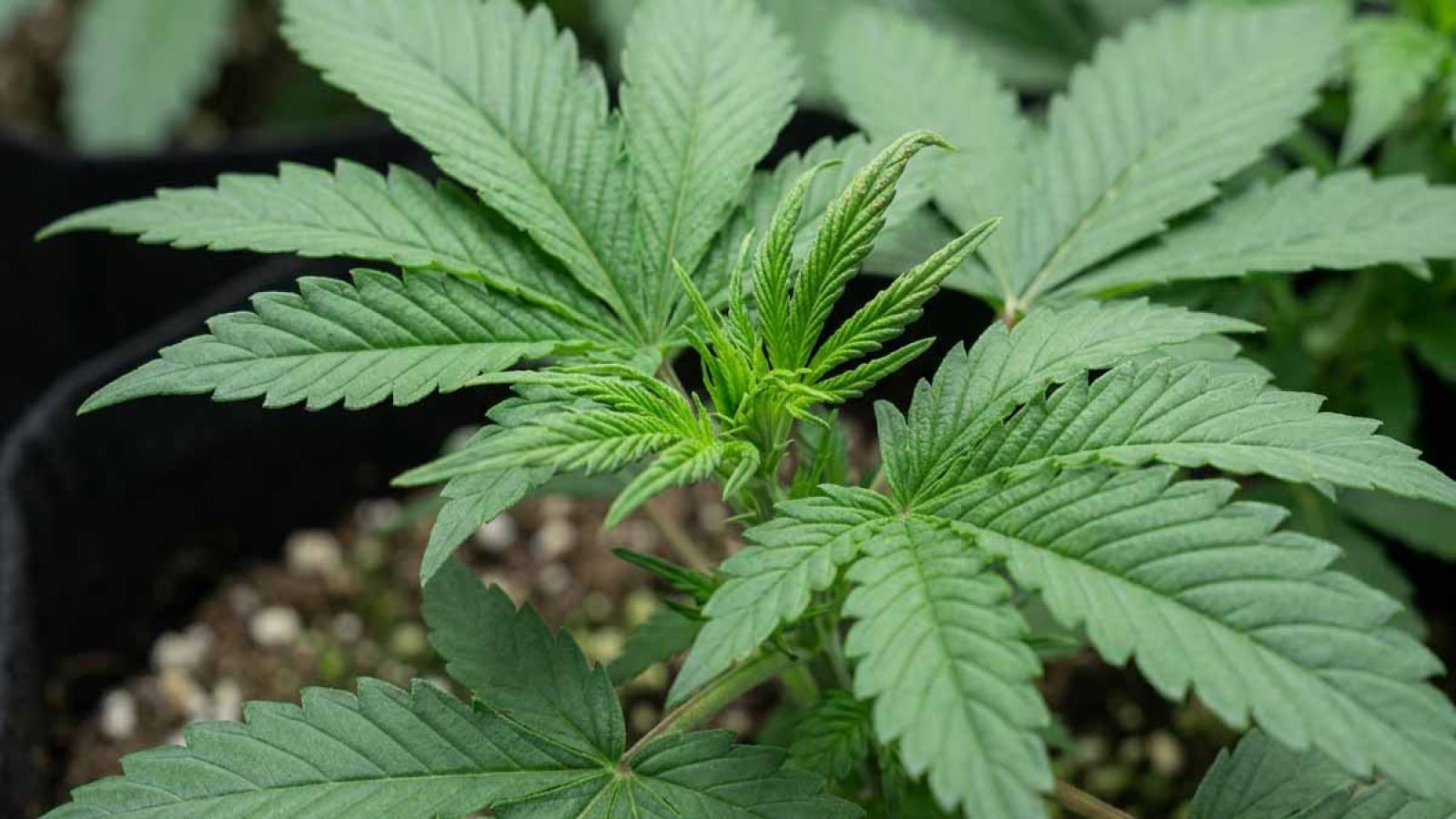
A boron deficiency in cannabis damages new growth first, twisting the growing tips, spotting young leaves brown, and leaving stems brittle or hollow. It looks so much like a calcium problem that growers often treat the wrong issue, because boron keeps calcium soluble and usable inside the plant.
Below you'll learn how to spot it, tell it apart from calcium, find the real cause, and fix it the right way for your setup. You'll also see what actually recovers and what doesn't.
The quick version: the real cause is usually a pH problem at the roots or underwatering, not a true boron shortage. That's why adding more boron rarely helps, and why the right fix depends on whether you grow in living soil, coco or hydro. Correct the root-zone conditions and healthy new growth returns, though the damaged growth won't repair itself.
What Is a Boron Deficiency in Cannabis?
A boron deficiency in cannabis develops when the plant cannot access enough boron to build new cell walls. Boron is a micronutrient, meaning the plant needs only tiny amounts of it, but those amounts are essential for healthy new tissue.
Boron is also immobile once the plant absorbs it, so the roots and older leaves can't share their supply with fresh growth. That immobility is what concentrates the damage in the newest growth, and what separates a boron problem from most other deficiencies.
Boron deficiency is uncommon in a well-run grow. It tends to appear when a plant is underwatered or when root-zone pH blocks uptake.
Because the symptoms overlap with calcium, growers frequently misdiagnose it, so confirming the cause matters before you treat anything.
What Does Boron Do for Cannabis Plants?
Boron supports cell-wall formation, calcium uptake and reproductive development in cannabis plants. Strong cell walls give stems and new shoots their structure, which is why a shortage makes growth twist, thicken and turn brittle.
Boron also works alongside calcium, so when boron runs low the plant struggles to use the calcium it already has. The relationship works in reverse too; too much calcium in the feed can suppress boron uptake, which is part of why the two deficiencies often appear together.
Boron plays a role in flowering and seed development too, because it affects how reproductive tissue forms. This is why a prolonged shortage can damage growth tips and developing flower sites, not just leaves. Growers pay little attention to this nutrient, but its structural role makes its absence obvious once it shows up.
What Are the Symptoms of Cannabis Boron Deficiency?
Cannabis boron deficiency symptoms start with twisted, thickened growth tips and brown or yellow spotting on young leaves, then progress to brittle stems and dying tips.
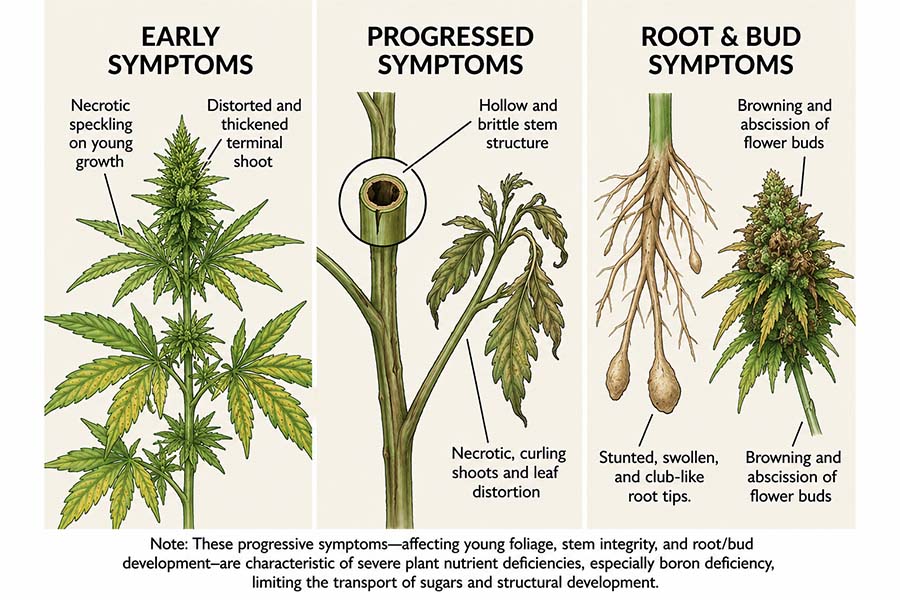
Boron deficiency progression
The damage moves through recognizable stages, and knowing the stage helps you judge how far the problem has progressed. Here's how the symptoms develop:
- Early symptoms - the first visible signs, when recovery is easiest.
- Progressed symptoms - spreading damage to stems and growth tips.
- Effects on roots and buds - deeper structural damage that signals a longer-standing shortage.
Early Symptoms of Boron Deficiency in Cannabis
Early boron deficiency shows as abnormal, thick growth tips with brown or yellow spotting on young leaves. New leaves may wrinkle, curl or unfold more slowly than healthy growth.
The spots often look like the early stage of several deficiencies, so this stage alone rarely confirms boron. Watch the growing tips closely, because distorted new growth is the more telling signal at this point.
Progressed Symptoms of Boron Deficiency in Cannabis
As boron deficiency progresses, it reaches the stems and worsens the damage already in the growth tips, leaving stems brittle and sometimes hollow. New shoots lose vigor, curl and can turn gray or brown, and the primary growth tip may stop expanding.
Stems lose firmness because boron no longer maintains cell-wall strength, and that texture change is one of the most reliable boron signals you can check by hand.
Effects on Roots and Buds
Boron deficiency slows root growth and can cause developing buds to die back. The root system slows and stunts overall, while the fine secondary roots go short, swollen and club-like as their tips die back, leaving them open to rot and infection. In flower, developing bud sites can brown and stop maturing because boron affects reproductive tissue.
Damage this deep usually means the shortage has run for a while, so act quickly once you see it.
Is It Boron or Calcium Deficiency in Cannabis?
Cannabis boron deficiency and calcium deficiency produce similar brown spotting, because boron is what keeps calcium in a soluble, usable form. Both hit new growth, and both share the same pH and moisture triggers. Heavily filtered water belongs to calcium alone, since RO strips dissolved calcium but barely dents boron.
The clearest way to tell them apart is spot size: boron leaves small, tight necrotic specks (think strawberry seeds), while calcium tends toward larger dead blotches. Boron also brittles and hollows out the stems, though weak stems alone won't separate the two, since calcium weakens them as well.
If your plant also shows a calcium deficiency, restoring boron helps the plant hold that calcium in a usable form again.
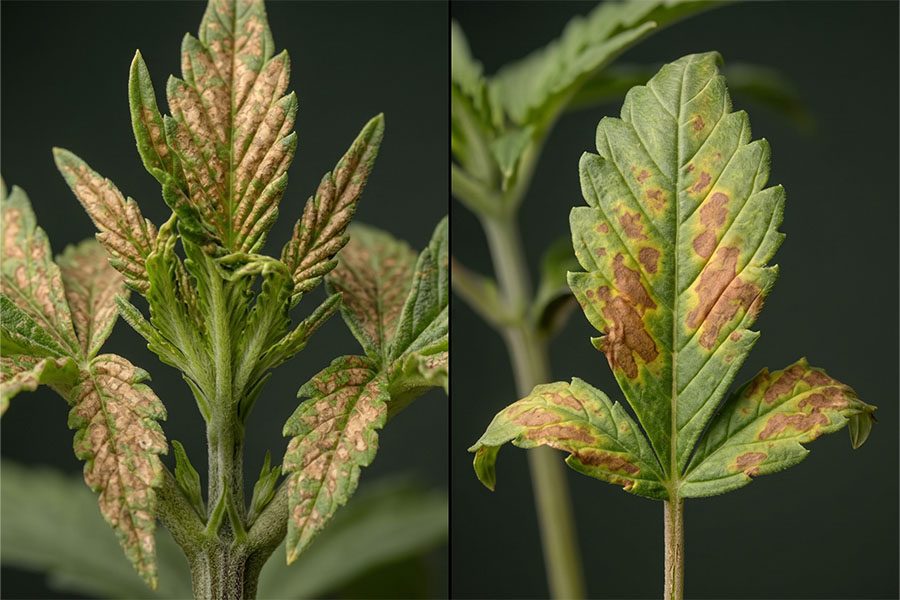
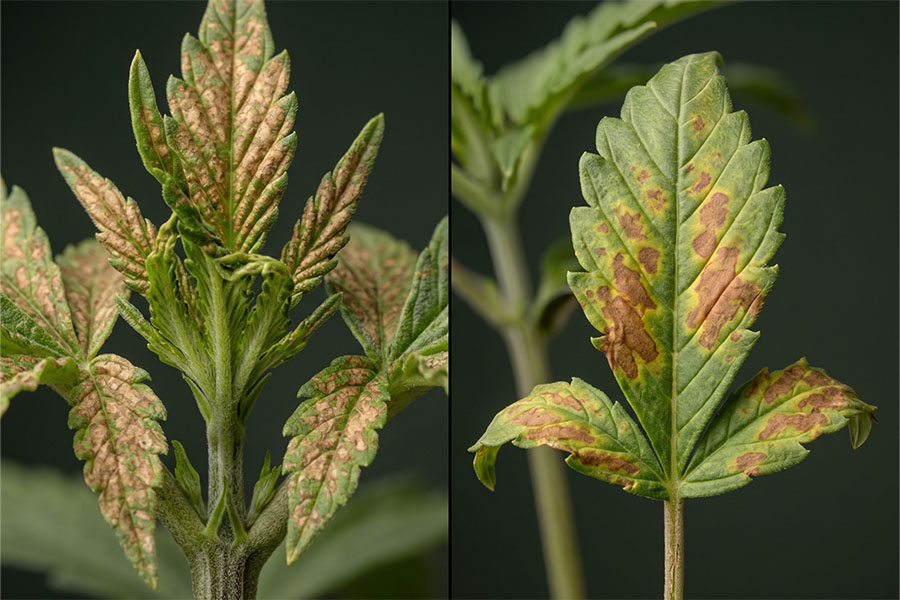
Boron vs calcium: boron leaves small, tight specks; calcium leaves larger blotches. Spot size is your tie-breaker.
|
Trait |
Boron deficiency |
Calcium deficiency |
Reliability |
|
First damage location |
New growth, top tips |
New growth (similar) |
Medium |
|
Spot size |
Small, tight specks (strawberry-seed size) |
Larger brown blotches |
High |
|
Growth tips |
Twisted, thick, may die off |
Distorted, less twisting |
Medium |
|
Stems |
Brittle, can go hollow |
Weak, crack easily |
Medium |
|
Roots |
Slowed, stunted, swollen |
Less affected |
Medium |
|
Common trigger |
pH lockout, underwatering |
pH, low Cal-Mag, RO water |
Medium |
Use spot size as your tie-breaker, since it's the trait that most reliably separates the two. Boron's spots stay small and tight; calcium's run larger.
Stem damage and twisted tips flag a problem but won't confirm which nutrient on their own, because both deficiencies weaken the stems. When the signals stay ambiguous, treat the shared causes first - pH and moisture - because that corrects both.
What Causes Boron Deficiency in Cannabis?
Boron deficiency in cannabis results from a pH problem at the roots, usually on the high side, or from underwatering, more often than from a true boron shortage. Sandy or low-organic-matter media and cold root-zone temperatures are additional, less common risk factors worth knowing.
When root-zone pH sits too high, the plant can't absorb the boron that's already present, so the deficiency is really a lockout.
A dry root zone causes the second most common trigger, because boron moves to new growth on the transpiration stream. A plant that isn't drinking steadily can't move boron into new growth, and very high, stagnant humidity makes it worse by slowing transpiration.
Reverse-osmosis (RO) water gets blamed for boron shortages, but boron is stubborn stuff that filtering struggles to remove, so it's rarely the real culprit. Over-fertilizing can also lock nutrients out at the roots.
In most grows, the boron is physically there; the plant just can't reach it - which is why adding more boron is rarely the right first move.
How Do You Fix Boron Deficiency in Cannabis Plants?
You fix boron deficiency in cannabis plants by correcting root-zone pH the right way for your medium, then confirming steady moisture. Most guides tell you to pH your water and flush. That works for coco and hydro, but living soil manages its own pH, so the right move depends on how you grow.
Work through these three steps in order:
- Correct pH the right way for your medium - the single most common fix, handled differently in soil, coco and hydro.
- Restore consistent watering and humidity - a real, independent trigger that pH correction won't solve.
- Flush only if salt has built up - a separate job that clears salts, not a pH fix and not a deficiency cure.
Correct pH the Right Way for Your Medium
The correct pH fix depends on your growing medium. In organic or living soil, root-zone microbes buffer pH to what the plant needs, so you don't pH your water or use pH Up/Down. Genuine out-of-range soil is corrected slowly with amendments, using lime to raise pH and elemental sulfur to lower it.
In coco and synthetic-fed soil, mix your nutrients into the water first, then pH the finished solution to range. In true hydro — DWC, NFT, rockwool or LECA — pH the final nutrient solution daily, because the nutrients shift it and that solution is what reaches the roots.
Target the ranges that suit each medium: soil sits best at 6.0–6.3, with 5.5–6.5 acceptable, while coco and hydro run best at 5.8–6.2, with 5.6–6.4 acceptable.
Restore Consistent Watering and Humidity
Steady watering and good airflow restore the moisture flow boron needs to reach new growth. Underwatering triggers boron deficiency on its own, separate from any pH problem, and very high, stagnant humidity compounds it by slowing the transpiration that carries boron into new tissue.
A regular watering routine keeps that flow steady, and decent air movement through the canopy keeps transpiration ticking over. Fix the moisture and you remove one of the two most common causes outright.
Flush Only If Salt Has Built Up
A flush clears salt buildup; it does not correct pH or cure a deficiency. Only flush when an EC or TDS reading sits well above your input, which confirms salts have accumulated, rather than assuming it. Run plain, pH-corrected water with no nutrients mixed in until roughly 30% drains from the bottom.
When both salt buildup and pH drift apply, flush first, then correct pH on your following feeds, and supply boron only if a true shortage remains. Add it gradually and watch closely, because boron overcorrects into toxicity easily.
Will Cannabis Recover From a Boron Deficiency?
Yes, cannabis usually recovers once you correct pH, moisture and boron supply, though damaged growth will not repair itself. The leaves, tips and stems already harmed stay that way, so don't judge the fix by whether old damage heals.
Watch the newest growth instead: clean, healthy tips emerging above the damage tell you the problem has stopped spreading. Recovery is a signal you read at the top of the plant, not a reversal of what's already scarred.
Other Cannabis Nutrient Deficiencies to Rule Out
Cannabis boron deficiency overlaps in appearance with several other nutrient deficiencies that damage new growth and leaf color. Its closest look-alike is a calcium deficiency, since the two nutrients depend on each other and produce similar spotting.
Damage that starts on older lower leaves instead points away from boron and toward a potassium deficiency, which shows as browning edges and burnt tips. Yellowing new tips and wilting can signal a copper deficiency, another trace nutrient that locks out at the wrong pH. Confirming which deficiency you're facing keeps you from treating the wrong problem.
How Do You Prevent Boron Deficiency in Cannabis?
You prevent boron deficiency in cannabis by maintaining correct pH, steady watering and a complete nutrient source. Keep your medium in its target pH range, water on a consistent schedule, and hold humidity in a healthy band (roughly 40 to 60% in veg, lower through flower) so boron keeps reaching new growth without inviting mold or bud rot.
Use a full cannabis nutrient program rather than isolated additives, and avoid over-fertilizing, which locks nutrients out at the roots. Running a complete, balanced nutrient line keeps a steady supply of boron in the mix, so the plant never has to reach for what isn't there. Starting with quality cannabis seeds, including feminized cannabis seeds or autoflowering seeds, also gives your grow a strong foundation.
Grow only where cultivation is lawful under federal, state and local rules.
Frequently Asked Questions
Is Boron Deficiency in Cannabis Common?
No, boron deficiency is uncommon in a well-managed grow. It usually appears only when a plant is underwatered, sits in stagnant, high humidity that stalls transpiration, or is held at a root-zone pH that blocks uptake.
Do You Need to pH Your Water to Fix Boron Deficiency in Cannabis?
It depends on your medium. In organic or living soil, the soil buffers its own pH, so you correct it with slow amendments rather than pH'd water — but in coco, hydro and synthetic-fed soil you do pH the finished nutrient solution to range.
Can Too Much Boron Hurt Cannabis?
Yes, excess boron causes toxicity, which shows as yellowing, dying leaf tips. Boron overcorrects easily, so add it gradually and monitor the plant rather than dosing heavily.
How Long Does Cannabis Take to Recover From a Boron Deficiency?
New healthy growth usually shows within three to five days of correcting pH and moisture. The existing damaged growth won't recover, so judge progress by clean new tips rather than by the old leaves.