




Spider Mites on Cannabis: Identification, Damage, Webs and Control

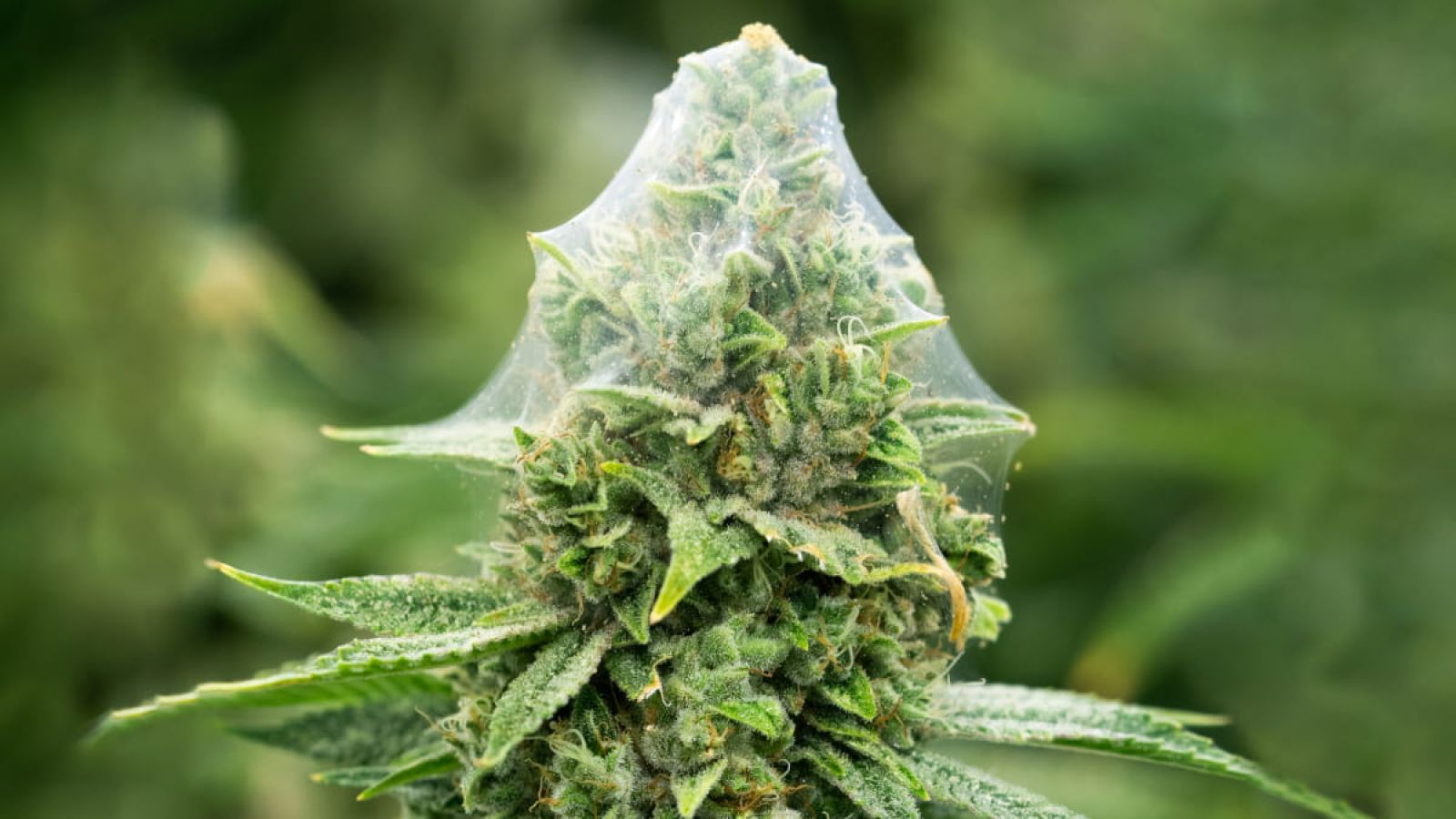
Tiny speckles on your fan leaves and fine webbing across the canopy usually mean one thing: spider mites have moved in. These sap-feeding pests breed fast, hide on leaf undersides and can strip a healthy cannabis plant of vigor in days if you miss the early signs.
This guide shows you how to identify spider mite damage, eggs and webs, how to tell mites apart from harmless spiders, and how to get rid of them at every stage, including flowering. By the end you'll know what to look for and how to protect your crop before the infestation spreads.
At a glance:
Spider mite damage shows first as fine yellow stippling on fan leaves plus tiny dots on the undersides (that's mites, not nutrient burn), fading to a silvery, sandblasted look as the colony grows. Rinse the plants, isolate them and start treatment the same day; webbing means the colony is already large.
What Are Spider Mites on Cannabis?
Spider mites are tiny sap-feeding arachnids that colonize the undersides of cannabis leaves and pierce the plant tissue to drain its fluids. The most common culprit in a grow is the two-spotted spider mite, a pest barely visible to the naked eye that ranges from pale yellow to red-brown.
These mites reproduce in days under warm, dry conditions, so a handful of them turns into hundreds across a weed plant fast. Left alone, they weaken photosynthesis, stunt growth and eventually kill leaves outright.
Spider mites target cannabis because the plant's broad, tender fan leaves offer easy feeding and shelter. Warm indoor tents and hot outdoor summers give them the exact conditions they thrive in.
Catching them at the pinhead stage is the difference between a quick fix and a full-blown invasion.
Are Spider Mites Spiders or Something Else?
No, spider mites are not true spiders. They are arachnids in the mite family, which is why growers hunting for "weed spiders" are usually looking at mites without realizing it. Both have eight legs, but spider mites are far smaller than any spider you'd notice crawling across a plant.
True spiders in a grow space are usually harmless predators that eat other bugs, while spider mites feed directly on your cannabis and cause the damage.
If you spot an actual web-spinning spider sitting in a corner, it's likely helping you. The pests draining your marijuana plants are the near-invisible mites clustered on the leaf undersides.
Do Spider Mites Bite Humans?
No, spider mites do not bite humans. They feed only on plant tissue and have no interest in people or pets. Their mouthparts are built to pierce leaves and drain sap, not skin, so you won't get bites from handling an infested cannabis plant. Any itch you feel while inspecting a plant is far more likely from leaf hairs or general skin sensitivity than from the mites themselves.
Spider mites can hitch a ride on your clothes and spread to clean plants, though. That's a transfer risk to your grow, not a health risk to you.
How Do You Identify Spider Mite Damage on Cannabis?
Spider mite damage on cannabis appears first as tiny yellow speckles scattered across the tops of fan leaves, only paling to a silvery white as feeding intensifies. This stippling comes from mites puncturing individual plant cells and draining them, leaving pinprick dots that spread as the colony grows.
As feeding intensifies, whole leaves fade to yellow or bronze, curl at the edges and drop early. Growers often mistake the early speckling for a nutrient deficiency, which costs precious days.
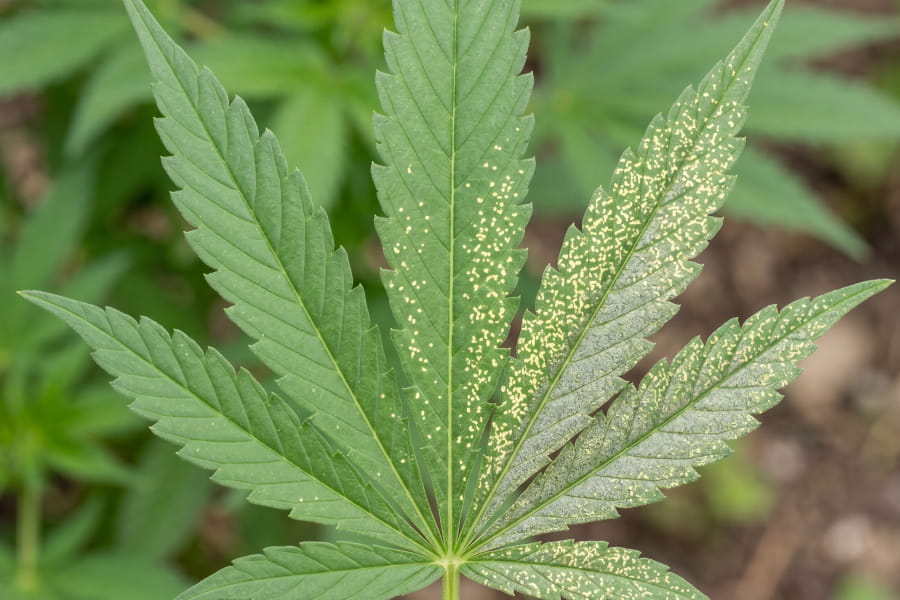
Fine yellow stippling across the top of a fan leaf is one of the earliest signs of spider mite feeding, often mistaken for a nutrient problem.
The fastest way to confirm mites over a nutrient issue is to flip a speckled leaf and check the underside. Nutrient problems don't leave moving dots or fine silk, but a mite colony does. A magnifier or phone camera zoom reveals the pests, their eggs and the beginnings of webbing.
What Do Spider Mite White Spots Look Like?
Spider mite spots start as fine, even yellow stippling across the top surface of cannabis fan leaves, unlike the larger blotches of nutrient burn or the yellow wedges of a deficiency. Each tiny dot marks a spot where a mite drained a leaf cell of its chlorophyll.
Held to the light, a heavily fed leaf pales to a sandblasted, silvery white as the dots merge and the tissue dies. This pattern is one of the clearest early tells that mites, not feeding problems, are hitting your plants.
What Do Spider Mite Eggs Look Like?
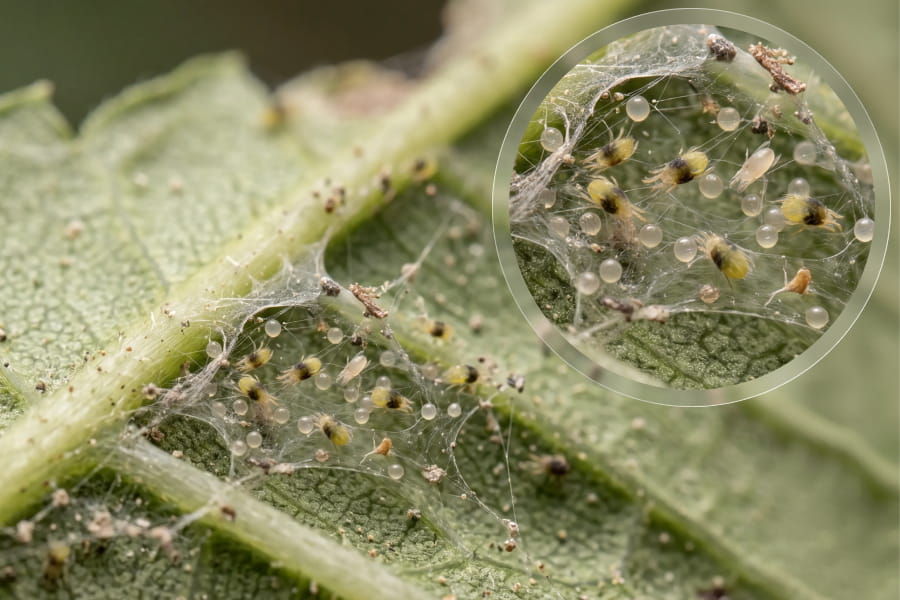
Spider mite eggs look like tiny translucent spheres clustered along the undersides of leaves, usually near the veins where mites shelter.
Each egg is round, slightly pearlescent and smaller than a grain of salt, so a magnifier makes them far easier to see. A single female lays dozens of eggs that hatch within days in warm conditions, which is why infestations rebound quickly if you only kill the adults.
Any effective treatment has to break the egg cycle, not just wipe out the mites you can see.
What Do Spider Mite Webs on Cannabis Mean?
Spider mite webs signal a heavy, advanced infestation that has already spread across the cannabis canopy. The fine silk stretches between leaves, stems and even buds, and the mites use it to travel and shield their colony.
By the time webbing is visible, you're no longer dealing with a few pests, you're facing thousands. Webbing on buds is the worst case, because silk and mite debris are nearly impossible to fully clean off harvested flower.
Fine silk webbing stretched across the canopy signals a heavy, advanced infestation with a colony that has long since spread beyond a few pests.
Webbing means treatment can't wait and a single spray won't cut it. Rinse the plants hard, isolate them from the rest of the grow and commit to repeated treatments over the next two to three weeks. Any web-covered nugs close to harvest may not be salvageable, so protecting the rest of the crop becomes the priority.
How Do You Get Rid of Spider Mites on Cannabis?
You get rid of spider mites on cannabis by combining physical removal, targeted sprays and repeated treatment that breaks the egg cycle. No single method wipes out a colony in one pass, because eggs keep hatching after the adults die.
The reliable approach layers several tactics and repeats them every few days until the plants stay clean.
Here's how the toolkit breaks down:
- Best ways to kill spider mites — the core methods, from a water rinse to sprays and predators, and how to rotate them.
- Does BT kill spider mites — a common misconception worth clearing up before you waste a treatment.
- Getting rid of them during flowering — the residue-free approach for plants that are already budding.
Best Ways to Kill Spider Mites on Cannabis
The best ways to kill spider mites on cannabis start with a strong water rinse to knock colonies off the leaves, then rotate treatments so the mites never adapt. A firm spray of water on the leaf undersides physically removes a large share of the population and buys you time.
From there, insecticidal soap, neem oil and horticultural oils smother mites and eggs on contact, while dedicated miticides handle stubborn colonies. Rotating between two or three options prevents the survivors from building resistance to any one treatment.
Predatory mites are a powerful biological option, especially in indoor tents, since they hunt spider mites without harming the plant. Home remedies like diluted soap sprays can work on light infestations, but they need the same repeat-every-few-days schedule to break the egg cycle.
Whatever mix you choose, treat the whole plant, isolate it from healthy stock and re-inspect the undersides after each round.
Does BT Kill Spider Mites?
No, BT does not kill spider mites, because Bacillus thuringiensis targets the larvae of caterpillars and fungus gnats, not arachnids. BT is a bacterial insecticide that works on the digestive systems of specific insect larvae, and spider mites simply aren't in that group. Reaching for BT against a mite outbreak wastes days you don't have while the colony keeps breeding.
For mites, stick with rinses, oils, insecticidal soap, miticides or predatory mites instead.
How Do You Get Rid of Spider Mites During Flowering?
Getting rid of spider mites during flowering relies on residue-free methods, because buds readily absorb sprays and hold onto anything you put on them. A gentle water rinse and a careful application of insecticidal soap or light neem to the fan leaves — kept off the buds — are the safest tools this late in the cycle.
Predatory mites shine here too, since they leave no residue on the flower. Heavy oils and harsh chemicals are off the table once buds have formed, so early detection matters even more in bloom. Where growing cannabis is lawful, eligible adult growers should always follow the product label and local rules on what can be applied to a flowering plant.
If webbing has already reached the buds, weigh whether those colas are worth saving. Protecting the clean flower on the rest of the plant usually matters more than rescuing a few contaminated nugs.
How Do You Prevent Spider Mites on Cannabis?
You prevent spider mites on cannabis by scouting early, keeping the grow space clean and denying the pests the warm, dry, still conditions they breed in.
Check leaf undersides every few days with a magnifier, since catching the first few mites beats fighting a colony later. Quarantine every new clone or plant before it joins your grow, because infested stock is the most common way mites get in. Good airflow, moderate temperatures and controlled humidity make the environment far less friendly to them.
Cleanliness between grows matters just as much as scouting during one. Wipe down tents, tools and surfaces, and keep clothing and pets from ferrying mites in from outside. A tidy space and a healthy plant together form the cheapest, most reliable defense you have.
How Healthy Genetics Support Spider Mite Resistance
Healthy genetics give cannabis plants the vigor to shrug off pest pressure that would overwhelm a weaker, stressed plant. Strong, stable seeds produce robust plants with dense foliage and steady growth, and a vigorous plant recovers from a mite setback far faster than a struggling one.
Starting your grow with quality marijuana seeds sets the foundation, since resilient stock is your first line of defense before any spray enters the picture. Genetics won't make a plant mite-proof, but they tilt the odds in your favor.
Seed type also shapes how much exposure a plant faces over its life. Feminized cannabis seeds grow into all-female plants with predictable, uniform vigor, which makes scouting and early treatment simpler across the whole canopy.
Autoflower seeds finish their cycle quickly, so their shorter lifespan naturally limits the window a mite colony has to explode. Pairing solid genetics with early scouting is the most reliable long-term guard against spider mites.
Frequently Asked Questions About Spider Mites on Cannabis
Are Those Spiders on My Weed Plant or Spider Mites?
If the specks are near-invisible, clustered on leaf undersides and paired with white stippling or webbing, they're spider mites, not spiders. True spiders are larger, easy to see and generally beneficial because they eat other pests. Most "weed spiders" turn out to be spider mites the moment the grower flips a leaf and looks closely.
What Causes Spider Mites on Weed Plants?
Spider mites usually arrive on infested clones, contaminated soil, nearby plants, or by hitching a ride on clothing, pets and gardening tools. Once they're in, warm and dry conditions let them multiply fast. They don't appear from nothing, a mite outbreak almost always traces back to something or someone that carried them into the grow.
Can You Smoke Buds That Had Spider Mites on Them?
Buds with light, early mite exposure are often fine once treated and cleaned, but heavily webbed flower carrying silk, eggs and debris is not worth smoking. Webbing traps contaminants that a rinse can't remove from dense colas. When mites reach the buds late in flower, protecting the clean flower elsewhere on the plant is the smarter call.
What's the Best Home Remedy for Spider Mites on Weed Plants?
The most reliable home remedy is a firm water rinse of the leaf undersides followed by an insecticidal soap or diluted neem spray, repeated every few days. The repeat schedule matters because it breaks the egg cycle that a single spray leaves behind.
Light infestations respond well to this approach, but heavy or web-covered plants usually need dedicated miticides or predatory mites on top of it.