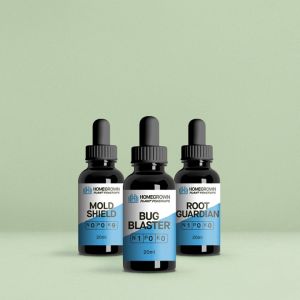
New
$5.99



Are you over 21 years of age?
Discover the best cannabis fertilizers to boost growth, yield, and quality across every stage. You’ll find everything from weed nutrients, organic fertilizers and bloom boosters to root stimulants, cal-mag supplements and grow supplies at Homegrown Cannabis Co.

 Filter
Cannabis fertilizer delivers the nitrogen, phosphorus and potassium that weed plants need to support growth through every stage. Cannabis plants grown in containers or soilless media can't draw nutrients from a living ecosystem. External feeding fills that gap from the seedling stage through harvest.
Typically, cannabis fertilizer supplies three tiers of nutrients:
Marijuana fertilizer comes in liquid concentrates, dry powders and organic amendments, each suited to a different growing setup and feeding style.
Cannabis plants need different nutrient ratios at each growth stage, and the balance shifts substantially from seedling to harvest.
Cannabis plants shift their nitrogen (N), phosphorus (P) and potassium (K) demands at each stage of growth. High nitrogen drives stem and leaf production in veg. High phosphorus and potassium fuel bud development in flower. Use the table below as a quick N-P-K ratio reference guide:
| Growth Stage | Nitrogen (N) | Phosphorus (P) | Potassium (K) | Example Ratio | Key Function |
| Seedling | Low | Low | Low | 1-1-1 | Supports early root and leaf development |
| Vegetative | High | Medium | Medium | 3-1-2 | Drives stem, leaf and canopy growth |
| Early Flowering | Medium | High | High | 1-3-2 | Supports stretch and flower site formation |
| Late Flowering | Low | High | High | 0-2-2 | Maximizes bud density and weight |
The biggest gains in bud weight come from a high phosphorus and potassium formula in the late flowering stage. Reduce nitrogen gradually as plants enter bloom rather than cutting it abruptly to prevent stress during the stretch phase.
Calcium and magnesium are the secondary nutrients most likely to create visible deficiencies in weed plants grown in containers and soilless media. Coco coir naturally binds calcium and magnesium, so growers using coco need a cal-mag supplement alongside their base nutrients from the start.
Quality cannabis fertilizers include iron, manganese, zinc, copper, boron and molybdenum as micronutrients. These elements support enzyme function and plant metabolism at low concentrations.
Organic and synthetic cannabis fertilizers suit different growing styles and goals, and neither is universally better.
Organic cannabis nutrients derive from natural sources like worm castings, bat guano, bone meal and kelp. Soil microbes break them down before plants absorb them, which builds long-term soil health and lowers overfeeding risk.
Organic feeding programs are widely favored by growers focused on terpene complexity, flavor and aroma. They work best in soil grows and are less effective in hydroponic systems, where the absence of microbial activity limits nutrient release.
Synthetic cannabis nutrients are chemically formulated for immediate absorption. Your plants take them up as soon as they reach the root zone. This makes synthetics the standard for hydroponic and coco coir grows, where there's no soil biology to moderate nutrient release. Precision dosing is easy, but overfeeding risk is higher than with organic options.
| Feature | Organic Nutrients | Synthetic Nutrients |
| Absorption speed | Slow (days to weeks) | Fast (immediate) |
| Dosing precision | Low (microbial-dependent) | High (exact ratios) |
| Soil health | Builds microbial life | Can degrade over time |
| Overfeeding risk | Lower | Higher |
| Hydroponic compatible | Not ideal | Yes |
| Terpene influence | Preferred for flavor-focused grows | Neutral |
| Best suited to | Soil & outdoor grows | Hydro, coco & soilless grows |
Many growers combine both, using an organic base in soil with targeted synthetic top-ups during peak flowering for bud development.
The best cannabis fertilizer for your setup depends on your growing medium, whether you use soil, hydroponics or an outdoor bed. Each medium handles nutrient delivery differently, so the product type and feeding approach need to match.
The section below cover the following:
Soil grows give nutrients some natural buffering, making them more forgiving of minor feeding inconsistencies than hydroponic setups.
Organic nutrients, amendments and liquid nutrients all work well in soil.
Start at half the recommended strength and increase only if your plants show pale or lime-green coloring across the whole canopy. Keep soil pH between 5.5 and 6.5 for maximum nutrient availability, with 6.0 to 6.3 being the optimal window for most container grows.
Coco coir isn't traditional soil. Treat it as a hydroponic medium from day one and supplement with cal-mag from the start.
Hydroponic cannabis grows require fully soluble, complete nutrient solutions because the growing medium contains no natural mineral content. Keep pH between 5.6 and 6.4 and monitor EC to track nutrient concentration at each stage, with 5.8 to 6.2 being the optimal range for most cultivars.
Target roughly 200-400 PPM for seedlings, 800-1,200 PPM through vegetative growth and 1,200-1,600 PPM at peak flower. Keep organic matter out of the reservoir entirely, as it risks contamination and root problems in a closed system. Refresh your reservoir or flush the system regularly to prevent salt buildup and pH drift.
Outdoor cannabis grows often start with some natural soil nutrition, but plants still need supplemental fertilizer when bud development begins in late summer. Test your soil before the season starts if possible. Knowing your baseline nitrogen, phosphorus and potassium levels prevents overfeeding early on.
Liquid fertilizers allow fast adjustments when deficiencies appear. Controlled-release cannabis fertilizers suit low-maintenance outdoor beds through the vegetative season. A bloom-specific formula applied as bud sites form in late summer fuels the flower development stage.
Different seed types respond to cannabis fertilizer at different rates. Autoflowers are the most nutrient-sensitive, while photoperiod varieties follow a more predictable N-P-K cycle.
Your fertilizer plan works best when it starts with the right marijuana seeds for your goals. Seed type shapes every feeding decision from week one.
Whether you're starting from seed or planning to buy cannabis clones, your nutrient schedule adapts from day one. Clones skip the seedling stage and can move to a light vegetative feed sooner than seed-started plants.
Most cannabis plants in soil respond well to feeding every 7 to 10 days, allowing the medium to dry slightly between waterings. Hydroponic and coco coir systems receive nutrients with every watering or continuous drip. Pale or lime-green growth across the canopy usually signals that feeding frequency or strength needs adjusting.
Yes. Regular plant food can supply enough N-P-K for cannabis in a pinch, but general-purpose formulas rarely match the stage-specific ratios cannabis needs. A bloom-specific cannabis fertilizer produces better results through flowering.
A controlled-release fertilizer delivers nitrogen, phosphorus and potassium through a coated granule that breaks down gradually in response to soil temperature and moisture. Instead of feeding all at once, nutrients are released steadily over weeks, reducing the risk of spikes, deficiencies or overfeeding between applications.
Mycorrhizae powder improves nutrient uptake, supports faster establishment after transplant, and increases the plant's natural resilience to stress and drought. Mycorrhizae are beneficial fungi that form a symbiotic network around the roots, extending their reach to access water and nutrients that roots can't get to alone.
Cannabis nutrient deficiencies show up as yellowing, browning or discoloration in the leaves, with the location pointing to which nutrient is low. Yellowing on lower, older leaves points to a mobile nutrient issue like nitrogen, which the plant reallocates from old growth toward new. Pale or yellowing new growth on upper leaves suggests an immobile nutrient deficiency. Iron is the most reliable example, since it can’t relocate once fixed in plant tissue.
To prevent nutrient burn, start every new fertilizer at half the manufacturer's recommended strength and increase gradually based on plant response. Nutrient burn in cannabis plants starts as brown, crispy leaf tips when plants receive more nutrients than they can process. If burn appears, flush your growing medium with pH-balanced water to clear excess salt buildup.